
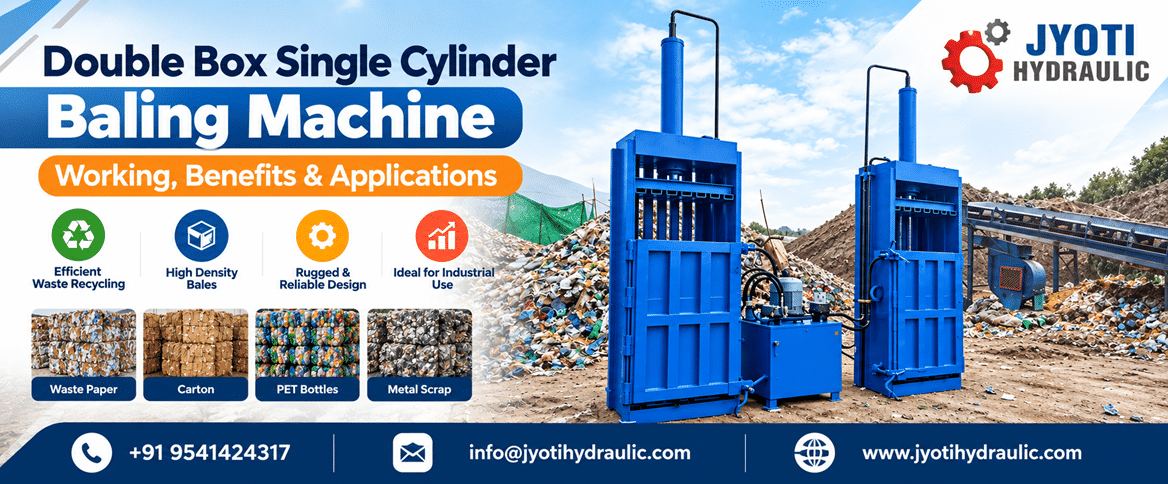
Jyoti Hydraulic understands that waste handling becomes a production challenge long before a factory runs out of storage space. Loose cartons block movement, plastic packaging occupies dispatch areas, and textile offcuts require repeated handling. A Double Box Single Cylinder Baling Machine helps organise these materials into compact, secured bales while offering a practical way to manage loading and compression through two chambers. For businesses evaluating this equipment, the key is understanding how its design fits the material, daily workload, and recycling process.
This guide explains the working principle, technical considerations, applications, benefits, and selection criteria that determine whether a double-box baler is suitable for your operation.
What Is a Double Box Single Cylinder Baling Machine?
A Double Box Single Cylinder Baling Machine is a hydraulic press with two material-loading chambers served by one main compression cylinder. The chambers share the compression system, allowing material to be processed in an alternating sequence.
Depending on the design, the boxes rotate or move into the pressing position, or the pressing assembly moves between them. Some arrangements allow the inactive chamber to be loaded while compression takes place in the other, provided the guarding and controls permit that operation. Manufacturer descriptions confirm that twin-chamber systems can use this alternating loading and pressing arrangement.
The main advantage is better coordination of material handling and pressing. Two boxes do not mean that a single cylinder compresses both chambers simultaneously.
Industry Overview: Why Baling Matters on the Factory Floor
Manufacturers, warehouses, textile processors, and recycling businesses face a common problem: recyclable material often occupies far more space in loose form than its weight suggests.
A warehouse may generate cardboard steadily throughout the day but dispatch recyclables only periodically. A garment factory may produce lightweight fabric offcuts across several workstations. A plastic recovery facility may receive material faster than workers can sort, consolidate, and store it.
In these situations, the operational challenge extends beyond compression. It includes collection routes, sorting discipline, labour availability, temporary storage, and vehicle loading.
Baling can make that flow more manageable. However, a baler does not sort contaminated material or guarantee a better selling price. Its value depends on producing bales that the receiving recycler can accept, handle, and process.
For facilities considering a double-box arrangement, the central question is: Will the second chamber reduce a real loading or handling bottleneck?
How Does a Double Box Single Cylinder Baling Machine Work?
The exact sequence depends on the machine configuration, but a typical operating process follows these stages.
1. Material preparation and segregation
Operators separate the approved material before loading. Cardboard, plastic film, and textiles should generally remain in separate batches unless the receiving recycler specifically accepts a mixture.
Remove unsuitable contaminants. Batteries, aerosols, sealed containers, and hazardous residues must not enter a general-purpose recycling baler.
2. Chamber loading
Material is distributed within the loading box according to the operating instructions. Uneven filling can produce an irregular bale and increase off-centre loading on the platen and guides.
Large cartons or awkward offcuts may need preparation before loading. Operators must never reach into a dangerous area to reposition material.
3. Chamber positioning and locking
The loaded chamber is brought into the pressing position using the machine’s designed transfer mechanism.
Correct alignment and positive locking are essential. The control system should prevent compression when the chamber or protective doors are not correctly secured.
4. Hydraulic compression
An electric motor drives the hydraulic pump. The pump supplies oil flow, and pressure develops as the compression platen encounters resistance.
The cylinder advances the platen, reducing the volume of the material. Several loading and pressing strokes may be required before enough material has accumulated for a complete bale.
5. Bale tying
Once the required bale size or compression condition is reached, the bale is secured with the specified wire or strapping using the manufacturer’s protected tying procedure.
Material behaviour matters here. Plastic film and textiles can expand after compression, so the tying arrangement must suit the expected rebound.
6. Bale removal and chamber changeover
The completed bale is removed using the specified ejection arrangement and suitable handling equipment. The next prepared chamber can then enter the pressing sequence.
The productivity benefit depends on how effectively loading, pressing, tying, and removal are coordinated—not simply on the presence of a second box.
Technical Insights: What Determines Actual Performance?
Pressing force and hydraulic pressure are different
Pressing force is commonly expressed in tonnes-force, while hydraulic pressure is expressed in bar or another pressure unit.
In simplified terms:
Cylinder force = hydraulic pressure × effective piston area
Actual available force also depends on mechanical losses and pressure acting on the opposite side of the piston. A pressure figure alone therefore cannot establish the machine’s pressing capacity.
Likewise, a higher force rating does not automatically mean a better result. Chamber dimensions, material characteristics, and platen guidance also affect bale formation.
Bale density depends on more than tonnage
Bale density is the bale’s mass divided by its volume.
Two materials pressed in the same machine can produce very different bale weights. Moisture, initial bulk density, particle shape, compression resistance, and rebound all influence the result.
For this reason, buyers should request a material trial instead of treating an advertised bale weight as universal.
Hydraulic cycle time is not complete bale production time
A cylinder stroke may take relatively little time, but a finished bale can require repeated loading, several strokes, tying, chamber transfer, and ejection.
A useful production calculation is:
Hourly output = average accepted bale weight × completed bales per hour
For illustration, 10 completed bales weighing 60 kg each would represent 600 kg per hour. This is a calculation example, not a Jyoti Hydraulic machine specification.
Measure output over a representative operating period, including normal handling delays.
Power and heat must match the workload
Motor rating alone does not reveal energy consumption per tonne. Pump selection, operating pressure, idle running, material resistance, and production rate all influence electricity use.
Repeated operation also generates heat. Reservoir capacity, filtration, and any required cooling must suit the intended duty cycle and ambient conditions.
Structural details deserve close attention
The frame, platen guides, chamber walls, hinges, and locking system all carry working loads. Buyers should examine how the machine controls side loading, maintains alignment, and provides access for inspection.
The chamber transfer mechanism is especially important because dependable positioning is central to a double-box design.
Applications Across Industries
The machine must be selected for the specific material stream. Suitability for one recyclable does not establish suitability for every type of waste.
| Industry | Potential material stream | Main selection consideration |
|---|---|---|
| Warehousing and distribution | Corrugated cartons and packaging paper | Loading opening and peak daily volume |
| Textile and garment production | Fabric offcuts, rags, and approved textile waste | Rebound, tying strength, and contamination |
| Plastic recycling | Approved films, woven sacks, and PET bottles | Material preparation and achievable bale stability |
| Paper collection and processing | Segregated waste paper and board | Moisture, grade separation, and bale dimensions |
| Industrial recycling centres | Separate batches of approved dry recyclables | Changeover procedure and buyer requirements |
Twin-chamber single-cylinder balers are marketed for applications including plastic film, PET bottles, woven sacks, textiles, and packaging waste, although the approved material list remains model-specific.
Heavy steel scrap, dense metal components, and difficult mixed waste may require a purpose-designed scrap baler. They should not be loaded into a machine selected for paper, film, or textiles without written manufacturer approval.
Benefits of a Double-Box Baling Arrangement
Better use of available working time
Where safe parallel loading is supported, workers can prepare one chamber while the other is being pressed. This can reduce waiting between operations.
The improvement will be smaller if tying, bale removal, or material supply remains the main bottleneck.
More organised storage
Stable, consistently sized bales are easier to count and allocate to storage locations than loose piles. This can help businesses maintain clearer collection and dispatch routines.
Actual floor-space savings depend on bale dimensions, permitted stacking, aisle requirements, and inventory levels.
More efficient transport preparation
Compaction can improve vehicle space utilisation when loose material fills the load area before the permitted payload is reached.
Transport savings still depend on route distance, vehicle type, bale arrangement, and legal load limits.
Shared compression equipment
A single main pressing cylinder serves both chambers. This can offer an alternative to installing two independent presses where the workload suits alternating operation.
However, shared equipment also creates a common stoppage point: a fault in the main compression system can interrupt both chambers.
Easier batch identification
Bales can be labelled by material grade, date, supplier, or production area. This supports traceability and makes stock reconciliation more practical.
Buying Guide: How to Select the Right Machine
When comparing Double Box Single Cylinder Baling Machine Manufacturers, begin with your operating requirements rather than a price list.
Define the material and daily workload
Provide the supplier with:
- Material type, condition, and typical contamination.
- Average daily volume and peak hourly generation.
- Available operating hours and staffing.
- Required bale dimensions and handling method.
- Recycling buyer requirements.
- Available electrical supply and installation space.
Photographs are useful, but a representative material sample provides stronger evidence for selection.
Request a realistic demonstration
A meaningful trial should include loading, repeated compression, tying, chamber changeover, and bale removal.
Record completed bale weight, dimensions, stability, operator involvement, and elapsed time. A demonstration using easily compressed material may not represent your actual workload.
Confirm the complete installation footprint
Allow space for incoming material, chamber movement, doors, finished bales, maintenance, and forklift or pallet-truck access.
A machine that physically fits inside a building may still create an impractical workflow.
Review safeguarding and maintenance access
Check door and chamber-position interlocks, emergency stops, movement guarding, and the method for isolating electrical and hydraulic energy during maintenance.
Emergency stopping does not replace proper isolation. Maintenance procedures must address stored pressure and any platen or component that could move unexpectedly.
Compare the total cost of ownership
Purchase price is only one part of the decision. Include delivery, installation, electrical work, oil, tying consumables, labour, servicing, and replacement parts.
Ask for written confirmation of warranty scope, commissioning support, recommended maintenance, and spare-part availability.
Put performance commitments in writing
The quotation should clearly distinguish pressing force, hydraulic pressure, chamber size, finished bale dimensions, expected bale weight, and throughput assumptions.
Model-specific specifications should be confirmed directly with Jyoti Hydraulic rather than inferred from another machine or a general product category.
Maintenance Practices That Support Reliable Output
Routine care should follow the supplied maintenance schedule.
Operators should check for visible leaks, damaged hoses, loose components, unusual noise, and debris around moving mechanisms. Trained personnel should inspect locking arrangements, guides, filters, and hydraulic oil condition at the specified intervals.
Changes in cycle time, oil temperature, or bale consistency can indicate developing problems. Recording these observations helps maintenance teams investigate before a minor issue becomes a production stoppage.
Never increase hydraulic pressure beyond the approved setting to compensate for poor bale formation.
Future Trends: Features Worth Discussing
For future purchases, useful options to evaluate include programmable operating sequences, cycle counters, oil-temperature monitoring, idle shutdown, and maintenance reminders.
Jyoti Hydraulic’s published material discusses optional controls, temperature monitoring, and potential developments such as remote diagnostics. Availability must be confirmed for the particular machine being quoted.
The practical test for any added feature is straightforward: does it improve measurable output, make faults easier to identify, or reduce unnecessary operating effort?
Conclusion
A Double Box Single Cylinder Baling Machine can help businesses coordinate loading and compression while converting suitable loose recyclables into manageable bales. Its strongest results come from matching the chamber arrangement, hydraulic system, handling method, and safety provisions to the actual material stream.
For buyers, a representative trial and clearly documented specifications are more valuable than broad promises about capacity or savings. The right machine should fit the working day, the available team, and the requirements of the recycler receiving the finished bales.
Frequently Asked Questions
What is the purpose of two boxes in a single-cylinder baler?
Two boxes allow alternating material preparation and compression. Where the machine’s safeguards permit it, one chamber can be loaded while the other is being pressed.
Does a double-box baler produce twice as much as a single-box machine?
Not automatically. Output depends on material supply, pressing strokes, tying time, chamber transfer, bale removal, and staffing. The second box helps only where it reduces delays in the complete process.
Which materials can it compress?
Depending on the approved configuration, suitable materials may include cardboard, paper, textile waste, plastic film, woven sacks, and PET bottles. Confirm each material with the manufacturer before operation.
What bale weight should a buyer expect?
There is no universal bale weight. It depends on material density, moisture, chamber dimensions, compression force, and rebound. A trial with your own material provides the most useful estimate.
Is a single-cylinder machine automatically more energy-efficient?
No. Electricity consumption depends on the hydraulic circuit, pressure, operating time, idle running, and output. Compare measured energy use per tonne under similar conditions.
How should businesses compare manufacturers?
Evaluate material trials, written specifications, safeguards, build quality, installation requirements, and service support. Compare quotations for the same material and production requirement.
What information is needed for a quotation?
Share the material type, daily quantity, available working hours, preferred bale size, electrical supply, installation space, and handling arrangement. Include photographs or samples where possible.
Get a Baling Solution Matched to Your Operation
Contact Jyoti Hydraulic to discuss your material, production target, and installation requirements. Request a quotation and expert consultation to identify a suitable Double Box Single Cylinder Baling Machine for your business.
📧 Email: info@jyotihydraulic.com
📞 Call: +91 9541424317


