
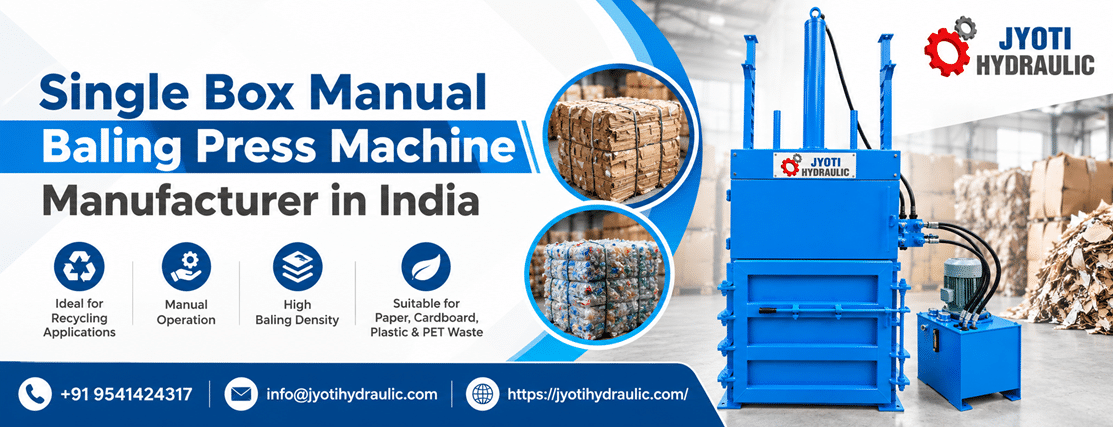
Jyoti Hydraulic understands that effective waste handling begins where loose material starts interrupting daily work. Discarded cartons beside a packing line, plastic film filling a warehouse corner, and textile offcuts awaiting collection all occupy valuable space. A correctly selected Single Box Manual Baling Press Machine helps convert suitable loose recyclables into compact, tied bales that are easier to store, handle, and dispatch.
For businesses evaluating a Single Box Manual Baling Press Machine Manufacturer in India, the decision should go beyond pressing capacity and purchase price. Material behaviour, loading effort, bale dimensions, safety arrangements, and maintenance access determine how useful the machine will be on the shop floor. This guide explains those factors and the questions worth asking before requesting a quotation.
What Is a Single Box Manual Baling Press Machine?
A single box manual baling press compresses material inside one chamber. The operator loads the material and carries out specified tasks such as controlling compression, tying the bale, and preparing it for discharge, depending on the machine’s configuration.
“Single box” describes the number of compression chambers. It does not automatically specify the number of hydraulic cylinders, compression direction, or type of power supply.
Likewise, “manual” does not necessarily mean that the machine operates without electricity. A baler may have a motor-driven hydraulic power pack while using manual loading, lever controls, and manual tying. Buyers should confirm exactly which functions are manual and which are powered.
The essential purpose is straightforward: reduce the volume of compatible material and produce manageable bales for the next stage of recycling or transport.
Industry Overview: Why Baling Matters in Everyday Operations
In packaging units, warehouses, printing facilities, and recycling businesses, loose waste creates a handling problem before it becomes a disposal problem.
A stack of empty corrugated cartons contains considerable air space. Thin plastic packaging can spread across a storage area. Fabric offcuts often form irregular piles that are difficult to move efficiently. When these materials remain loose, workers may spend unnecessary time gathering, relocating, and preparing them for collection.
A single-chamber baler can suit operations where material arrives in batches and the required output is compatible with operator-assisted handling. Its suitability depends on the complete workflow, including segregation, loading, tying, and bale removal.
For facilities with continuous, high-volume waste generation, a different configuration may be more appropriate. The right question is: Can this machine process our actual material within the time and labour available?
Technical Insights: What Determines Baler Performance?
1. Pressing force and hydraulic pressure are different
Hydraulic pressure is the fluid pressure within the circuit. Pressing force is the load generated by the cylinder and transmitted to the compression platen.
The basic theoretical relationship is:
Cylinder force = hydraulic pressure × effective piston area.
This means pressure alone cannot tell a buyer how much force a machine develops. Cylinder dimensions also matter, while actual usable force is affected by losses and operating conditions. Parker’s hydraulic reference material describes this pressure-and-area relationship.
Ask the supplier to specify the rated pressing force, working pressure, and intended duty. Increasing pressure beyond approved settings is not an acceptable way to compensate for an undersized machine.
2. Chamber size must match the incoming material
Chamber dimensions affect loading convenience and the size of material that can be accommodated.
Large cartons may require flattening or preparation before loading. Lightweight film can require repeated filling and compression before a bale is complete. A chamber that appears suitable on a drawing may still create unnecessary handling if the loading opening is poorly matched to the waste stream.
Check the usable loading opening, internal chamber dimensions, platen travel, and finished bale dimensions separately.
3. Bale weight depends on more than machine capacity
A baler does not produce the same bale weight from every material.
Finished weight depends on material type, moisture, initial bulk density, compression behaviour, bale dimensions, and how much the material expands after pressure is released. Cardboard, textile waste, and plastic film should therefore be evaluated independently.
Treat quoted bale weights as material-specific figures. A demonstration using representative samples provides a stronger basis for selection than a general capacity statement.
4. Full bale time matters more than ram travel time
A short compression stroke does not necessarily mean high production.
The full operating cycle may include material preparation, repeated loading, compression strokes, tying, door operation, discharge, and clearing the collection area. When comparing machines, ask whether the quoted cycle time refers to one hydraulic movement or an entire finished bale.
A practical planning calculation is:
Required average output = material to be processed ÷ available baling hours.
For example, processing 600 kg during three available hours requires an average of 200 kg per hour across the complete workflow. This is a planning illustration, not a performance claim for a particular machine.
5. Structure and hydraulic components work as a system
The frame, chamber, platen guides, doors, and locking arrangements must withstand the loads generated during compression.
Uneven material distribution can place uneven loads on the platen. Good guidance and appropriate structural design help manage those loads. Hydraulic reliability also depends on suitable hoses, seals, filtration, valves, and operating temperatures.
Ask how inspection and maintenance are performed. Components that are difficult to access can turn routine servicing into extended downtime.
Applications of a Single Box Manual Baling Press Machine
Material compatibility must be confirmed for the particular model. Typical applications for appropriately configured single-chamber balers include:
| Application | Material to assess | Main selection consideration |
|---|---|---|
| Warehouses and distribution centres | Corrugated cartons and packaging board | Loading opening and daily waste volume |
| Printing and paper-processing units | Paper trim and segregated paper waste | Bale consistency and recycler requirements |
| Textile and garment facilities | Fabric offcuts and textile waste | Material spring-back and tying method |
| Packaging operations | Compatible plastic film and woven sacks | Repeated filling requirements and bale stability |
| Recycling collection centres | Approved, segregated recyclable streams | Material changes, throughput, and discharge handling |
Metal scrap requires particular care in selection. A machine intended for cardboard or soft packaging should not be assumed suitable for rigid metal components, heavy sections, or sharp scrap.
Similarly, batteries, pressurised containers, hazardous residues, and unidentified mixed waste require separate assessment and appropriate handling. Only materials approved for the selected baler should enter its chamber.
Benefits: Where a Suitable Baler Adds Value
Better use of storage space
Compacting loose material can reduce the space occupied by recyclable waste. The actual reduction depends on the material and the achievable bale density.
The practical benefit is often a more organised collection area with clearer separation between production, storage, and dispatch activities.
More manageable handling and transport
Consistently sized bales can be easier to count, move, and arrange for collection than loose piles. However, bale dimensions and weight must match the available handling equipment and the recycler’s receiving requirements.
Transport savings are most likely where loose material fills vehicle volume before reaching the allowable payload.
Improved segregation discipline
A baling station can support separate collection of paper, film, and other approved materials. Keeping streams separate helps avoid contamination and makes material quality easier to assess.
Baling itself does not clean waste or guarantee a higher selling price. Recycler acceptance still depends on the material’s composition and condition.
A practical level of automation
Manual loading and tying can be appropriate where volumes are manageable and trained operators are available. Businesses should compare the initial investment with ongoing labour requirements, rather than assuming the simplest machine will always have the lowest lifetime cost.
Buying Guide: How to Select the Right Machine
Start with a material survey
Record what the facility generates during a normal working week. Include material types, daily quantities, peak accumulation, contamination, and the time available for processing.
Photographs and representative samples help the manufacturer understand conditions that a short enquiry may miss.
Agree on the finished bale requirements
Speak to the recycler or collection contractor before finalising the machine.
Confirm acceptable bale dimensions, approximate weight, tying material, segregation requirements, and loading arrangements. A dense bale has limited value if it cannot be handled at the receiving facility.
Check the installation area
Allow space for incoming material, door movement, operator access, maintenance, and finished bale removal.
For vertical machines, check overhead clearance. For powered machines, confirm electrical requirements against the actual site supply. Floor suitability and anchoring should follow the manufacturer’s installation instructions.
Evaluate safety as part of the specification
Ask about guarding, access-door protection, emergency stops where applicable, and a lockable means of energy isolation.
Maintenance and blockage removal require a defined procedure that addresses electrical, hydraulic, and stored mechanical energy. Emergency stopping is not a substitute for secure isolation. HSE guidance for recycling machinery emphasises effective safeguards and isolation arrangements.
Request a representative trial
Observe the complete process using material similar to what your business generates. Record loading time, number of compression strokes, tying effort, discharge time, bale weight, and bale stability.
This reveals whether the proposed machine fits your operation more clearly than an unloaded demonstration.
Compare the complete quotation
When assessing a Single Box Manual Baling Press Machine Manufacturer in India, request clarity on:
- Approved materials and rated operating capacity.
- Chamber, loading opening, and bale dimensions.
- Power requirements and operating controls.
- Tying and bale discharge arrangements.
- Installation, commissioning, and operator training.
- Warranty terms, service support, and spare parts.
- Freight, taxes, and any excluded accessories.
A detailed quotation makes competing proposals easier to compare on equal terms.
Maintenance and Operating Practices That Support Reliability
Routine care should follow the machine-specific manual. Typical inspection priorities include hydraulic oil condition, visible leaks, hose damage, door locking components, guards, platen guidance, and unusual operating noise.
Keep loading areas clear and prevent unsuitable objects from entering the chamber. Operators should report changes in compression speed, oil temperature, or bale consistency instead of compensating by adjusting pressure settings.
Before servicing, authorised personnel must isolate energy sources and manage residual pressure or supported loads according to the manufacturer’s procedure.
Consistent operation also matters. Even loading, correct segregation, and the specified tying method help produce more predictable bales and reduce avoidable interruptions.
Future Trends: Measuring the Whole Baling Process
For future purchases, useful improvements are those that reduce measurable operating losses.
Depending on the application, these may include easier bale discharge, improved maintenance access, suitable energy-saving controls, and monitoring of operating hours or oil temperature. Buyers should confirm whether such features are available on the proposed model.
Even without advanced monitoring, a simple record of material processed, labour hours, electricity use, and maintenance interruptions can show when an upgrade becomes worthwhile.
The most useful performance measure is often cost per tonne processed, supported by acceptable bale quality and reliable operation.
Conclusion
A Single Box Manual Baling Press Machine can be a practical investment when its chamber size, pressing force, operating method, and discharge arrangement match the material being handled.
Successful selection starts with actual waste quantities and ends with a bale that the recycler can accept. Between those points, loading effort, safety, maintenance, and operator time determine everyday performance.
When discussing your requirement with Jyoti Hydraulic, share the material details and workflow first. A clearly defined application provides the foundation for a meaningful technical recommendation and quotation.
Frequently Asked Questions
What does “single box” mean in a baling press?
It means the machine has one compression chamber. The term alone does not identify cylinder count, pressing force, or automation level.
Does a manual baling press need electricity?
It may. “Manual” can describe loading, control, tying, or discharge tasks while compression is powered by an electric hydraulic unit. Confirm the proposed configuration before purchase.
Which materials can the machine compress?
Suitably configured models may handle cardboard, paper, textile waste, and selected plastics. Material approval is model-specific; metal scrap requires a machine designed for that application.
How do I choose the correct pressing capacity?
Consider material behaviour, desired bale dimensions, daily volume, and available processing time. Validate the proposed capacity with a representative material trial.
What is the price of a single box manual baler in India?
Pricing depends on pressing force, chamber size, hydraulic equipment, safety features, discharge method, and supply scope. Request an application-specific quotation for an accurate comparison.
Can one machine produce the same bale weight from different materials?
Usually not. Material density, moisture, compressibility, and spring-back affect the finished bale weight. Ask for separate expectations for each intended material.
When should a business consider greater automation?
Consider it when manual loading, tying, or discharge causes persistent queues, excessive labour demand, or missed processing targets. Compare measured operating costs before upgrading.
Contact Jyoti Hydraulic for a Quotation and Expert Consultation
Turn your waste-handling requirement into a clearly specified baling solution. Contact Jyoti Hydraulic with your material type, daily quantity, preferred bale size, and installation details.
Request a quotation, discuss machine suitability, and get expert consultation on the configuration your operation needs.
📧 Email: info@jyotihydraulic.com
📞 Call: +91 9541424317
Contact Jyoti Hydraulic today to discuss your Single Box Manual Baling Press Machine requirement.


