
Turning Waste Into Worth
Every warehouse, printing house, or packaging unit knows the problem: loose cardboard piles up fast. Corrugated boxes fill corners, cartons overflow bins, and before long, valuable floor space is gone. A manual waste baling machine solves this practically and affordably — and that’s exactly what Jyoti Hydraulic has been building for India’s industrial sector.
Why Businesses Are Investing in Balers Right Now
India’s e-commerce and packaging industries have grown faster in the last five years than in the previous two decades. More goods moving through warehouses means more packaging waste — daily. Retail chains restock shelves constantly, carton manufacturers trim and cut continuously, and printing presses generate off-cuts on every run.
Most of this material has genuine resale value as scrap. The problem isn’t the waste itself — it’s the form it comes in. Loose, bulky, and unmanageable. A baling press changes the equation entirely.
Compressed bales are easier to store, simpler to transport, and more attractive to recyclers who pay better for well-formed, consistently tied bales. A machine that costs a fraction of your monthly logistics bill can pay for itself within months.
What a Manual Baling Machine Actually Does
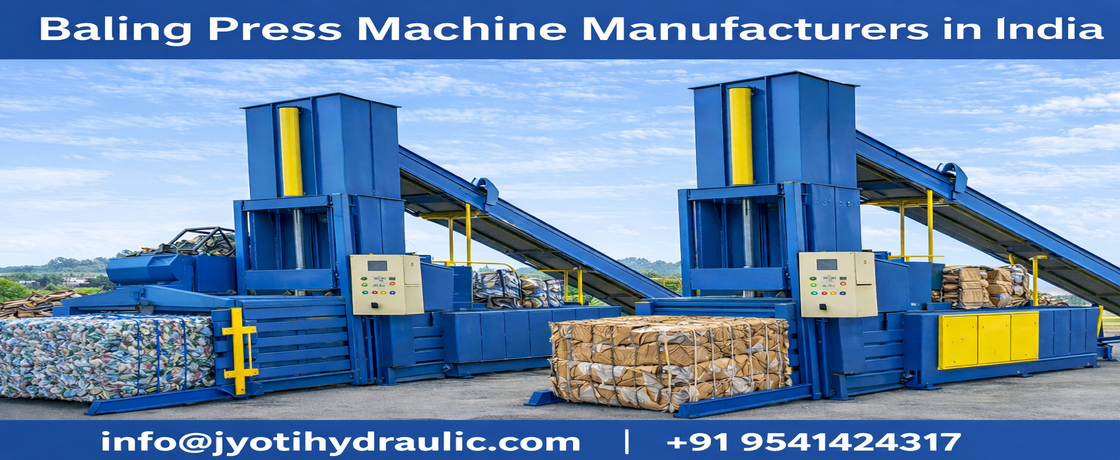
A manual baler is a hydraulic press. You load waste material into the chamber — cardboard, cartons, corrugated sheets, newspaper, printing scrap — activate the hydraulic cylinder, and it compresses everything under significant force into a dense, uniform block. You tie the bale with wire or strap, eject it, and it’s ready for storage or dispatch.
It’s straightforward by design. No complex automation, no elaborate controls. An operator can learn the process in a single shift, and the machine keeps working reliably with standard maintenance.
Common materials handled include:
- Corrugated boxes and sheets
- Cardboard packaging and cartons
- Waste paper and newspaper
- Printing trims and rejected stock
- Paperboard and packaging offcuts
Technical Considerations Worth Understanding
Hydraulic System
The hydraulic circuit is the core of the machine. Motor, pump, oil reservoir, control valves, and cylinder all need to be properly matched for the pressing force required. A well-engineered system runs quietly, maintains consistent pressure across cycles, and lasts for years with standard oil changes and periodic checks.
At Jyoti Hydraulic, we don’t use undersized components to cut costs. The hydraulic system is built for actual industrial duty — not light intermittent use.
Pressing Force
Machines are available from 5 ton up to 30 ton and beyond. The right choice depends on material density and how tight you want your bales. Corrugated boxes need enough force to stay compressed after the bale is removed. Loose bales waste transport space and fetch lower recycling prices.
Bale Size and Weight
Chamber dimensions determine bale output. Smaller units produce bales of 30–70 kg, useful for businesses with moderate waste volumes. Larger chambers produce 100–300 kg bales, preferred by recyclers and high-throughput operations. Think about how your bales will be moved — forklift, pallet, or manual handling — and choose accordingly.
Frame and Build Quality
A baling press works under repeated high-pressure loads. The frame must be fabricated from heavy-duty mild steel with proper welding and reinforced joints. Thin frames flex, crack, and vibrate — reducing bale quality and machine lifespan. We build ours to handle continuous operation without structural fatigue.
Safety
Manual balers at Jyoti Hydraulic include pressure relief valves, overload protection, emergency stop controls, and proper operator guarding. These aren’t optional extras — they’re standard on every unit we ship.
Who Uses These Machines
Warehouses and logistics centers use balers to handle packaging waste from inbound and outbound shipments — keeping dock areas clear and organized.
Recycling units need compact, consistent bales to efficiently move material to end buyers. Loose material is harder to weigh, load, and price accurately.
Carton and packaging manufacturers generate constant cutting waste and rejected material. A baler turns that into a revenue stream rather than a disposal cost.
Printing presses deal with paper trims on every job. Without a baler, that waste accumulates quickly and creates both a fire hazard and a housekeeping problem.
Retail chains and supermarkets receive stock in cartons daily. Balers keep back-of-store areas functional and cut cardboard disposal costs significantly.
Manufacturing facilities manage packaging waste from production lines, raw material handling, and dispatch operations — all of which generate regular recyclable scrap.
Real Benefits, Practically Speaking
Floor space recovered. Loose cardboard takes up ten times the room a bale does. Free that space for productive use.
Transport costs reduced. Dense bales mean more material per vehicle. Fewer pickups, lower freight costs, better economics for your recycler relationship.
Scrap value improved. Recyclers price tied, dense bales better than loose mixed waste. Consistent bale quality builds better long-term relationships with buyers.
Workplace hygiene maintained. Waste in bales is contained, stable, and manageable. Loose waste creates clutter, dust, and risk.
Lower investment than automation. For businesses generating moderate waste volumes, a manual baler delivers most of the benefit at a fraction of the cost of a fully automatic system.
How to Choose the Right Machine
Start with your daily waste volume. Measure it honestly. A machine sized for your actual output will serve you better than one that’s either underused or constantly overloaded.
Match the machine to your material. Corrugated boxes, cartons, and paper all compress differently. Tell us what you’re baling — we’ll recommend the right chamber size and pressing force.
Think about bale handling. How will finished bales be moved? If you’re using a forklift, larger bales make sense. If it’s manual handling, smaller and lighter bales are more practical.
Don’t evaluate price alone. A cheaper machine that produces loose bales, breaks down frequently, or consumes excess power becomes expensive quickly. Total cost of ownership matters more than the purchase price.
Ask about spares and service. A manufacturer that can supply parts and technical support within a reasonable timeframe is worth more than a lower quote from one who can’t.
Looking Ahead
Waste management requirements in India are becoming more structured. Corporate sustainability targets, environmental regulations, and recycler preferences are all pushing businesses toward better waste handling practices. Businesses that invest in reliable baling equipment now will have an operational and compliance advantage as these expectations increase.
Jyoti Hydraulic continues to develop machines that are more energy-efficient, easier to operate, and better suited to the evolving needs of Indian industry.
Frequently Asked Questions
What materials can a manual baler handle? Waste paper, corrugated boxes, cardboard sheets, cartons, newspaper, packaging scrap, and printing waste are all suitable. The machine should be selected based on the primary material and daily volume.
Is a manual baler suitable for a small or mid-sized business? Yes. Manual balers are purpose-built for businesses that generate regular waste but don’t need the throughput of a fully automatic system. They’re cost-effective, easy to operate, and straightforward to maintain.
What affects the price of a baling press? Pressing force, chamber dimensions, motor rating, hydraulic component quality, bale output capacity, and structural specifications all influence pricing. Customization for specific bale sizes or operating conditions also affects cost.
How long does a baling cycle take? Cycle time varies by machine size and material, but most manual balers complete a cycle in 2–5 minutes. Output depends on how quickly material is loaded and how bales are handled after ejection.
What after-sales support does Jyoti Hydraulic provide? We offer technical consultation, spare parts supply, and service support. We’d rather help you get full life from your machine than sell you a replacement.
Contact Jyoti Hydraulic
Ready to find the right machine for your facility? We’ll help you assess your waste volumes, select the appropriate model, and provide a clear, competitive quotation.
📧 info@jyotihydraulic.com 📞 +91 9541424317


