
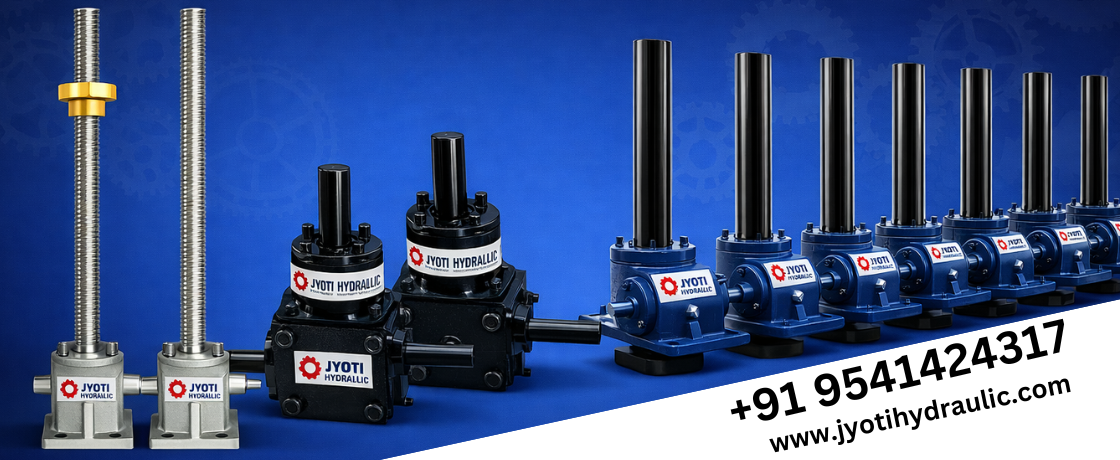
Jyoti Hydraulic is recognized for delivering robust, precision-engineered industrial lifting and motion control solutions designed for demanding applications across manufacturing, infrastructure, process plants, automation systems, and heavy engineering industries. In today’s industrial environment, where safety, accuracy, durability, and controlled movement are critical, the Worm Gear Screw Jack has become one of the most dependable mechanical lifting devices.
A heavy-duty worm gear screw jack is not just a lifting component. It is a highly engineered mechanical system used to convert rotary motion into linear motion for lifting, lowering, tilting, pushing, pulling, clamping, tensioning, and accurate positioning of heavy loads. Industries in Delhi NCR increasingly depend on these systems because they offer excellent load control, compact installation, self-locking capability, and reliable performance in harsh operating conditions.
Delhi NCR is home to automotive plants, fabrication units, packaging machinery manufacturers, steel processing facilities, warehouse automation systems, construction equipment manufacturers, power sector units, and industrial automation companies. These industries require rugged mechanical lifting solutions that can work safely under high loads and repetitive operating cycles. This growing demand has increased the importance of trusted Worm Gear Screw Jack Manufacturers, reliable Worm Gear Screw Jack Manufacturers in India, and experienced Screw Jack Manufacturer in India companies capable of supplying customized and application-specific solutions.
This detailed blog explains the design, working principle, industrial relevance, technical parameters, configurations, maintenance practices, and future automation possibilities of heavy-duty worm gear screw jacks.
Overview of Heavy Duty Worm Gear Screw Jacks
A Worm Gear Screw Jack is a mechanical actuator used to produce linear movement by rotating a screw through a worm gear arrangement. The device generally consists of a worm shaft, worm wheel, lifting screw, thrust bearings, housing, lubrication system, and end fittings. When torque is applied manually or through a motorized drive, the worm shaft rotates the worm wheel, causing the screw or nut to move linearly.
Heavy-duty worm gear screw jacks are designed for applications where conventional hydraulic or pneumatic systems may not be suitable due to leakage risk, high maintenance, space limitations, synchronization challenges, or the need for precise mechanical positioning.
Why Worm Gear Screw Jacks Are Used in Heavy Industries
Heavy-duty screw jacks are preferred because they provide:
- High mechanical advantage
- Stable and controlled load movement
- Accurate positioning under heavy load
- Self-locking in many configurations
- Easy synchronization of multiple lifting points
- Long service life with proper lubrication
- Suitability for vertical, horizontal, and angular movement
Unlike hydraulic cylinders, worm gear screw jacks do not depend on pressurized fluid to hold a load. This makes them highly useful in applications where load holding safety, repeatable positioning, and mechanical reliability are essential.
A well-designed screw jack can lift loads ranging from a few hundred kilograms to several hundred tons, depending on screw size, gear ratio, material grade, housing strength, and drive arrangement.
Industrial Importance in Delhi NCR
Delhi NCR has developed into one of India’s most important industrial regions. Areas such as Faridabad, Gurugram, Noida, Greater Noida, Ghaziabad, Sonipat, Manesar, Bhiwadi, Bahadurgarh, and surrounding industrial belts host a wide range of manufacturing and engineering operations.
These industries require mechanical lifting systems that can operate in:
- Dusty shop-floor environments
- High-temperature zones
- Continuous production lines
- Heavy fabrication areas
- Automated assembly systems
- Outdoor construction and infrastructure projects
- Material handling and logistics facilities
Why Delhi NCR Industries Need Heavy Duty Worm Gear Screw Jacks
1. Growth of Industrial Automation
Automation systems require controlled linear movement. Worm gear screw jacks can be connected with motors, encoders, gearboxes, limit switches, and PLC-based control panels for automated lifting and positioning.
2. Heavy Load Handling
Many industries in Delhi NCR handle dies, molds, steel structures, machine beds, platforms, conveyor sections, furnace doors, gates, and lifting tables. Heavy-duty screw jacks provide safe and stable load movement.
3. Need for Synchronized Lifting
Large platforms and machinery often need lifting from multiple points simultaneously. Worm gear screw jacks can be linked mechanically using shafts, couplings, bevel gearboxes, and motor drives to achieve synchronized lifting.
4. Reduced Dependency on Hydraulics
Hydraulic systems may face leakage, seal failure, oil contamination, and pressure drop issues. Screw jacks provide a clean mechanical alternative, especially in food processing, packaging, pharmaceutical, and precision assembly applications.
5. Long-Term Cost Efficiency
Although the initial investment may vary based on capacity and configuration, worm gear screw jacks offer long operational life, reduced downtime, and lower maintenance when properly selected.
Technical Working Principle of Worm Gear Screw Jack
The working principle of a Worm Gear Screw Jack is based on the conversion of rotary motion into linear motion using a worm gear drive and threaded screw mechanism.
Main Components
Worm Shaft
The worm shaft is the input driving component. It receives torque from a handwheel, electric motor, geared motor, or mechanical transmission system.
Worm Wheel
The worm wheel meshes with the worm shaft and transfers motion to the lifting screw or nut. It is usually manufactured from bronze, phosphor bronze, or other wear-resistant materials for smooth operation.
Lifting Screw
The lifting screw is the linear movement component. It may move upward and downward or rotate depending on the screw jack design. It is commonly made from alloy steel, carbon steel, or stainless steel based on load and environmental requirements.
Housing
The housing supports internal components and maintains alignment. Heavy-duty housings are generally made from cast iron, ductile iron, or fabricated steel.
Thrust Bearings
Thrust bearings absorb axial loads generated during lifting. Bearing selection is critical for smooth movement and long service life.
Lubrication System
Proper lubrication reduces friction, heat generation, wear, and power loss.
Step-by-Step Working Process
- Input torque is applied to the worm shaft.
- The worm shaft rotates and drives the worm wheel.
- The worm wheel transfers motion to the screw or nut.
- Rotary motion is converted into linear movement.
- The connected load moves upward, downward, forward, backward, or angularly.
- The system holds the load mechanically when motion stops, depending on screw pitch and gear ratio.
Self-Locking Feature
One major benefit of a worm gear screw jack is self-locking. In many machine screw jack designs, the lead angle of the screw and friction in the worm gear arrangement prevent the load from driving the system backward.
This means the load remains in position even when the input torque is removed. However, self-locking depends on screw pitch, gear ratio, lubrication, vibration, load type, and operating conditions. For critical applications, external brakes or locking systems may still be recommended.
Types and Configurations of Worm Gear Screw Jacks
Different industries require different screw jack designs. Experienced Worm Gear Screw Jack Manufacturers in India offer multiple types based on lifting direction, speed, efficiency, duty cycle, and mounting arrangement.
1. Machine Screw Jack
Machine screw jacks use an acme or trapezoidal threaded screw. They are widely used for heavy-duty lifting and positioning.
Key Characteristics
- Self-locking in many cases
- Suitable for low to moderate speeds
- High load-holding capability
- Simple and rugged construction
- Cost-effective for static or intermittent operations
Common Uses
- Lifting tables
- Industrial platforms
- Machine adjustment
- Steel plant equipment
- Gate and valve operation
2. Ball Screw Jack
Ball screw jacks use recirculating ball bearings between the screw and nut. This greatly reduces friction and improves efficiency.
Key Characteristics
- Higher efficiency than machine screw jacks
- Suitable for high-speed movement
- Lower power consumption
- Ideal for frequent operation
- Requires braking system because it is usually not self-locking
Common Uses
- Automation systems
- High-speed lifting
- Servo-controlled positioning
- Robotic assembly lines
- Precision industrial machinery
3. Translating Screw Jack
In this configuration, the screw moves linearly through the jack housing while the worm gear remains fixed.
Best For
- Vertical lifting
- Pressing applications
- Platform elevation
- Linear pushing and pulling
This is one of the most common configurations used in general industrial lifting.
4. Rotating Screw Jack
In a rotating screw jack, the screw rotates in place while a traveling nut moves along the screw.
Best For
- Applications with limited vertical space
- Long-stroke systems
- Guided lifting structures
- Multi-point synchronized lifting
5. Keyed Screw Jack
A keyed screw jack prevents the lifting screw from rotating. This is useful where the load is not externally guided.
Benefits
- Prevents unwanted screw rotation
- Improves load stability
- Suitable for unguided or partially guided loads
6. Motorized Worm Gear Screw Jack
A motorized unit uses an electric motor or geared motor to operate the screw jack.
Benefits
- Automated lifting
- Higher productivity
- Reduced manual effort
- PLC and sensor integration possible
- Suitable for repeated industrial cycles
Key Features and Technical Specifications
A heavy-duty Worm Gear Screw Jack must be selected according to load conditions, speed, stroke length, duty cycle, mounting style, and environmental exposure.
Important Features
High Load Capacity
Heavy-duty screw jacks can support substantial axial loads. Load capacity depends on screw diameter, thread profile, material strength, bearing rating, gear ratio, and housing design.
Precision Linear Movement
These systems offer accurate and repeatable positioning. This is important in assembly fixtures, machine alignment, height adjustment, and automation systems.
Compact Mechanical Design
Worm gear screw jacks provide high lifting force in a compact structure, making them suitable for machines where space is limited.
Strong Load Holding
Machine screw jacks often hold loads mechanically without continuous power input.
Multiple Mounting Options
They can be installed vertically, horizontally, inverted, or in custom orientations depending on design requirements.
Custom Stroke Length
Stroke length can be customized based on lifting height or travel distance.
Manual or Motorized Operation
Depending on application needs, the system can be operated by handwheel, electric motor, geared motor, servo motor, or pneumatic motor.
Typical Technical Specifications
| Technical Parameter | Common Industrial Range |
|---|---|
| Load Capacity | 0.5 Ton to 200 Ton or more |
| Screw Type | Acme, Trapezoidal, Ball Screw |
| Drive Type | Manual, Electric, Geared Motor, Servo Drive |
| Gear Ratio | Application-specific |
| Housing Material | Cast Iron, Ductile Iron, Fabricated Steel |
| Screw Material | Carbon Steel, Alloy Steel, Stainless Steel |
| Worm Wheel Material | Bronze / Phosphor Bronze |
| Stroke Length | Customized |
| Mounting Type | Upright, Inverted, Flange, Trunnion, Foot Mounted |
| Operation Mode | Translating, Rotating, Keyed, Traveling Nut |
| Lubrication | Grease or Oil |
| Safety Options | Limit Switches, Brakes, Bellows, Load Sensors |
These specifications may vary based on the design standards followed by the Screw Jack Manufacturer in India.
Industrial Applications of Heavy Duty Worm Gear Screw Jacks
Heavy-duty worm gear screw jacks are used in a wide range of industries because they combine strength, simplicity, accuracy, and reliability.
1. Steel and Metal Processing Plants
Used for furnace doors, roller adjustments, billet handling, coil processing, and heavy-duty positioning systems.
2. Automotive Manufacturing
Used in assembly lines, vehicle lifting platforms, welding fixtures, die handling systems, and production automation equipment.
3. Packaging Machinery
Used for height adjustment, conveyor alignment, filling systems, sealing machines, and synchronized lifting systems.
4. Construction and Infrastructure
Used in bridge lifting, formwork adjustment, heavy structure positioning, and temporary load support systems.
5. Material Handling Systems
Used in scissor lifts, conveyor lifts, pallet positioning systems, lifting tables, and warehouse automation systems.
6. Power Plants
Used for damper control, valve actuation, turbine maintenance platforms, and heavy equipment positioning.
7. Cement and Mining
Used in rugged applications requiring strong mechanical movement under dusty and abrasive conditions.
8. Food and Pharmaceutical Industries
Used where clean, controlled, and oil-leak-free mechanical lifting is preferred over hydraulic systems.
9. Paper and Textile Machinery
Used for roll positioning, tension adjustment, machine bed alignment, and web handling systems.
10. Renewable Energy Systems
Used in solar tracking systems, maintenance platforms, and wind energy equipment positioning.
Advantages and Performance Benefits
Choosing the right Worm Gear Screw Jack provides several engineering and operational advantages.
High Mechanical Advantage
The worm gear mechanism multiplies input torque, allowing heavy loads to be moved with comparatively lower input power.
Excellent Position Control
Screw jacks allow accurate movement, making them suitable for positioning-sensitive applications.
Stable Load Holding
Machine screw jacks can hold loads safely without constant motor operation.
Low Operational Noise
Compared to many hydraulic and pneumatic systems, worm gear screw jacks operate with lower noise when properly lubricated.
Long Service Life
With correct selection, alignment, lubrication, and load management, screw jacks can perform reliably for many years.
Flexible System Design
Multiple screw jacks can be connected using shafts, couplings, bevel gearboxes, and a single motor to lift large platforms evenly.
Reduced Leakage Risk
Mechanical screw jacks eliminate hydraulic oil leakage, making them useful in clean industrial environments.
How to Choose the Right Screw Jack
Selecting the correct screw jack requires technical evaluation. Choosing only on the basis of load capacity is not enough.
Key Selection Factors
1. Load Type
Identify whether the load is static, dynamic, compressive, tensile, guided, unguided, eccentric, or shock-loaded.
2. Required Capacity
Always consider working load, peak load, safety factor, and possible overload conditions.
3. Stroke Length
Stroke should match required travel distance while considering buckling risk for long screws.
4. Duty Cycle
For occasional movement, a machine screw jack may be suitable. For frequent or continuous operation, a ball screw jack may be better.
5. Lifting Speed
Speed depends on screw pitch, gear ratio, motor RPM, and load conditions.
6. Environment
Dust, moisture, heat, chemicals, outdoor exposure, washdown conditions, or corrosive environments affect material and sealing selection.
7. Mounting Arrangement
The screw jack must be installed with proper alignment and structural support.
8. Synchronization Requirement
For multiple lifting points, mechanical or electronic synchronization must be planned carefully.
9. Safety Requirement
Consider brakes, limit switches, anti-rotation systems, overload protection, emergency stop systems, and mechanical locking devices.
10. Customization Support
A reliable Screw Jack Manufacturer in India should be able to provide custom stroke, special mounting, protective bellows, motor integration, and technical support.
Maintenance & Safety Tips
Proper maintenance is essential for safe and efficient screw jack operation.
Maintenance Guidelines
Lubricate Regularly
Use recommended grease or oil. Insufficient lubrication can cause overheating, thread wear, gear damage, and reduced efficiency.
Inspect Screw Threads
Check for wear, deformation, corrosion, or contamination on the lifting screw.
Check Gearbox Condition
Monitor worm gear wear, backlash, abnormal noise, vibration, and housing temperature.
Maintain Alignment
Misalignment can create side loads, which may damage the screw, bearings, and housing.
Avoid Side Loading
Screw jacks are primarily designed for axial loads. Side loads should be managed through external guides.
Inspect Fasteners
Mounting bolts, couplings, keys, and shafts should be checked periodically.
Use Protective Bellows
Bellows protect the screw from dust, chips, weld spatter, moisture, and chemical exposure.
Monitor Operating Temperature
Excessive heat may indicate overload, poor lubrication, or misalignment.
Safety Tips
- Never exceed rated load capacity.
- Do not use screw jacks without proper load guidance where required.
- Install limit switches to prevent over-travel.
- Use brakes for ball screw jack applications.
- Do not operate damaged or noisy screw jacks.
- Provide guards for rotating shafts and couplings.
- Train operators before use.
- Follow manufacturer-recommended inspection intervals.
Safety should always be considered during design, installation, operation, and maintenance.
Future Industrial Trends and Automation Integration
The future of heavy-duty worm gear screw jacks is strongly connected with automation, digital monitoring, and smart industrial systems.
1. PLC-Controlled Lifting Systems
Screw jacks are increasingly integrated with PLC panels for controlled lifting, sequencing, and safety interlocking.
2. Servo Motor Integration
Servo-driven screw jacks provide accurate position control for advanced automation lines.
3. Sensor-Based Monitoring
Load cells, proximity sensors, encoders, temperature sensors, and vibration sensors can help monitor performance in real time.
4. Predictive Maintenance
Industries are shifting from breakdown maintenance to predictive maintenance. Screw jack systems can be monitored for load variation, wear, lubrication status, and operating cycles.
5. Energy-Efficient Motion Systems
Mechanical screw jacks are being optimized for reduced power consumption and better efficiency.
6. Customized Industrial Automation
Demand is growing for application-specific screw jack systems with special mounting, multi-jack synchronization, remote controls, and intelligent safety features.
As Industry 4.0 adoption increases, Worm Gear Screw Jack Manufacturers in India will continue to develop smarter, stronger, and more efficient lifting solutions.
Conclusion
A heavy-duty Worm Gear Screw Jack is one of the most reliable and versatile mechanical lifting solutions for industrial applications in Delhi NCR. Its ability to lift heavy loads, maintain accurate positioning, hold load safely, and integrate with automation systems makes it an essential component in modern industrial machinery.
From automotive manufacturing and steel plants to packaging systems, construction equipment, and warehouse automation, worm gear screw jacks deliver dependable performance where strength and precision are equally important.
For industries searching for reliable Worm Gear Screw Jack Manufacturers, trusted Worm Gear Screw Jack Manufacturers in India, or an experienced Screw Jack Manufacturer in India, the most important factors are engineering capability, product customization, material quality, manufacturing precision, and after-sales technical support.
A properly selected and maintained screw jack improves safety, reduces downtime, enhances productivity, and supports long-term industrial growth.
FAQ Section
1. What is a Worm Gear Screw Jack?
A Worm Gear Screw Jack is a mechanical lifting device that converts rotary motion into linear motion using a worm gear and screw mechanism. It is used for lifting, lowering, pushing, pulling, tilting, and positioning heavy loads.
2. Where are heavy-duty worm gear screw jacks used?
They are used in steel plants, automotive factories, packaging machinery, material handling systems, construction equipment, power plants, cement industries, food processing units, and automation systems.
3. What is the main advantage of a worm gear screw jack?
The main advantage is controlled heavy-load movement with strong load-holding capability. Many machine screw jack designs are self-locking, which improves safety in industrial lifting applications.
4. What is the difference between a machine screw jack and a ball screw jack?
A machine screw jack uses an acme or trapezoidal screw and is suitable for heavy-duty, low-speed, self-locking applications. A ball screw jack uses recirculating balls for higher efficiency and speed but usually requires a brake for load holding.
5. Can worm gear screw jacks be motorized?
Yes. Worm gear screw jacks can be operated with electric motors, geared motors, servo motors, handwheels, or other drive systems depending on the application.
6. Can multiple screw jacks lift one platform together?
Yes. Multiple screw jacks can be synchronized mechanically using shafts, couplings, bevel gearboxes, and one common motor. They can also be synchronized electronically with motor control systems.
7. Are worm gear screw jacks better than hydraulic cylinders?
Both have different advantages. Screw jacks are preferred for precise positioning, mechanical load holding, clean operation, and synchronization. Hydraulic cylinders are preferred where very high speed or compact power density is required.
8. What factors should be considered before buying a screw jack?
Important factors include load capacity, stroke length, speed, duty cycle, mounting orientation, environmental conditions, safety factor, lubrication, synchronization needs, and customization requirements.
9. How often should a worm gear screw jack be maintained?
Maintenance frequency depends on duty cycle, operating environment, load, and lubrication type. Regular inspection, lubrication, alignment checks, and thread condition monitoring are essential for safe operation.
10. Why choose an experienced Screw Jack Manufacturer in India?
An experienced Screw Jack Manufacturer in India can provide proper technical selection, customized design, quality materials, precision manufacturing, motor integration, and reliable after-sales support.
11. Can worm gear screw jacks be used in automation systems?
Yes. They can be integrated with motors, PLCs, encoders, limit switches, load sensors, brakes, and control panels for automated industrial lifting and positioning.
12. What materials are used in heavy-duty screw jacks?
Common materials include cast iron or steel housing, alloy steel lifting screws, bronze worm wheels, hardened worm shafts, and industrial-grade bearings and seals.
For reliable, heavy-duty, and customized worm gear screw jack solutions in Delhi NCR and across India, connect with Jyoti Hydraulic today.
Discuss your load capacity, stroke length, mounting style, automation requirement, safety needs, and industrial working conditions with technical experts.
📧 info@jyotihydraulic.com
📞 +91 9541424317
Contact Jyoti Hydraulic to request a quotation, get expert consultation, and discuss customized industrial requirements for high-performance worm gear screw jack systems.


