
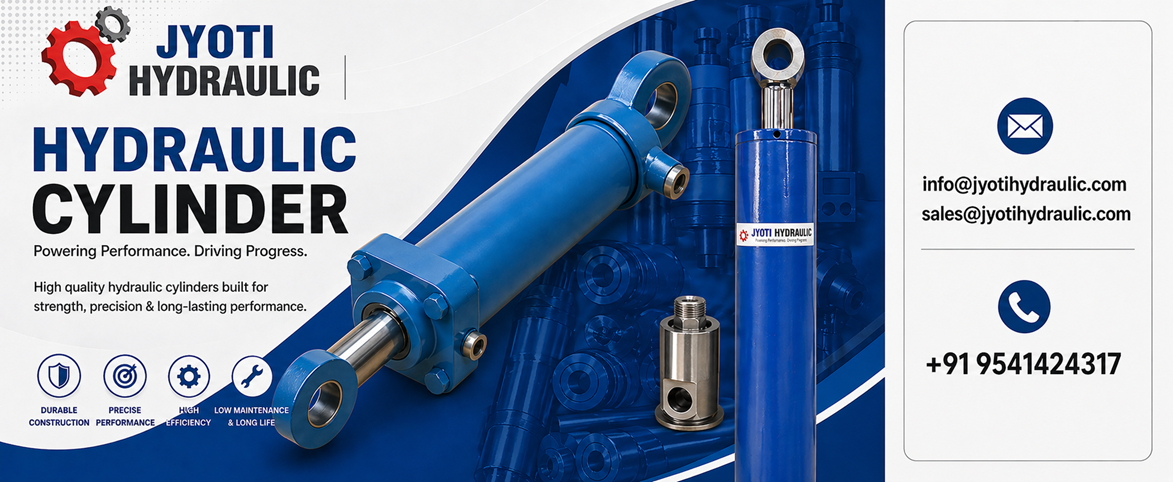
Jyoti Hydraulic represents the kind of engineering-focused hydraulic expertise that modern Indian industries require for heavy-duty machinery, automation systems, steel plant equipment, scrap handling machines, construction equipment, and customized industrial applications. In heavy machinery, a hydraulic cylinder is not merely a mechanical actuator. It is the core power component that converts hydraulic energy into controlled linear motion, enabling machines to lift, press, bend, clamp, shear, tilt, push, pull, compact, and position heavy loads with accuracy and repeatability.
As industrial machines become more powerful, faster, and smarter, the demand for reliable hydraulic cylinders has increased significantly. Businesses searching for a trusted Hydraulic Cylinder Manufacturer in India are no longer looking only for standard products. They need engineering partners who understand force calculation, pressure ratings, material selection, seal technology, surface finishing, mounting geometry, duty cycles, contamination control, heat generation, sensor integration, and long-term field performance.
In industries such as steel plants, mining, construction, recycling, material handling, heavy engineering, and automation, a poorly designed hydraulic cylinder can cause frequent leakage, rod bending, seal failure, machine downtime, production loss, and safety risks. On the other hand, a precisely engineered cylinder improves machine efficiency, reduces maintenance costs, and ensures dependable operation even under shock loads, high pressure, dust, vibration, and continuous working cycles.
This detailed guide explains the hydraulic cylinder industry in India, major cylinder types, deep technical features, magnetic hydraulic cylinder applications, industrial use cases, selection criteria, maintenance practices, future trends, and practical insights for choosing the right hydraulic cylinder manufacturer.
Overview of the Hydraulic Cylinder Industry in India
India’s hydraulic cylinder industry has evolved from basic fabrication-based manufacturing to advanced engineering-driven production. Earlier, many industries relied on imported hydraulic components for heavy-duty machinery. Today, experienced Indian manufacturers are capable of producing customized cylinders for demanding applications such as steel mills, hydraulic presses, scrap balers, mining machinery, construction equipment, material handling systems, and automated production lines.
The demand for Industrial Hydraulic Cylinder Manufacturers in India is driven by several factors:
- Rapid infrastructure development
- Expansion of steel and metal processing industries
- Growth in mining and construction equipment
- Increased automation in manufacturing plants
- Rising demand for scrap recycling and metal recovery
- Growth in heavy fabrication and engineering sectors
- Need for customized hydraulic solutions for Indian working conditions
Indian industrial environments are often harsh. Equipment may operate in dusty construction sites, high-temperature steel plants, abrasive mining zones, outdoor yards, scrap handling units, cement plants, foundries, and heavy fabrication workshops. These conditions demand cylinders that are not only strong but also resistant to contamination, corrosion, vibration, misalignment, and pressure spikes.
A high-quality hydraulic cylinder must be designed according to the actual application, not just catalog dimensions. For example, a cylinder used in a hydraulic press has different requirements from one used in an excavator arm. A scrap baler cylinder experiences heavy shock loads, while a material handling cylinder may require smooth movement and precise positioning. A magnetic hydraulic cylinder in automation must provide accurate signal feedback along with mechanical reliability.
This is why experienced manufacturers focus on application engineering, not just production.
Types of Hydraulic Cylinders Used in Heavy Machinery
Hydraulic cylinders are available in different designs depending on force requirement, stroke length, mounting style, operating pressure, duty cycle, and machine function.
1. Single-Acting Hydraulic Cylinders
Single-acting cylinders apply hydraulic pressure in one direction only. The return movement is achieved through gravity, spring force, or external load. These cylinders are simple, cost-effective, and suitable for applications where force is required in one direction.
Common uses include:
- Dumping systems
- Hydraulic jacks
- Lifting tables
- Tipper trailers
- Pressing applications
- Load-lifting equipment
In heavy machinery, single-acting cylinders are often used where the load itself helps return the piston. For example, in a tipping application, hydraulic pressure lifts the body, while gravity assists the return stroke.
2. Double-Acting Hydraulic Cylinders
Double-acting cylinders use hydraulic pressure for both extension and retraction. This design provides better control, faster movement, and higher operational flexibility.
Common uses include:
- Excavators
- Hydraulic presses
- Scrap shearing machines
- Steel plant machinery
- Industrial automation systems
- Material handling equipment
- Construction machinery
Double-acting cylinders are the most widely used cylinders in heavy-duty industrial machinery because they provide controlled motion in both directions. They are ideal for pushing, pulling, clamping, lifting, and positioning operations.
3. Telescopic Hydraulic Cylinders
Telescopic cylinders are designed with multiple stages that extend one after another. They provide a long stroke from a compact closed length.
Common uses include:
- Dump trucks
- Tippers
- Lifting platforms
- Mobile hydraulic systems
- Material unloading machines
- Special-purpose lifting equipment
A telescopic cylinder is useful where machine space is limited but long extension is required. However, proper design is important because each stage must be accurately machined and sealed to avoid leakage and instability.
4. Welded Hydraulic Cylinders
Welded hydraulic cylinders have a strong compact construction. The barrel is usually welded directly to the end caps or mounting components, making the cylinder suitable for high-pressure and heavy-duty applications.
Common uses include:
- Earthmoving equipment
- Mining machines
- Construction machinery
- Heavy lifting systems
- Scrap handling equipment
- Industrial hydraulic power packs
Welded cylinders are preferred where compact design, high strength, and rugged operation are required.
5. Tie-Rod Hydraulic Cylinders
Tie-rod cylinders are assembled with external rods that hold the end covers and barrel together. They are easy to disassemble and service.
Common uses include:
- Machine tools
- Automation systems
- Packaging machines
- Light and medium-duty presses
- Industrial production equipment
Tie-rod cylinders are commonly used in factory environments where regular maintenance and replacement of seals are expected.
6. Mill-Type Hydraulic Cylinders
Mill-type cylinders are extremely strong and are designed for severe-duty industrial applications. They are commonly used in steel plants, rolling mills, forging presses, and heavy engineering systems.
Common uses include:
- Steel rolling mills
- Ladle handling systems
- Furnace door operations
- Billet pushing equipment
- Heavy industrial presses
- Metal forming machines
These cylinders usually have thick barrels, heavy-duty rods, robust end covers, and strong mounting systems.
7. Magnetic Hydraulic Cylinders
Magnetic hydraulic cylinders are designed with a magnetic piston that works with external sensors. These sensors detect the position of the piston without requiring direct contact with internal components.
Industries looking for Magnetic Hydraulic Cylinder Manufacturers usually require better automation, position monitoring, safety interlocking, and PLC-based machine control.
Common uses include:
- Automated clamping systems
- Material handling automation
- Hydraulic presses with sequence control
- Packaging and production machines
- Robotic hydraulic movement systems
- Smart industrial machinery
Technical Features & Engineering Insights
A hydraulic cylinder must be designed using mechanical, hydraulic, and application-specific calculations. Small design mistakes can lead to serious performance issues in the field.
Bore Diameter and Force Output
The bore diameter determines the effective piston area. The larger the bore, the higher the force output at the same pressure.
The basic force formula is:
Force = Pressure × Area
For example, if a hydraulic cylinder operates at high pressure in a scrap baling machine, a larger bore may be required to generate enough compacting force. However, simply increasing bore size is not always the best solution. A larger cylinder needs more oil flow, a bigger power pack, stronger mounting, and larger structural support.
A good manufacturer balances force, speed, pressure, machine space, and cost.
Rod Diameter and Buckling Strength
The piston rod must be strong enough to handle compression and tensile loads. Long-stroke cylinders are especially vulnerable to buckling if the rod diameter is too small.
Rod diameter selection depends on:
- Stroke length
- Load direction
- Mounting type
- Operating pressure
- Rod extension length
- Side load possibility
- Machine movement geometry
For example, in a construction machine boom cylinder, the rod may face bending loads due to machine movement and uneven ground conditions. A weak rod can bend, damage seals, and cause permanent cylinder failure.
Stroke Length Accuracy
Stroke length defines the total movement of the cylinder. In heavy machinery, accurate stroke selection is critical. Too little stroke may prevent the machine from completing its operation. Too much stroke may create mechanical interference or overload the cylinder at the end position.
In automation applications, stroke length must match sensor position, machine sequencing, and control logic.
Working Pressure and Safety Margin
Hydraulic cylinders are designed for specific working pressure. Heavy-duty industrial cylinders may operate under high-pressure conditions, but the actual design must also consider pressure spikes. Pressure spikes occur when a machine suddenly stops, hits resistance, or experiences shock loading.
Important pressure-related design factors include:
- Barrel wall thickness
- Piston strength
- End cover strength
- Welding quality
- Seal pressure capacity
- Port size
- Thread strength
- Mounting strength
A reliable cylinder should not only survive normal pressure but also withstand temporary overload conditions within safe design limits.
Seal Technology
Seals directly affect hydraulic cylinder performance. Even a perfectly machined cylinder will fail if the seal selection is wrong.
Common sealing components include:
- Piston seals
- Rod seals
- Wiper seals
- Wear rings
- Backup rings
- O-rings
- Guide seals
Different operating conditions require different seal materials. For example:
- Polyurethane seals are used for wear resistance.
- Nitrile rubber seals are suitable for general hydraulic oil applications.
- PTFE seals offer low friction and high chemical resistance.
- Viton seals are suitable for high-temperature applications.
- Bronze-filled or reinforced guide rings help manage side loads.
In steel plants, seals must tolerate heat and scale contamination. In mining, seals must resist abrasive dust. In automation, low-friction seals may be required for smooth movement.
Honed Tube Quality
The cylinder barrel must have a precise internal surface finish. Honed tubes help reduce friction, improve seal life, and ensure smooth piston movement.
Poor honing can cause:
- Seal wear
- Internal leakage
- Jerky movement
- Pressure loss
- Heat generation
- Reduced cylinder life
A good barrel finish allows the piston seal to maintain proper contact without excessive friction.
Piston Rod Surface Finish and Chrome Plating
The piston rod is exposed to the external environment. It must resist corrosion, impact, scratches, and seal wear.
Important rod features include:
- Accurate diameter
- Hard chrome plating
- Smooth surface finish
- Straightness
- Corrosion resistance
- Proper hardness
In scrap yards and construction sites, rods may be exposed to dust, metal particles, moisture, and impact. Damaged rods quickly destroy rod seals and cause leakage.
Cushioning for Shock Reduction
Cushioning slows down the piston near the end of the stroke. This prevents metal-to-metal impact and reduces shock load.
Cushioning is useful in:
- Fast-moving cylinders
- Automation systems
- Material handling equipment
- Heavy lifting applications
- Repetitive cycle machines
Without cushioning, repeated impact can damage the piston, end cover, mounting pins, and machine structure.
Port Size and Oil Flow
Port size affects cylinder speed and pressure drop. Small ports may restrict flow, generate heat, and slow movement. Oversized ports may increase cost without adding performance benefits.
Correct port selection depends on:
- Required cylinder speed
- Pump flow rate
- Oil viscosity
- Pressure rating
- Hose size
- Valve capacity
A technically capable manufacturer considers the entire hydraulic circuit, not just cylinder dimensions.
Mounting Design and Alignment
Mounting is one of the most overlooked factors in cylinder life. Incorrect mounting creates side loading, which damages rods, seals, bearings, and piston guides.
Common mounting styles include:
- Clevis mount
- Trunnion mount
- Flange mount
- Foot mount
- Eye mount
- Lug mount
- Custom bracket mount
For moving equipment, pin-mounted cylinders are often preferred because they allow angular movement. For fixed pressing systems, flange or foot mounting may be suitable.
Importance of Magnetic Hydraulic Cylinders in Industrial Applications
Magnetic hydraulic cylinders are becoming increasingly important as industries move toward automation and smart machine control. These cylinders allow external magnetic sensors to detect piston movement through the cylinder barrel, depending on the design and material compatibility.
Many industries now look for specialized Magnetic Hydraulic Cylinder Manufacturers because standard cylinders cannot always provide the feedback required for automated operations.
How Magnetic Hydraulic Cylinders Work
A magnetic hydraulic cylinder typically uses a magnetic piston. External sensors are mounted along the cylinder body. When the piston reaches a certain position, the magnetic field activates the sensor. This signal is sent to a PLC, relay system, controller, or machine safety circuit.
This allows the machine to know whether the cylinder has:
- Fully extended
- Fully retracted
- Reached an intermediate position
- Completed a specific movement
- Failed to reach the expected position
Why Magnetic Cylinders Are Valuable
Magnetic hydraulic cylinders offer several practical benefits:
- Non-contact position sensing
- Reduced mechanical wear
- Better automation control
- Improved machine sequencing
- Enhanced operator safety
- Faster troubleshooting
- Cleaner machine design
- Reduced dependency on limit switches
- Suitable for compact systems
Practical Example in Automation
In a hydraulic clamping system, the machine may need confirmation that the clamp has closed before the pressing cycle begins. A magnetic cylinder can send this confirmation signal automatically. This prevents unsafe operation and protects both the machine and the workpiece.
Practical Example in Scrap Handling
In a scrap baling machine, the cylinder must move in a specific sequence: feeding, compressing, holding, and ejecting. Magnetic sensors can confirm each cylinder position and help the control system prevent incorrect sequencing.
Practical Example in Material Handling
In a lifting table or transfer system, magnetic cylinders can confirm whether a platform has reached the correct level before moving the load forward. This improves safety and process reliability.
Major Applications Across Industries
Hydraulic cylinders are used across almost every heavy industrial sector. Their design must match the specific load, speed, working environment, and safety requirement of each application.
Steel Plants
Steel plants are among the most demanding environments for hydraulic cylinders. Cylinders may operate near heat, scale dust, water, vibration, and heavy loads.
Applications include:
- Furnace doors
- Rolling mill equipment
- Slab handling systems
- Billet pushers
- Ladle tilting mechanisms
- Shearing machines
- Coil handling equipment
- Hydraulic press systems
Steel plant cylinders need strong rods, heat-resistant seals, robust mountings, and excellent contamination protection.
Scrap Handling and Recycling
Scrap handling equipment requires cylinders capable of handling shock loads and irregular loading.
Applications include:
- Scrap balers
- Scrap shears
- Metal compactors
- Hydraulic grabs
- Ejection cylinders
- Compression chambers
- Feeding mechanisms
In scrap machines, cylinders often face sudden load changes because scrap material is uneven. This makes rod strength, guide rings, mounting alignment, and seal protection extremely important.
Construction Equipment
Construction machines operate in dust, mud, rain, vibration, and heavy impact conditions.
Applications include:
- Excavator boom cylinders
- Loader lift cylinders
- Crane outriggers
- Concrete pump cylinders
- Road construction equipment
- Hydraulic lifting systems
These cylinders must provide high strength, corrosion resistance, and long service life under outdoor conditions.
Mining Machinery
Mining operations require cylinders that can survive abrasive environments and heavy-duty cycles.
Applications include:
- Rock breakers
- Underground mining equipment
- Loaders
- Dumpers
- Drilling rigs
- Crusher adjustment systems
- Conveyor positioning systems
Mining cylinders must be rugged, contamination-resistant, and easy to maintain.
Material Handling Equipment
Material handling machines require smooth operation and reliable load control.
Applications include:
- Scissor lifts
- Dock levelers
- Stackers
- Pallet handling systems
- Loading platforms
- Conveyor adjustment systems
- Hydraulic elevators
For these applications, smooth movement, controlled speed, and safety are essential.
Industrial Automation
Hydraulic cylinders are widely used in automation where high force is required in compact spaces.
Applications include:
- Clamping
- Pressing
- Indexing
- Pushing
- Cutting
- Bending
- Positioning
- Assembly line movement
Magnetic cylinders are especially useful in automation because they provide position feedback for PLC-controlled operations.
Heavy Engineering and Fabrication
Heavy engineering companies use cylinders for large-scale movement and force applications.
Applications include:
- Hydraulic presses
- Plate bending machines
- Welding fixtures
- Lifting systems
- Alignment equipment
- Shipyard equipment
- Special-purpose machines
These applications often require fully customized cylinders.
Advantages of High-Quality Industrial Hydraulic Cylinders
Choosing high-quality cylinders from experienced Industrial Hydraulic Cylinder Manufacturers in India provides major operational and financial advantages.
Higher Productivity
Reliable cylinders reduce breakdowns and allow machines to operate consistently. In production environments, even a small hydraulic failure can stop the entire line.
Better Load Handling
Properly designed hydraulic cylinders generate high force in a compact form. This makes them ideal for heavy machinery where space is limited but power demand is high.
Reduced Leakage
Leakage wastes oil, reduces pressure, creates safety hazards, and contaminates the workplace. Quality seals, proper surface finish, and accurate assembly reduce leakage risk.
Longer Machine Life
A good cylinder protects the machine from jerky movement, shock impact, misalignment stress, and repeated breakdowns.
Lower Maintenance Cost
Although quality cylinders may cost more initially, they reduce long-term repair costs, oil loss, downtime, and spare part consumption.
Safer Operation
Heavy machinery must operate safely. A reliable hydraulic cylinder ensures controlled movement and reduces the risk of sudden failure.
Better Customization
A good manufacturer can customize:
- Bore diameter
- Stroke length
- Rod diameter
- Mounting type
- Seal material
- Pressure rating
- Port position
- Cushioning
- Rod coating
- Sensor integration
- Special end connections
How to Choose the Right Hydraulic Cylinder Manufacturer in India
Selecting the right Hydraulic Cylinder Manufacturer in India is an important decision for OEMs, plant maintenance teams, project engineers, and machinery builders.
1. Evaluate Technical Understanding
The manufacturer should understand:
- Load calculation
- Pressure design
- Rod buckling
- Seal selection
- Material compatibility
- Mounting stress
- Stroke speed
- Hydraulic circuit behavior
- Real industrial working conditions
A manufacturer who only asks for bore and stroke may not be enough for critical heavy-duty applications.
2. Check Manufacturing Infrastructure
Look for capabilities such as:
- Precision machining
- Honing facilities
- Rod grinding and polishing
- Welding expertise
- CNC turning
- Accurate assembly
- Pressure testing
- Quality inspection
3. Review Customization Capability
Heavy machinery often requires customized cylinders. The manufacturer should be able to design cylinders based on drawings, samples, machine requirements, or application data.
4. Ask About Material Selection
Good hydraulic cylinders require suitable materials for the barrel, rod, piston, gland, mounting parts, and seals. Material selection should match the pressure, load, temperature, and working environment.
5. Confirm Testing Standards
Before dispatch, cylinders should be tested for:
- Leakage
- Pressure holding
- Smooth movement
- Stroke accuracy
- Seal performance
- Port connection quality
- Cushioning performance where applicable
6. Consider Field Experience
Manufacturers with experience in steel plants, scrap machinery, construction, mining, material handling, and automation can provide better practical solutions.
7. Check Support for Magnetic Cylinders
For automation projects, choose manufacturers who understand sensor mounting, magnetic piston design, signal positioning, and compatibility with control systems.
8. Evaluate After-Sales Support
Hydraulic cylinders often require service guidance, seal replacement, repair support, and technical troubleshooting. A dependable manufacturer should support customers after supply.
Maintenance & Performance Tips
Proper maintenance is essential for long hydraulic cylinder life.
Keep Hydraulic Oil Clean
Contaminated oil is one of the biggest reasons for hydraulic cylinder failure. Dirt particles damage seals, scratch rods, block valves, and increase wear.
Use proper filtration and replace oil as recommended.
Inspect Rod Surface Regularly
Scratches, dents, rust, and chrome damage can quickly destroy rod seals. In harsh environments, rods should be cleaned and protected from impact.
Avoid Side Loading
Hydraulic cylinders are designed mainly for linear force. Side loading causes rod bending, uneven seal wear, and internal damage. Check alignment regularly.
Monitor Seal Leakage
Small leakage should not be ignored. It may indicate seal wear, rod damage, excessive pressure, or contamination.
Check Mounting Pins and Bushes
Loose or worn pins can create vibration and misalignment. This increases stress on the cylinder.
Maintain Correct Pressure
Operating above design pressure can damage seals, barrels, rods, and mountings. Pressure relief valves must be correctly set.
Protect Cylinders from Heat
Excessive heat reduces oil viscosity and damages seals. In steel plants and foundries, heat shielding may be required.
Watch for Performance Warning Signs
Common warning signs include:
- Jerky movement
- Slow operation
- Oil leakage
- Noise during movement
- Rod vibration
- Excessive heating
- Loss of force
- Uneven extension or retraction
Early detection prevents major failure.
Future Trends & Innovations in Hydraulic Cylinder Technology
Hydraulic cylinder technology is improving as industries demand higher performance, better control, and lower maintenance.
Smart Hydraulic Cylinders
Smart cylinders with sensors can monitor position, pressure, temperature, and cycle count. This supports predictive maintenance and Industry 4.0 integration.
Magnetic Position Feedback
Magnetic cylinders will become more common in automation because they provide non-contact position sensing without complicated mechanical linkages.
Advanced Sealing Systems
New seal designs are improving performance under high pressure, high temperature, and contaminated environments.
Better Rod Coatings
Advanced coatings can improve corrosion resistance, reduce friction, and extend life in mining, marine, steel, and outdoor applications.
Energy-Efficient Hydraulic Systems
Future cylinder designs will focus on reducing internal leakage, friction, heat generation, and energy loss.
Compact High-Force Cylinders
Machine builders increasingly need compact cylinders that generate high force in limited space. This requires advanced material selection and precision engineering.
Predictive Maintenance Integration
Sensors and data monitoring will help industries detect failure before breakdown. This will reduce downtime and improve plant reliability.
Conclusion
Hydraulic cylinders are the power-driving components behind many of India’s most demanding machines. From steel plants and scrap handling systems to construction machinery, mining equipment, material handling solutions, automation lines, and heavy engineering machines, hydraulic cylinders provide controlled force where mechanical systems alone cannot perform efficiently.
Choosing the right Hydraulic Cylinder Manufacturer in India requires more than comparing prices. It requires evaluating engineering knowledge, material quality, machining accuracy, seal technology, pressure testing, customization capability, and after-sales support. For automation-driven industries, working with experienced Magnetic Hydraulic Cylinder Manufacturers is especially important because position feedback and sensor integration are now critical for smart machinery.
High-quality hydraulic cylinders improve productivity, machine safety, energy efficiency, and long-term reliability. In demanding industrial environments, investing in well-engineered cylinders is not an expense; it is a strategic decision that protects equipment, reduces downtime, and improves operational performance.
FAQ Section
1. What is the role of a hydraulic cylinder in heavy machinery?
A hydraulic cylinder converts hydraulic pressure into linear mechanical force. It is used to lift, push, pull, clamp, press, tilt, compact, and position heavy loads in industrial machines.
2. Why should I choose an experienced Hydraulic Cylinder Manufacturer in India?
An experienced manufacturer understands real industrial challenges such as pressure spikes, seal wear, rod bending, side loading, contamination, high temperature, and machine downtime. This helps in designing cylinders that last longer and perform better.
3. What are magnetic hydraulic cylinders?
Magnetic hydraulic cylinders use a magnetic piston and external sensors to detect piston position. They are useful in automation, safety control, machine sequencing, and PLC-based industrial systems.
4. Where are magnetic hydraulic cylinders commonly used?
They are commonly used in automation systems, hydraulic presses, clamping machines, material handling systems, scrap handling machines, packaging machines, and smart industrial equipment.
5. What industries use industrial hydraulic cylinders?
Industrial hydraulic cylinders are used in steel plants, mining, construction, scrap recycling, cement plants, power plants, heavy engineering, automation, material handling, machine tools, and hydraulic press manufacturing.
6. What causes hydraulic cylinder leakage?
Leakage may be caused by worn seals, damaged piston rods, contaminated oil, excessive pressure, poor surface finish, incorrect seal material, or improper installation.
7. How can hydraulic cylinder life be improved?
Cylinder life can be improved by using clean oil, maintaining proper alignment, avoiding side loads, inspecting rods and seals, controlling operating pressure, and replacing worn mounting pins or bushes.
8. What is the difference between single-acting and double-acting cylinders?
A single-acting cylinder uses hydraulic pressure in one direction and returns by gravity, spring, or external force. A double-acting cylinder uses hydraulic pressure for both extension and retraction, offering better control.
9. Why is rod diameter important?
Rod diameter affects strength and buckling resistance. If the rod is too small for the load or stroke length, it may bend and damage the cylinder.
10. What information is required to design a custom hydraulic cylinder?
Important details include bore size, stroke length, operating pressure, rod diameter, mounting style, application type, load condition, speed requirement, working temperature, duty cycle, and environmental conditions.
11. Why is seal selection important?
Seals prevent leakage and maintain hydraulic pressure. The wrong seal material can fail quickly under high temperature, high pressure, abrasive dust, or chemical exposure.
12. Can hydraulic cylinders be repaired?
Yes, many hydraulic cylinders can be repaired by replacing seals, polishing or rechroming rods, changing guide rings, repairing mountings, or replacing damaged components. However, severely damaged cylinders may require replacement.
13. What is cushioning in hydraulic cylinders?
Cushioning slows the piston near the end of its stroke to reduce impact, vibration, noise, and mechanical shock. It is useful in high-speed and heavy-duty applications.
14. How do I choose between standard and customized hydraulic cylinders?
Standard cylinders are suitable for general applications. Customized cylinders are better for heavy machinery, special mounting conditions, high-pressure systems, long strokes, automation, and harsh industrial environments.
15. What makes a hydraulic cylinder suitable for heavy-duty applications?
A heavy-duty cylinder should have strong material, correct bore and rod size, high-quality seals, precision machining, proper mounting, pressure-tested construction, suitable rod coating, and application-specific design.
Contact Jyoti Hydraulic for Expert Hydraulic Cylinder Solutions
For reliable, heavy-duty, and customized hydraulic cylinder solutions, connect with Jyoti Hydraulic for professional industrial guidance.
Whether you need cylinders for steel plants, scrap handling machines, construction equipment, mining machinery, material handling systems, automation, hydraulic presses, or heavy engineering applications, expert consultation can help you select the right design for long-term performance.
Discuss your requirement, request a quotation, or get customized hydraulic cylinder consultation today.
📧 Email: info@jyotihydraulic.com
📞 Phone: +91 9541424317


