
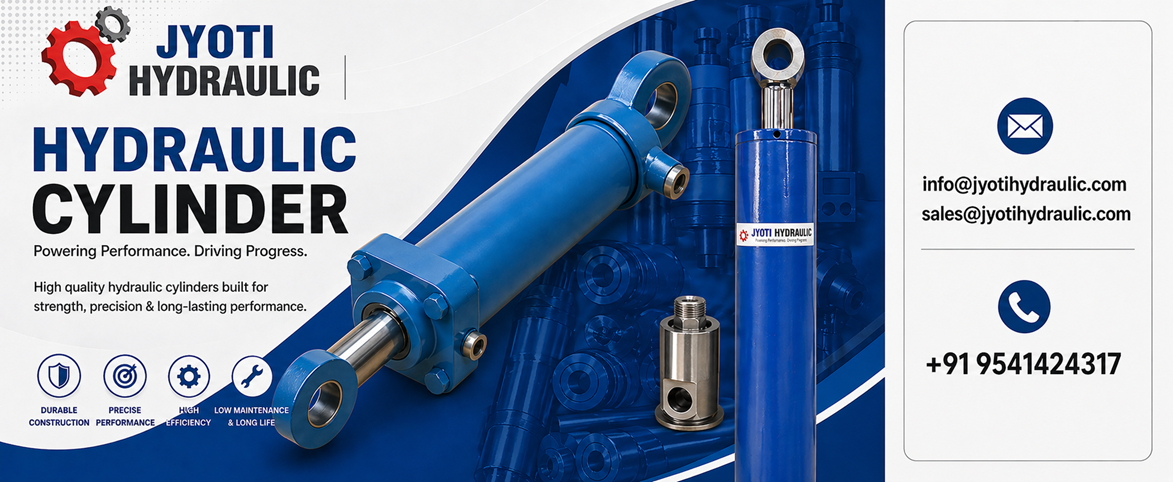
Jyoti Hydraulic invites industrial buyers to look beyond pressure ratings when selecting a hydraulic cylinder. On a production floor, dependable performance comes from matching force, stroke, speed, mounting geometry and operating conditions to the actual machine cycle. A Double Acting Hydraulic Cylinder provides powered movement in both directions, making it useful wherever equipment must push, pull, clamp, release or reposition a load under control. This guide explains how these cylinders work, where they deliver practical value and which engineering details buyers should discuss before ordering a cylinder for demanding industrial service.
Industry Overview
Industrial machines often need substantial linear force within limited installation space. Hydraulic cylinders meet this requirement by converting fluid pressure into mechanical movement. Double acting designs are particularly useful when a machine requires a powered return stroke instead of relying on gravity, a spring or an external load.
Applications range from production presses and material handling equipment to recycling machinery and fabrication fixtures. However, operating conditions differ considerably. A clamping cylinder may spend much of its cycle holding a workpiece, while a compactor repeatedly encounters changing resistance. A cylinder near a furnace faces thermal conditions that a sheltered assembly machine may never experience.
These differences explain why selecting from Double Acting Hydraulic Cylinder Manufacturers should involve an application review. Two cylinders with identical bore and stroke dimensions can perform very differently if their rod sizing, seals, bearings, mounting arrangements or pressure ratings differ.
How a Double Acting Hydraulic Cylinder Works
A typical single-rod cylinder contains a barrel, piston, piston rod, end closures, seals and two hydraulic connections. The piston separates the internal volume into a full-bore chamber and a rod-side chamber.
During extension, pressurised oil enters the full-bore chamber while oil leaves the rod-side chamber through the control circuit. During retraction, the flow path reverses. Hydraulic pressure therefore powers both movements.
This powered return is the defining feature of double acting operation. It does not mean that both directions produce equal force. In a conventional single-rod design, the rod occupies part of the piston area on one side, reducing the effective area available during retraction.
Controlled movement also depends on the surrounding hydraulic system. Pump flow, directional valves, flow controls, pipework and the load all influence how the cylinder behaves.
Technical Insights That Matter in Industrial Use
Pressure and Bore Determine Theoretical Force
The basic relationship is:
Theoretical force = hydraulic pressure × effective piston area.
For a single-rod cylinder, the extension area is πD²/4, while the retraction area is π(D² − d²)/4. Here, D is the bore diameter and d is the rod diameter.
Consider an illustrative cylinder with a 100 mm bore and a 50 mm rod, operating at 200 bar. Assuming negligible pressure in the returning chamber and ignoring friction:
| Parameter | Extension | Retraction |
|---|---|---|
| Effective piston area | Approximately 7,854 mm² | Approximately 5,890 mm² |
| Theoretical force at 200 bar | Approximately 157 kN | Approximately 118 kN |
These are calculated examples, not Jyoti Hydraulic product specifications. Actual available force is lower when seal friction and opposing chamber pressure are considered. Acceleration and the machine mechanism also affect the force required.
The practical lesson is straightforward: a cylinder that pushes adequately may still lack the pulling force needed for the return operation.
Flow Determines Movement Speed
At a given effective area, cylinder speed depends on the oil flow entering the chamber. A larger bore requires more oil to travel the same distance.
For a conventional single-rod cylinder receiving the same inlet flow in each direction, retraction is theoretically faster because the rod-side volume is smaller. During retraction, however, oil leaving the full-bore chamber can flow at a higher rate than the pump supplies to the rod side.
Return lines and valves must accommodate that discharge flow. Restrictive plumbing creates backpressure, reduces useful force and generates heat.
High Pressure Requires a Defined Rating
“High pressure” is not a complete technical specification. Buyers should distinguish between normal working pressure, maximum permitted operating pressure, transient pressure peaks and the agreed test pressure.
A pressure test does not establish that the cylinder can operate continuously at the test value. Likewise, increasing a relief-valve setting to obtain more force can exceed the limits of the cylinder, hoses, fittings or machine structure.
Pressure ratings must be checked for the complete selected configuration, including the mounting and rod-end connection.
Rod Stability and Alignment Affect Service Life
A long rod under compression can buckle even when the piston area provides sufficient theoretical force. Rod selection therefore depends on unsupported length, mounting conditions and compressive load.
Side loading creates another problem. If the machine mechanism pushes the rod sideways, the rod bearing and seals experience uneven loading. This can contribute to scoring, leakage and premature wear.
The cylinder should transmit force along its intended axis. External guides should support machine components where the application requires lateral restraint. Increasing rod diameter alone does not correct poor alignment.
Seals and Cushioning Must Suit the Duty
Seal selection depends on fluid chemistry, temperature, pressure, speed and operating conditions. A seal arrangement suitable for one hydraulic oil may be unsuitable for another fluid or a hotter installation. Wipers and rod protection also matter where dust, moisture or abrasive particles are present.
Where specified, end cushioning slows the piston near the end of travel by restricting oil discharge. Its suitability must be checked against moving mass, velocity and any external force driving the movement. Cushioning cannot be assumed to absorb unlimited impact energy.
Industrial Applications
Pressing and Fabrication
Cylinders can drive forming, straightening and pressing movements, with powered retraction helping withdraw tooling. Required force should be assessed across the complete working stroke.
For example, withdrawing a tool from a tight workpiece may require considerable pulling force. Selecting the cylinder only around pressing capacity can overlook this requirement.
Clamping and Workholding
Double acting operation supports controlled engagement and release. The circuit must maintain the required clamping condition without damaging the workpiece or allowing unintended movement.
The required clamping force should reflect the machining or assembly process, fixture geometry and allowable workpiece deformation.
Material Handling
Transfer mechanisms, positioning devices and lifting arrangements can use cylinders to move loads along a defined path. Overrunning or suspended loads require appropriate load-control measures.
Mounting geometry also matters: the force needed at the cylinder can change as a lifting linkage moves through its travel.
Recycling and Compaction
Balers and compactors encounter uneven resistance and possible shock loads. Mounting strength, rod protection and contamination control deserve particular attention.
An application review should account for occasional difficult material, rather than considering only the average operating load.
Heavy Machinery
Gates, slides and adjustable machine assemblies may require high force at relatively low speed. Environmental exposure, maintenance access and mounting geometry often influence the design as much as nominal capacity.
Benefits of Double Acting Hydraulic Cylinders
The main advantage is powered movement in both directions. This gives machine designers greater control over return motion, especially when gravity or a spring cannot provide a dependable return.
Hydraulic actuation also offers substantial force from a relatively compact actuator. When combined with a suitable control circuit, it can support adjustable operating speed and controlled force development.
Another benefit is flexibility. Bore, stroke, rod dimensions, mounting type and control arrangements can be selected around the machine’s requirements. Sensors and suitable valves can support feedback control where the process needs measured positioning.
These benefits depend on correct system design. Double acting construction alone does not guarantee precise positioning, constant speed, energy savings or secure load holding.
Buying Guide for Industrial Cylinder Selection
Define the Complete Operating Cycle
Begin with the work the cylinder must perform. Specify pushing and pulling loads, required stroke, orientation, extension time, return time and dwell periods.
Include cycles per hour and operating hours per day. Occasional movement and continuous production duty place different demands on seals, bearings and the hydraulic system.
Confirm Installation Dimensions
Provide the available installation space, mounting centres, fully retracted length, connection details and required port orientation. For a replacement cylinder, a drawing is more useful than bore and stroke alone.
Check access for installation, hose routing, seal replacement and cylinder removal. A component that fits the machine can still be unnecessarily difficult to maintain.
Match the Cylinder to the Hydraulic Circuit
Share the available pressure, pump flow, hydraulic fluid, expected temperature range and valve arrangement. Confirm the required return-line capacity and how the load behaves during motion.
Where a load can drive the cylinder, the circuit may need a properly selected counterbalance arrangement. Load holding may require other dedicated measures according to the machine design. A directional valve should not automatically be treated as a secure holding device.
Compare Technical Scope Across Quotations
When evaluating Double Acting Hydraulic Cylinder Manufacturers, compare quotations against the same operating requirements.
Ask for confirmation of:
- Bore, rod diameter, stroke and mounting dimensions.
- Permitted operating pressure and application limitations.
- Seal compatibility with the specified fluid and temperature.
- Cushioning, sensors or other options included in the supply.
- Inspection and testing scope, including acceptance criteria.
- Drawings, spare seal identification and maintenance information.
A lower purchase price can become expensive if it leads to modifications, repeated leakage or prolonged downtime.
Maintenance Practices That Protect Performance
Cylinder reliability depends partly on the condition of the entire hydraulic system. Contaminated oil can damage sealing surfaces, while overheated oil can shorten seal life.
Inspect exposed rods for scoring, corrosion and accumulated debris. Check mounting pins, bushes and fasteners for looseness or wear. Investigate changes in speed, unusual noise, external leakage or load drift before they develop into larger failures.
Avoid assuming that every performance problem originates inside the cylinder. Slow movement can result from inadequate pump flow or a restricted valve. Drift may involve cylinder seals, control valves or other circuit components. Diagnosis should consider the full system.
Before maintenance, isolate the equipment, release stored hydraulic energy and support loads using the machine’s prescribed procedure.
Future Trends in Hydraulic Actuation
Industrial hydraulic systems increasingly incorporate measurement and electronic control. Position feedback can help a controller compare actual travel with the commanded movement, while pressure and temperature measurements provide additional operating information.
Condition monitoring can support maintenance planning by tracking changes over time. Existing machinery can also be connected to monitoring systems, making operating data available without necessarily replacing the complete machine.
For example, a longer cycle time may justify checking for leakage, flow restriction or mechanical resistance. The measurement identifies a symptom; further diagnosis establishes its cause.
Demand-based hydraulic power is another development. Appropriately engineered pump and drive controls can reduce unnecessary energy use during parts of a machine cycle. The benefit depends on the complete system and duty profile, rather than on replacing the cylinder alone.
Conclusion
A high pressure Double Acting Hydraulic Cylinder should be selected around the machine’s actual force, travel and control requirements. Bore size establishes available piston area, but rod stability, mounting alignment, seal compatibility and circuit design determine whether that capability translates into dependable operation.
A clear application specification helps buyers compare proposals, avoid installation problems and obtain a cylinder suited to long-term industrial service.
Frequently Asked Questions
What is a double acting hydraulic cylinder used for?
It provides hydraulic force during both extension and retraction. Typical uses include pressing, clamping, compaction, material handling and controlled machine positioning.
Does it produce the same force in both directions?
Usually not for a conventional single-rod design. At equal supply pressure and negligible opposing pressure, retraction force is lower because the rod reduces the effective piston area.
What pressure rating should I choose?
Select a rating that accommodates the application’s working conditions and expected pressure peaks within the manufacturer’s limits. Check the whole hydraulic circuit and machine structure, rather than choosing a cylinder rating in isolation.
Can a double acting cylinder hold a load without movement?
That depends on the cylinder, valves, circuit and load. Internal leakage can cause movement. Applications requiring secure holding need suitable engineered load-holding provisions.
How do I choose the correct stroke length?
Specify the required working travel and verify retracted length, extended geometry and installation clearance. Long strokes also require a rod-stability assessment under compressive loading.
What information is needed for a quotation?
Provide the application, push and pull force requirements, bore and rod sizes if known, stroke, pressure, speed, mounting details, duty cycle, fluid and temperature. Include a drawing or replacement-cylinder dimensions when available.
Discuss Your Requirement with Jyoti Hydraulic
Contact Jyoti Hydraulic to discuss your industrial cylinder requirement, request a quotation or get expert consultation on application selection. Share your machine drawing, operating pressure, stroke and load details so the proposed configuration can be reviewed against your working conditions.
📧 Email: info@jyotihydraulic.com
📞 Call: +91 9541424317


