
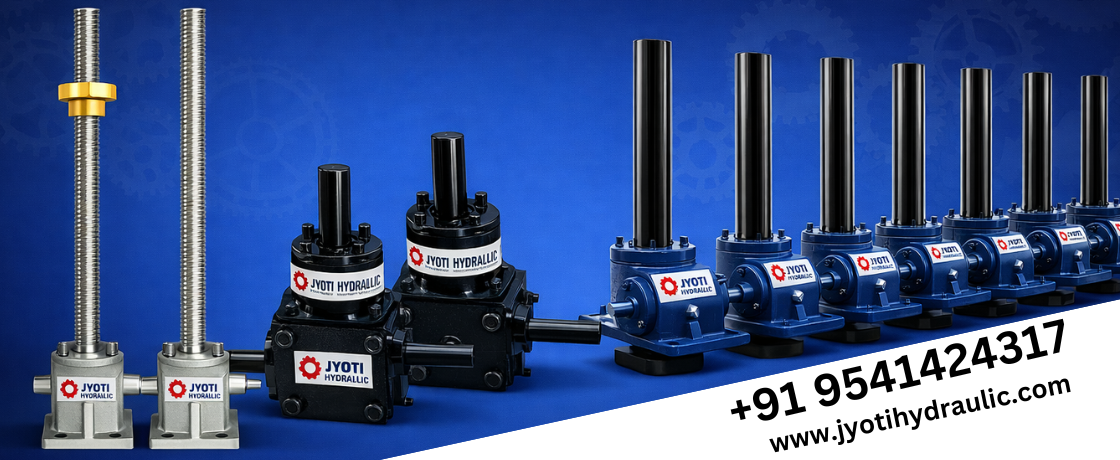
Jyoti Hydraulic stands for precision, reliability, and engineering excellence in lifting and positioning solutions. When industries need controlled linear motion, high-load lifting, dependable synchronization, and long service life, the Worm Gear Screw Jack remains one of the most trusted mechanical systems available. Choosing the right model, however, is not as simple as selecting a lifting device by capacity alone. The ideal screw jack must match the exact technical, environmental, and operational demands of the application.
In this guide, we will explain how to choose the best Worm Gear Screw Jack for your application, what technical factors matter most, where these systems are used, and why working with experienced Worm Screw Jack Manufacturers is critical for long-term performance. Whether you are an OEM, plant engineer, maintenance manager, or procurement professional searching for dependable Worm Gear Screw Jack Manufacturers in India, this article will help you make a confident and informed decision.
Introduction
A worm gear screw jack is a highly efficient mechanical lifting device that converts rotary motion into linear motion. It is widely used for lifting, lowering, tilting, positioning, and supporting heavy loads with precision. These jacks are found in manufacturing plants, steel industries, material handling systems, construction equipment, automation lines, gates, platforms, and many other industrial setups.
What makes the screw jack so valuable is its simplicity and strength. A rotating worm shaft drives a worm wheel, which then turns or translates the lifting screw. This arrangement allows controlled movement under substantial load, often with self-locking properties that improve safety in many applications.
However, not all screw jacks are the same. Load requirements, duty cycle, mounting arrangement, lifting speed, travel length, environmental exposure, and installation geometry all influence performance. Selecting the wrong product can lead to overload, excessive wear, instability, poor synchronization, and unplanned downtime. That is why buyers increasingly rely on trusted Worm Screw Jack Manufacturers with strong technical understanding and customization capabilities.
Industry Overview
The industrial demand for screw jacks continues to grow because modern machinery requires accurate lifting and positioning systems that are robust, compact, and easy to integrate. Across sectors such as cement, steel, packaging, pharmaceuticals, energy, logistics, defense, and infrastructure, worm gear screw jacks are used where hydraulic or pneumatic alternatives may be less suitable due to maintenance complexity, leakage risk, or lack of mechanical holding.
In many industrial environments, a Worm Gear Screw Jack is preferred for these reasons:
- Precise linear movement
- High load-handling capability
- Strong holding performance
- Simple installation and maintenance
- Compatibility with motorized and manual operation
- Long operational life under proper lubrication and alignment
India has become an important manufacturing hub for industrial motion and lifting equipment. As a result, buyers across domestic and international markets actively search for reliable Worm Gear Screw Jack Manufacturers in India that can deliver quality engineering, competitive pricing, and application-specific customization. This demand is especially strong in industries upgrading their plants for automation, heavy-duty material handling, and synchronized lifting systems.
Technical Insights
To choose the right screw jack, it is essential to understand how it works and what technical specifications define performance.
Working Principle
A worm gear screw jack operates through a gear reduction mechanism. The input shaft rotates the worm, which engages the worm wheel. This rotational motion is then converted into linear travel by the lifting screw. Depending on the design, the screw either moves upward and downward while the housing stays fixed, or the screw rotates and a traveling nut performs the linear movement.
This system provides high mechanical advantage, enabling controlled lifting of heavy loads with relatively low input torque.
Main Types of Worm Gear Screw Jacks
1. Translating Screw Type
In this design, the lifting screw moves linearly through the body of the jack. It is ideal for direct lifting applications where visible vertical movement is required.
Best for: lifting tables, platforms, presses, and structural adjustments.
2. Rotating Screw Type
Here, the screw rotates in place and a traveling nut moves along the screw to create linear motion. This type is useful when the screw cannot extend outward due to space limitations.
Best for: compact systems, enclosed machinery, and applications with restricted vertical clearance.
Key Technical Specifications to Evaluate
Load Capacity
Load capacity is the first major selection criterion. Screw jacks are available in a wide range, from light-duty units to heavy-duty models capable of handling several tons. Always consider:
- Static load
- Dynamic load
- Shock load
- Safety factor
Never size the jack only at the exact working load. A proper engineering margin is essential to ensure safety, durability, and reliable operation.
Travel Length
Travel length refers to the total linear movement required. Longer travel increases the risk of buckling in slender screws, especially under compression. For long-stroke applications, engineers must check the screw diameter, end support conditions, and guidance arrangement.
Lifting Speed
A Worm Gear Screw Jack is not generally designed for very high-speed continuous motion. Lifting speed depends on worm ratio, screw lead, input RPM, and duty cycle. Faster speeds may generate more heat and reduce service life if not designed properly.
Duty Cycle
Some applications require occasional adjustment, while others demand frequent operation. Duty cycle affects thermal buildup, lubrication needs, and gear life. A screw jack intended for intermittent use may not be suitable for continuous industrial cycles.
Mounting Configuration
Correct mounting is essential for stability and load alignment. Common mounting arrangements include upright, inverted, flange-mounted, and customized base-supported configurations. Side loads should be avoided or minimized through proper guiding systems.
Input Options
Screw jacks can be operated by:
- Handwheel
- Electric motor
- Gear motor
- Bevel gearbox
- Couplings and line shafts for synchronized systems
For multi-point lifting, jacks are often connected through shafts and gearboxes to maintain synchronized movement.
Material Selection
Material quality directly affects life, strength, and reliability. High-quality Worm Screw Jack Manufacturers typically use:
- High-strength alloy steel for screws
- Hardened steel or special-grade worm shafts
- Phosphor bronze or wear-resistant bronze for worm wheels
- Robust cast iron or fabricated steel housings
- Corrosion-resistant coatings for harsh environments
For food, marine, chemical, or outdoor applications, additional protection such as stainless steel components, sealed housings, or special surface treatments may be required.
Applications
A Worm Gear Screw Jack serves a wide range of industrial applications because of its precision and mechanical strength.
Material Handling Systems
Used in conveyor height adjustment systems, loading platforms, and transfer units where accurate elevation control is needed.
Steel and Heavy Engineering Plants
Applied in furnace doors, rolling mill adjustments, ladle covers, and heavy platform lifts where rugged mechanical motion is required.
Packaging and Automation
Used for machine height adjustment, synchronized positioning, and format change systems in automated production lines.
Construction and Infrastructure
Found in stage platforms, sluice gates, dam gate control systems, and maintenance access systems.
Solar and Energy Sector
Used in solar panel tilt systems, equipment positioning, and maintenance lifting assemblies.
OEM Machinery
Machine builders integrate screw jacks into special-purpose machinery, testing rigs, presses, and assembly stations where controlled movement is essential.
For example, in a four-point lifting platform, multiple screw jacks can be connected through a common drive system to raise a large worktable evenly. In another case, a rotating screw jack may be used inside a compact machine frame to position tooling where extension space is limited.
Benefits
Choosing a well-designed screw jack offers several long-term benefits.
Precision and Control
A worm gear mechanism allows smooth and accurate positioning, which is crucial in industrial adjustment and lifting operations.
High Load Capability
These jacks can safely handle significant loads when properly selected and installed.
Self-Locking Advantage
Many worm gear screw jacks provide self-locking under certain conditions, helping maintain position without back-driving. This adds operational safety in holding applications.
Durability
With correct lubrication, alignment, and material selection, screw jacks deliver excellent service life even in demanding industrial environments.
Cost-Effectiveness
Compared with more complex motion systems, screw jacks offer a practical and economical solution for many lifting and positioning tasks.
Easy Integration
They can be integrated into manual, motorized, or synchronized systems with relative ease.
These advantages explain why many buyers actively seek dependable Worm Gear Screw Jack Manufacturers in India that can provide reliable standard and custom-built solutions.
Buying Guide / Selection Tips
Selecting the best Worm Gear Screw Jack requires more than checking a catalog. Here are the most important expert considerations.
1. Define the Exact Load Condition
Identify whether the load is static, dynamic, eccentric, shock-loaded, or unevenly distributed. Also determine whether one jack or multiple synchronized jacks will be used.
2. Check Compression and Buckling Risk
For long travel lengths, screw buckling becomes a serious issue. Always evaluate unsupported screw length and guidance requirements.
3. Consider Duty Cycle and Heat Generation
Frequent operation can increase internal heat. For high-duty applications, confirm whether the jack is designed for the required cycle and speed.
4. Evaluate Speed Versus Capacity
Higher speed is not always better. A lower-speed jack often provides better control, higher life, and improved safety under heavy loads.
5. Match the Mounting Design to the Application
Improper mounting can create side loading and premature failure. The jack should be installed with proper alignment and guided motion wherever needed.
6. Choose the Right Screw Type
A translating screw is excellent for direct lifting, while a rotating screw is better for compact or constrained installations.
7. Assess Environmental Conditions
Dust, moisture, chemicals, outdoor exposure, and temperature variations all affect performance. Ask for suitable sealing, coatings, or material upgrades.
8. Verify Customization Capability
Every industrial application has unique constraints. Leading Worm Screw Jack Manufacturers can customize travel length, mounting style, gear ratio, input arrangement, and protective features.
9. Check Manufacturing Quality
Look for precision machining, robust housing design, quality materials, load testing, and engineering support. Product quality directly impacts downtime and maintenance cost.
10. Work with a Trusted Manufacturer
Experienced Worm Gear Screw Jack Manufacturers in India offer not only products but also technical support, sizing guidance, CAD assistance, and custom engineering. This is especially valuable for synchronized lifting systems and specialized industrial machinery.
Future Trends
Screw jack technology is evolving with industrial automation and smart manufacturing. The future of the Worm Gear Screw Jack includes:
Greater Automation Integration
More systems are being paired with servo motors, geared motors, sensors, and programmable controls for accurate positioning.
Improved Materials and Surface Engineering
Advanced alloy selection, wear-resistant coatings, and better sealing systems are enhancing life and reliability.
Compact High-Performance Designs
Manufacturers are developing more compact units with better load efficiency for space-constrained machines.
Smart Maintenance Support
Condition monitoring, predictive maintenance practices, and digital engineering support are helping users reduce failures and improve uptime.
Custom Engineered Multi-Jack Systems
As plants demand synchronized lifting for larger platforms and precision lines, customized multi-jack assemblies are becoming increasingly important.
This is where experienced Worm Screw Jack Manufacturers add major value by combining traditional mechanical engineering with modern automation requirements.
Conclusion
Choosing the right Worm Gear Screw Jack is a strategic engineering decision that affects safety, efficiency, reliability, and long-term operating cost. The best solution depends on a combination of load capacity, travel length, duty cycle, speed, mounting arrangement, environment, and system integration requirements. A technically correct selection ensures smoother operation, reduced maintenance, and longer service life.
For buyers seeking dependable performance and expert support, partnering with established Worm Gear Screw Jack Manufacturers in India is essential. A manufacturer with deep application knowledge can help you select the right model, avoid common design errors, and deliver a customized solution that fits your exact industrial requirement.
FAQ Section
1. What is a worm gear screw jack used for?
A worm gear screw jack is used for lifting, lowering, tilting, positioning, and supporting loads in industrial applications. It is widely used in material handling, automation, heavy machinery, and structural adjustment systems.
2. How do I choose the right load capacity for a screw jack?
You should consider actual working load, shock load, dynamic conditions, and a suitable safety factor. Never select a jack only at the exact required load.
3. What is the difference between translating and rotating screw jacks?
In a translating screw jack, the screw moves linearly. In a rotating screw jack, the screw rotates in place and a traveling nut creates linear motion. The choice depends on installation space and application design.
4. Are worm gear screw jacks self-locking?
Many worm gear screw jacks offer self-locking capability under specific design and load conditions. However, this should always be verified with the manufacturer for the intended application.
5. Where are worm gear screw jacks commonly used?
They are commonly used in steel plants, packaging machinery, lifting platforms, dam gates, solar systems, conveyor adjustments, and special-purpose industrial equipment.
6. Why should I buy from experienced Worm Screw Jack Manufacturers?
Experienced manufacturers provide better engineering support, higher material quality, precise manufacturing, reliable customization, and application-specific recommendations.
7. Why are buyers looking for Worm Gear Screw Jack Manufacturers in India?
India offers a strong industrial manufacturing base, competitive pricing, customization capability, and access to technically advanced lifting and motion control solutions.
8. Can a worm gear screw jack be customized?
Yes. Reputed manufacturers can customize load capacity, travel length, screw type, input arrangement, mounting style, protective coating, and synchronized system design.
Get Expert Help from Jyoti Hydraulic
When your application demands precision, strength, and long-term reliability, do not settle for guesswork. Connect with Jyoti Hydraulic for expert guidance in selecting the ideal Worm Gear Screw Jack for your exact operational needs. Whether you need a standard model, a heavy-duty solution, or a fully customized synchronized lifting system, our team is ready to help.
Contact us today for expert consultation, request a quotation, and get customized solutions built for your industry.
📧 info@jyotihydraulic.com
📞 +91 9541424317


