
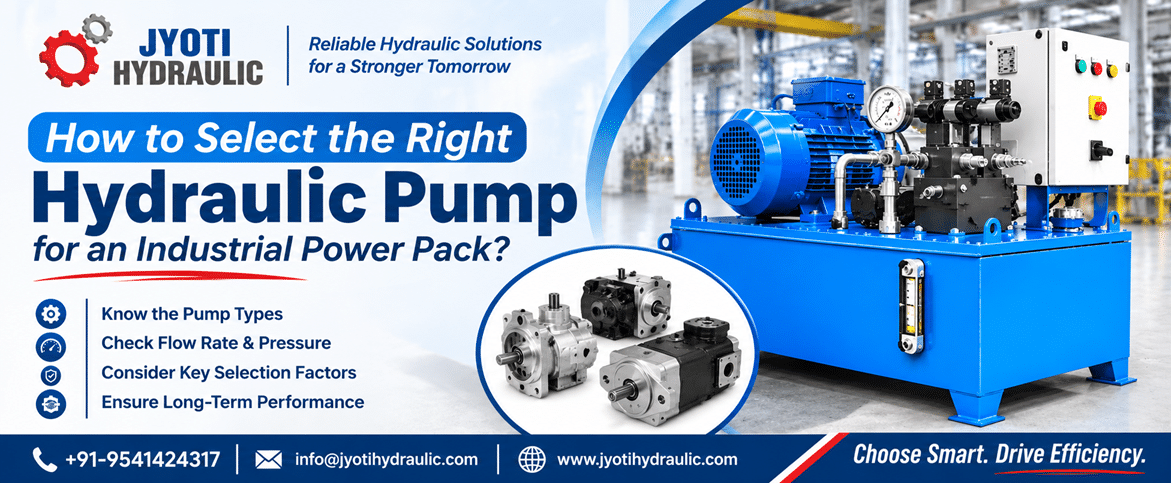
How to Select the Right Hydraulic Pump for an Industrial Power Pack?
Jyoti Hydraulic offers hydraulic pumps and industrial power packs, but choosing the right combination begins with your machine, not a catalogue number. A press that approaches quickly and then forms slowly needs a different supply strategy from a continuously operating hydraulic motor. Selecting a Hydraulic Pump for an Industrial Power Pack therefore means matching the complete operating cycle—not simply buying the highest pressure rating or the largest displacement.
This guide connects the calculations with the questions that matter before purchase: how much oil must move, at what pressure, for how long, and under which installation conditions? Understanding these requirements helps you compare options, avoid unsuitable equipment and build a power pack around your machine’s actual workload.
Which Hydraulic Pump Is Right for Your Power Pack?
Choose a pump that supplies the required flow at the required working pressure throughout the machine cycle. Then check its continuous-duty rating, drive power, control method, fluid compatibility and inlet conditions. Gear pumps suit straightforward fixed-flow duties; vane pumps are worth considering where smooth, quiet operation matters; variable-displacement piston pumps offer control options for demanding, changing loads. The final choice must follow the selected model’s performance data.
Industry Overview: Select a System, Not an Isolated Pump
Industrial hydraulic power packs supply machines used in metal forming, plastics processing, lifting and production automation. Their performance depends on the interaction between the pump, electric motor, reservoir, valves and fluid-conditioning equipment. A useful selection process therefore evaluates the application’s pressure, flow and time profile rather than treating peak pressure as the only design input.
The distinction between flow and pressure is fundamental. Flow determines actuator speed; the load and circuit resistance determine the pressure required. A higher-pressure-rated pump does not automatically move a cylinder faster. Equally, installing more displacement does not automatically increase useful force. Cylinder area, available pressure, drive power and circuit design must work together.
This system-level approach is particularly important when replacing an existing pump. Matching its mounting dimensions is only one part of the job. The replacement must also suit the machine’s operating pressure, required delivery, control arrangement and installation conditions.
Technical Insights: What Must You Calculate and Check?
1. Define the Complete Operating Cycle
Write down the machine’s approach, working, holding, return and idle stages. For each stage, record required flow, pressure and duration, including any simultaneous actuator movement. Do not automatically combine the highest flow from one stage with the highest pressure from another: establish which combinations actually occur, then check transitions and overload conditions.
As a practical buying exercise, ask production and maintenance staff to review this cycle together. A purchasing specification that says only “200 bar power pack” leaves the supplier without the information needed to determine speed, motor loading or cooling demand.
2. Calculate Actuator Flow and Pressure Separately
For a cylinder, the basic volume relationship is:
Flow formula:
Q (L/min) = 60,000 × A (m²) × v (m/s)
Here, A is the effective area being supplied and v is piston speed. An 80 mm bore cylinder extending at 0.10 m/s requires approximately 30.2 L/min, before allowances for circuit leakage. For retraction, use the annular area: piston area minus rod area. These are geometric calculations, not pump performance guarantees.
The theoretical cylinder force relationship is:
Force formula:
F (kN) = p (bar) × A (mm²) ÷ 10,000
Use the required force to establish cylinder pressure, then account for friction, acceleration, opposing-side pressure and supply-path losses. A pump’s continuous pressure rating must cover the intended duty; an intermittent or peak rating is not permission for continuous operation at that pressure.
3. Compare Pump Technologies Against the Application
| Pump Type | Why Consider It? | What Needs Checking? |
|---|---|---|
| External Gear Pump | A straightforward, cost-conscious option for fixed-displacement supply. | Actual delivery under load, noise, speed limits and how unused flow is handled. |
| Vane Pump | Low-pulsation, low-noise designs suit many industrial machines. Fixed and variable versions exist. | The exact pressure range, fluid requirements and control configuration. |
| Variable-Displacement Axial Piston Pump | Options include pressure, load-sensing and displacement control for changing demand. | Controller compatibility, inlet conditions, case-drain requirements and installation complexity. |
Pressure capability and efficiency vary by model; do not assign one pressure limit to an entire pump family. The right comparison uses actual performance curves, operating limits and control specifications for the pumps being considered.
4. Distinguish Displacement Control from Speed Control
A fixed-displacement pump moves a nominal volume per revolution; its delivered flow changes with shaft speed and internal leakage. A variable-displacement pump changes that volume. These are different from a variable-speed drive, which changes motor speed.
For a simple machine, fixed displacement with a properly designed unloading arrangement may be sufficient. For a machine with long holding periods or widely changing demand, compare pressure-compensated or variable-speed arrangements. Request a cycle-based comparison rather than assuming that the more sophisticated option will always deliver a worthwhile saving.
Worked Example: Calculate Displacement and Motor Power
Consider an illustrative requirement of 30 L/min at a pump differential pressure of 180 bar. Assume a shaft speed of 1,500 rpm, volumetric efficiency of 0.90 and overall pump efficiency of 0.85. These efficiencies are calculation assumptions; the selected pump’s curves must replace them during final engineering.
Pump displacement:
Vg (cm³/rev) = 1,000 × Q ÷ (n × ηv)
Hydraulic output power:
Power (kW) = Δp × Q ÷ 600
Pump shaft input power:
Power (kW) = Δp × Q ÷ (600 × ηoverall)
In these equations, Q is delivered flow in L/min, n is shaft speed in rpm and Δp is the pressure difference across the pump in bar. Volumetric efficiency accounts for leakage; overall efficiency also includes mechanical and hydraulic losses.
| Calculation | Substitution | Result |
|---|---|---|
| Required Displacement | 1,000 × 30 ÷ (1,500 × 0.90) | 22.2 cm³/rev |
| Hydraulic Output Power | 180 × 30 ÷ 600 | 9.0 kW |
| Pump Shaft Input Power | 180 × 30 ÷ (600 × 0.85) | 10.6 kW |
Now check the proposed catalogue size. If the supplier proposes a 25 cm³/rev pump, the same assumed speed and volumetric efficiency give 33.75 L/min. At 180 bar and the same overall efficiency, shaft demand becomes approximately 11.9 kW—not 10.6 kW.
This is why rounding displacement upward without recalculating power can produce a mismatched package. Specify a motor only after evaluating the proposed pump’s actual curves, starting torque, duty rating, operating speed and maximum circuit demand. Check electrical input separately from mechanical shaft output. This example is a sizing demonstration, not a final equipment recommendation.
Installation Checks That Protect the Pump Selection
Make Inlet Conditions Part of the Purchase Specification
Check inlet pressure at the pump—not merely the reservoir level. Suction-line diameter, length, fittings, oil viscosity and mounting height influence inlet conditions. Restricted supply can damage a pump even when its outlet pressure rating is adequate. Keep case-drain backpressure within the model’s limit and route the drain as its installation manual requires.
Do not add fine suction filtration by habit. Its pressure drop must be assessed against the pump’s inlet requirements, particularly during cold starts. The appropriate filtration arrangement depends on the selected equipment and circuit.
Specify Oil Condition, Not Just an Oil Grade
Confirm fluid chemistry, seal compatibility and permissible viscosity at both start-up and operating temperature. Obtain the required ISO 4406 cleanliness target from the component manufacturers, then specify filtration capable of maintaining it. There is no single oil grade, filter micron rating or cleanliness code that is correct for every hydraulic power pack.
Check Heat, Mounting and Protective Functions
Unnecessary pressure drop consumes useful power. For example, bypassing 10 L/min across a 150 bar pressure drop dissipates approximately 2.5 kW. Use the actual cycle to assess average heat generation and cooling needs; a larger tank alone is not a complete thermal design.
Confirm rotation, shaft and flange compatibility, coupling alignment and the manufacturer’s commissioning requirements. A pump pressure compensator is not a substitute for a protective pressure-relief arrangement. Final circuit protection and commissioning should be reviewed by a qualified hydraulic engineer.
Applications: Translate the Machine’s Job into Selection Priorities
The application checklist below helps turn a broad machine description into a useful engineering discussion. Rather than selecting a pump because it is commonly used in your industry, identify the operating demands that make it suitable for your particular machine.
| Application | Selection Priorities | Question for the Supplier |
|---|---|---|
| Hydraulic Presses and Forming Machines | Approach flow, working force, holding time and transition behaviour. | How will the proposed arrangement supply each stage without unnecessary bypass flow? |
| Plastic Processing Machinery | Changing flow demand, pressure response and repeatable cycles. | What performance can be demonstrated over the actual production cycle? |
| Machine-Tool Clamping Systems | Pressure holding, low noise and limited standby losses. | What happens to pump flow and power demand while the workpiece remains clamped? |
| Lifting and Material Handling | Required lifting speed, load variation and suitable protective circuit design. | Who is responsible for validating load-holding and controlled-lowering functions? |
Benefits of a Properly Matched Pump and Power Pack
A good selection gives you a measurable performance target: specified actuator speed, required force and acceptable power demand throughout the cycle. It also provides a clear basis for acceptance testing instead of relying on a vague promise of “heavy-duty performance”.
Demand-matched supply can reduce avoidable energy use and heat input. Correct inlet conditions, suitable fluid and controlled contamination help address recognised causes of component damage. These benefits depend on the whole installation and maintenance practice; no pump technology guarantees them on its own.
Documenting the selection also makes future maintenance decisions clearer. When the required flow, operating pressure and installation limits are recorded, maintenance teams have a useful baseline for evaluating replacement options and investigating changes in machine performance.
Buying Guide: How to Compare Hydraulic Pump Manufacturers
When comparing Hydraulic Pump Manufacturers, ask each supplier to quote against the same operating specification. A lower purchase price is difficult to evaluate when one quotation includes controls, filtration and testing while another covers only a bare pump.
| Specification Area | Information to Provide or Request |
|---|---|
| Machine and Actuators | Application, required force or torque, cylinder dimensions, movement speeds and simultaneous functions. |
| Operating Cycle | Pressure, flow and duration for each stage; daily operating hours and expected starts. |
| Pump Performance | Exact model code, continuous and peak limits, delivery curves, efficiency data and control type. |
| Drive and Installation | Supply voltage and frequency, motor duty, operating speed, mounting envelope, rotation and coupling details. |
| Fluid and Environment | Fluid type, start-up and operating temperatures, cleanliness requirement, dust exposure and cooling utilities. |
| Testing and Support | Agreed acceptance conditions, documentation, commissioning scope, spare parts, warranty terms and service responsibilities. |
Request the proposed pump’s delivered flow and input power at your actual working pressure and temperature. For a replacement, provide the existing nameplate and circuit drawing, but also explain the problem being solved. Repeating an old model specification can repeat an old system mismatch.
For lifecycle comparison, use annual energy consumption, maintenance needs and downtime exposure alongside purchase cost. A useful starting calculation is average measured input kW × annual operating hours. Multiply the resulting kWh by your applicable electricity tariff; do not estimate annual consumption from motor nameplate power alone.
Explore Jyoti Hydraulic’s hydraulic pump range and industrial hydraulic power packs, then request a proposal based on your operating data.
Future Trends: Demand-Based Drives and Condition Monitoring
Variable-speed pump drives are an established option worth evaluating in new projects and retrofits. Matching motor speed to demand can reduce idle losses and heat generation, but suitability depends on the pump’s approved speed range, required response and work cycle. Avoid accepting a headline savings percentage without a comparison for your machine.
Connected condition monitoring adds another selection consideration. For buyers, the practical question is not simply whether a package is “smart”, but which operating signals it measures, how alerts are interpreted and who will act on them. Monitoring supports maintenance decisions; it does not replace correct sizing or clean fluid.
When reviewing these options, ask how they fit your existing maintenance processes. A feature is more useful when your team can understand its information and turn it into a clear inspection, adjustment or service action.
Conclusion: Buy for the Operating Cycle, Not the Biggest Number
The right hydraulic pump for an industrial power pack is the one that fits the machine’s flow, pressure, control and duty requirements as a complete package. Begin with actuator demand, calculate displacement and shaft power, then verify the proposed model’s operating limits and installation conditions.
Before placing an order, ask for a documented selection—not just a product code. That makes the discussion with Jyoti Hydraulic specific, the quotation easier to compare and the final acceptance criteria clearer.
Frequently Asked Questions
What is the most important factor when selecting a hydraulic pump?
The starting point is the required flow at the required pressure across the operating cycle. Flow establishes movement speed; pressure must satisfy the load. Neither figure should be considered without duty duration and available drive power.
Which is better for a power pack: a gear, vane or piston pump?
There is no universal winner. Consider a gear pump for straightforward fixed-displacement supply, a suitable vane pump for low-noise industrial duty, or a variable piston pump when the application needs its pressure capability and control options. Compare specific models rather than labels alone.
Can I install a larger pump to make the machine faster?
Only after reassessing the system. More delivered flow can increase actuator speed, but it also changes power demand and the flow that the circuit must handle. Recalculate the package rather than treating additional displacement as a drop-in upgrade.
Does a variable-displacement pump always save energy?
No fixed saving should be assumed. Its value depends on the operating cycle, control arrangement and system used for comparison. Ask the supplier to compare complete-cycle input energy, including standby operation, rather than quoting efficiency at one favourable point.
What oil and filtration should the power pack use?
Follow the selected components’ fluid, viscosity and cleanliness requirements. Check cold starts as well as normal operating temperature, and obtain filter specifications suitable for the whole circuit. A familiar oil grade or micron number alone is not a complete specification.
Does a pressure-compensated pump still need overpressure protection?
Pressure compensation controls pump operation; it is not, by itself, a safety device. Provide the protective arrangement required by the pump manufacturer and the engineered circuit. Do not remove pressure protection merely because a compensator is fitted.
What should I send Jyoti Hydraulic for an accurate quotation?
Send the application, actuator details, required pressure and flow, cycle timings, operating hours, electrical supply and available space. For replacements, include the pump nameplate and circuit drawing. State the delivery, testing, documentation and support scope you expect.
Get the Right Pump Selection Before You Place the Order
Contact Jyoti Hydraulic for expert consultation and request a quotation for your hydraulic pump or industrial power pack. Share your pressure, flow, operating cycle and installation requirements so the discussion starts with the demands of your machine.
Whether you are selecting a pump for a new installation or reviewing a replacement, start with a clear specification and a focused technical discussion.
📧 info@jyotihydraulic.com📞 +91 9541424317
Request a Quotation & Expert Consultation from Jyoti Hydraulic


