
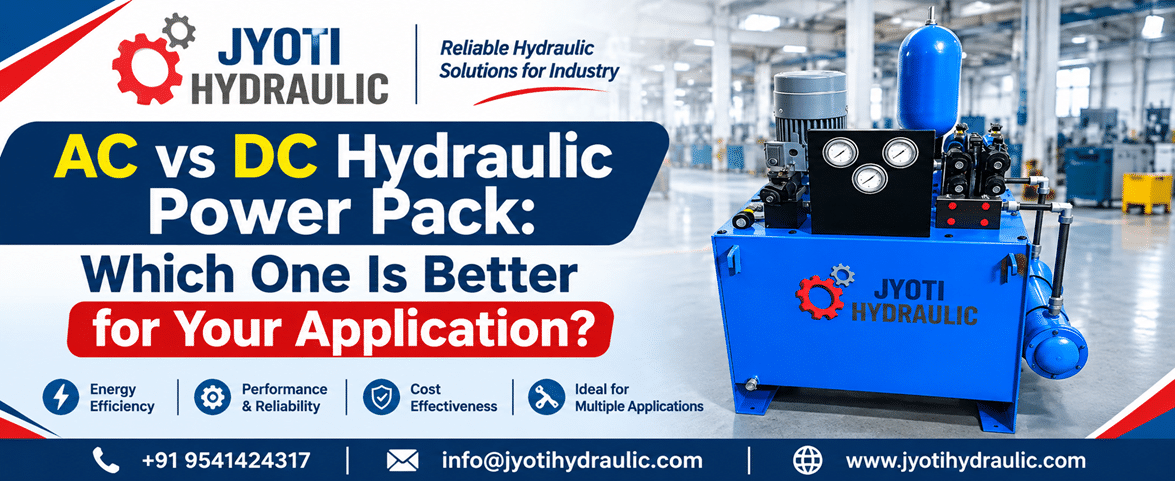
This guide compares AC and DC hydraulic power packs through the factors that matter in real installations: electrical compatibility, pressure, flow, motor duty, cooling, application requirements, and total installed cost.
Which Is Better: an AC or DC Hydraulic Power Pack?
An AC Hydraulic Power Pack is generally the practical choice for stationary industrial equipment with a suitable mains supply. A DC Hydraulic Power Pack is generally better suited to battery-powered, vehicle-mounted, and mobile equipment. However, continuous operation depends on the actual motor and power-unit ratings, not simply whether the supply is AC or DC.
| Selection Factor | AC Hydraulic Power Pack | DC Hydraulic Power Pack |
|---|---|---|
| Electrical supply | Site-matched single-phase or three-phase AC supply. | A compatible DC source, commonly a battery system. |
| Typical application | Stationary machinery and industrial installations. | Mobile equipment and battery-operated machinery. |
| Supply compatibility | Voltage, phase, and frequency must match the selected equipment. | Supply voltage and available current must match the selected equipment; common compact configurations include 12V and 24V. |
| Operating duty | Continuous or intermittent, depending on the specified unit. | Often intermittent in compact units; continuous-duty configurations also exist. |
| Important electrical checks | Supply capacity, starting arrangement, motor protection, and approved duty. | Battery capability, loaded voltage, current demand, cable losses, and approved duty. |
| Hydraulic capability | Determined by the pump, motor, valves, and circuit. | Determined by the pump, motor, valves, and circuit. |
These are selection tendencies rather than universal limits. The final comparison must use the specifications of the proposed units, particularly their delivered flow at working pressure and their permitted operating cycle.
Industry Overview: The Same Hydraulic Function, Different Electrical Arrangements
A hydraulic power pack brings together an electric motor, hydraulic pump, reservoir, and valve arrangement. The motor drives the pump, while the hydraulic circuit controls how energy reaches the actuator. AC and DC power packs can share a similar hydraulic layout; the electrical drive and its operating requirements are the main distinction.
The pump primarily produces flow. Pressure develops as the load and circuit resist that flow. This is why supply voltage alone cannot establish lifting force, movement speed, or suitability for a demanding production cycle.
For buyers, two quotations should not be compared by voltage or horsepower alone. Compare what each proposed unit can deliver at the required pressure, flow, and operating cycle. A power pack that performs well during an occasional lift may not be suitable for repeated movements throughout a production shift.
Technical Insights That Determine the Right Choice
Pressure Determines Force; Flow Determines Speed
For a hydraulic cylinder, pressure acting over the effective piston area produces force, while flow into that area determines movement speed. Actual performance also requires allowances for friction, opposing pressure, and the machine’s mechanical arrangement.
Theoretical cylinder force = pressure × effective piston area.
Theoretical cylinder speed = flow ÷ effective piston area.
This distinction helps avoid a common buying mistake: treating a high pressure rating as proof that a machine will work faster.
Consider two proposed units operating the same cylinder at the same pressure. A unit delivering more usable flow can move that cylinder faster, but the pressure rating alone does not establish speed. Likewise, changing the cylinder bore changes the relationship between force, speed, and oil demand.
The useful purchasing question is: “What flow will this power pack deliver at my required working pressure?” That is more informative than asking for maximum pressure and maximum flow as two unrelated catalogue figures.
For a closer look at actuator calculations, read our guide on how to calculate hydraulic cylinder force, pressure, and bore size.
Motor Power Must Match Pressure and Flow Together
Hydraulic output power can be calculated using the following relationship:
Hydraulic power in kW = pressure differential in bar × flow in L/min ÷ 600.
Pump input power must be higher because the pump is not perfectly efficient. Electrical input must also account for motor losses.
For an illustrative requirement of 160 bar at 6 L/min, the calculation is:
| Calculation | Result |
|---|---|
| Hydraulic output: 160 × 6 ÷ 600 | 1.60 kW |
| Shaft input, assuming 85% pump efficiency | Approximately 1.88 kW |
| Electrical input, assuming a further 85% motor efficiency | Approximately 2.21 kW |
These are example calculations, not specifications for a particular Jyoti Hydraulic model. The assumed efficiencies must be replaced with suitable manufacturer data during selection.
The practical lesson is important: a motor’s shaft-output rating is not the same as the hydraulic power delivered to the circuit. Selecting a motor solely by matching its kilowatt rating to the calculated hydraulic output overlooks losses.
Low-Voltage DC Can Require Substantial Current
Using the same example, an electrical input of approximately 2.21 kW corresponds to roughly 92 A at 24V or 185 A at 12V, before additional cable or controller losses. This follows from the DC relationship:
Current in amperes = electrical input power in watts ÷ supply voltage.
These figures explain why the electrical installation deserves as much attention as the hydraulic components. They are operating-current illustrations, not cable, fuse, or contactor sizing instructions.
For a real DC installation, request the current requirement at the specified pressure-flow operating point and at the relief setting. Manufacturer performance curves and electrical protection requirements should govern the final selection, not an approximate calculation alone.
Treat the battery, motor, connections, protective devices, and charging arrangement as one system. Battery capacity alone does not confirm that the supply can deliver the necessary starting or loaded current.
Our Mini DC Hydraulic Power Pack 12V and 24V buying guide explains the relationship between voltage, current, installation requirements, and hydraulic performance.
Duty Cycle Matters More Than the AC or DC Label
Motor duty ratings describe how the motor is intended to operate thermally. Three useful terms are:
- S1: Continuous duty
- Operation at the specified load for long enough to reach thermal equilibrium.
- S2: Short-time duty
- Operation for a specified period, followed by sufficient rest for cooling.
- S3: Intermittent periodic duty
- Repeated loaded and de-energised periods, under conditions where starting does not significantly affect temperature rise.
For example, where the manufacturer specifies a 10% duty cycle over ten minutes, this represents one minute operating and nine minutes resting. It should not automatically be interpreted as permission to run for six minutes continuously and then stop for fifty-four minutes.
Ask for the permitted on-time, rest time, loading conditions, and starts per hour. A percentage without these details is an incomplete selection basis.
Most importantly, an AC motor does not automatically make a power pack suitable for continuous operation. Compact AC units can also have intermittent-use limits, while some DC configurations permit continuous operation under defined conditions.
Cooling and Oil Management Cannot Be an Afterthought
A power pack must reject the heat generated during operation. Where heat generation exceeds the system’s cooling capacity, temperature will continue to rise. Pressure losses across restrictions also convert hydraulic energy into heat.
Ask the supplier to assess the complete operating cycle rather than choosing a reservoir only because it fits the available space. Request confirmation of the acceptable oil-temperature range and any cooling requirement.
Oil cleanliness is equally important. Contamination can cause wear and malfunction, and even new oil may require filtration to meet the system’s specified cleanliness level. Reservoir levels must remain within the approved limits as actuators move through their strokes.
A correctly sized motor cannot compensate for an unsuitable reservoir, excessive circuit losses, or inadequate cooling. These requirements apply to both AC and DC installations.
Applications and Benefits: Where Each Type Makes Sense
AC Power Packs for Stationary Industrial Machinery
An AC hydraulic power pack is a logical starting point for mains-powered presses, baling machines, production equipment, and automation systems. Its practical advantage is compatibility with an established industrial electrical supply rather than dependence on a separate battery-charging arrangement.
For a proposed production installation, assess the busiest operating period, not merely average daily usage. Specify the pressure and flow required during each part of the machine cycle, then verify that the selected motor and hydraulic system can sustain it.
Where demand varies significantly, a compatible variable-speed pump drive can adjust output to the load. This can reduce unnecessary energy consumption compared with constantly driven arrangements, although the benefit depends on the application.
Explore our industrial hydraulic power pack options as a starting point for discussing factory machinery, installation requirements, and application-specific configurations.
DC Power Packs for Mobile and Battery-Operated Equipment
A DC hydraulic power pack is particularly relevant where equipment must operate away from a mains connection. Potential applications include vehicle-mounted lifting systems, loading platforms, trailers, agricultural machinery, and battery-powered material-handling equipment.
The main benefit is integration with a compatible onboard DC supply. For a mobile machine, this can be more valuable than choosing a different drive arrangement simply because it offers a higher nominal motor rating.
A 12V DC Hydraulic Power Pack should be considered where the equipment has a suitable 12V electrical system. A 24V DC Hydraulic Power Pack should be evaluated against the requirements of a compatible 24V installation.
For quotation purposes, describe how the machine is actually used: how many movements occur consecutively, how long each movement takes, and how much recovery or charging time is available. A description such as “occasional lifting” is too vague to establish a suitable duty rating.
Lifting Equipment Requires More Than a Motor Decision
Lifts and platforms can use different power-pack configurations, but safe load control is a separate engineering requirement. Depending on the application, the circuit may require dedicated load-holding and motion-control valves to manage lowering and prevent uncontrolled movement.
Discuss load holding, controlled lowering, and failure behaviour alongside the AC-versus-DC decision. A pressure relief valve limits pressure in the circuit it protects; it is not a substitute for a complete load-holding arrangement.
The power source alone does not establish the safety of a lifting system. The complete machine, hydraulic circuit, controls, and supporting structure must be assessed together.
Buying Guide: How to Evaluate DC Hydraulic Power Pack Manufacturers
When comparing DC Hydraulic Power Pack Manufacturers, or evaluating suppliers of AC units, request a proposal built around your application rather than a standard product description.
Start With a Complete Application Brief
Provide the machine function, required load, cylinder dimensions, stroke, target movement time, available electrical supply, and expected operating sequence. Include mounting restrictions and environmental conditions.
For a retrofit, supply the existing hydraulic schematic and explain what must improve. Faster lifting, more cycles per hour, and operation without mains power are different engineering objectives.
Pressure-flow requirements and the load cycle should remain central to the selection process. For machines with unusual space, control, or circuit requirements, our article on custom DC hydraulic power pack solutions provides a useful starting point for the discussion.
Ask for Evidence at the Required Operating Point
Request the proposed unit’s delivered flow at working pressure, motor rating, permitted duty, electrical demand, and applicable operating limits.
For a DC unit, ask for current data across the expected load range rather than relying on a single nominal figure. Also ask how supply-voltage variation affects performance and what electrical protection the installation requires.
Request a hydraulic circuit drawing, installation instructions, maintenance guidance, and clearly identified replacement components. These documents make proposals easier to compare and help define what the supplier is actually offering.
Compare Installed Cost, Not Just the Bare Unit Price
Build a comparison that includes the items each quotation assumes somebody else will provide.
For DC proposals, request separate identification of battery, charging, cabling, controls, and protection requirements. For AC proposals, clarify the supply connection, starter or drive, controls, and installation scope.
Include cooling, commissioning, consumables, service access, and spare parts in the commercial discussion. Do not declare either technology cheaper until the scope is equivalent.
A useful final question is: “What is excluded from this quotation that is still necessary to operate the machine as specified?”
Make Acceptance Criteria Measurable
Instead of accepting a broad statement such as “suitable for heavy-duty use,” define what successful operation must demonstrate.
Proposed acceptance criteria might include the required loaded movement time, the agreed sequence of consecutive cycles, and operation within the manufacturer’s approved temperature and electrical limits.
This turns a general sales description into a purchasing specification that both parties can review.
Future Trends: More Efficient and Better-Monitored Power Packs
The most useful developments go beyond changing the motor’s supply type.
Variable-speed drives and integrated monitoring are already used in modern hydraulic power units. Suitable systems can adjust pump operation and monitor conditions such as oil temperature and level, supporting energy management and maintenance planning.
These features should be assessed against the machine’s actual workload rather than selected purely because they are available. Their inclusion in a proposed unit should be confirmed, not assumed.
Electrified mobile machinery also shows why the traditional AC-versus-DC distinction has limits. A machine can use a DC battery supply while an inverter drives an AC motor connected to the hydraulic pump. This is a designed drive arrangement, not a direct connection between a battery and an AC motor.
For future-ready procurement, define the available supply and required hydraulic performance first. Then evaluate the motor, drive, pump, and control arrangement together.
Conclusion: Choose the Power Pack Around the Working Cycle
Use AC as the starting point for a stationary, mains-powered industrial installation. Use DC as the starting point for mobile or battery-operated equipment. Then verify the proposed unit’s pressure, flow, electrical requirements, and approved duty rather than assuming the supply type guarantees performance.
The strongest specification describes what the machine must accomplish throughout its working cycle. That gives the supplier a clear engineering target and gives the buyer a meaningful basis for comparing quotations.
The better power pack is the one that matches the application, not the one with the most impressive headline rating.
Frequently Asked Questions
What is the main difference between an AC and DC hydraulic power pack?
The main difference is the electrical supply and drive arrangement. Conventional AC units use an AC motor supplied appropriately for the installation, while conventional DC units use a compatible DC motor and supply. Both arrangements drive a hydraulic pump.
Can a DC hydraulic power pack run continuously?
Some configurations can, under specified conditions. Many compact DC units have intermittent operating limits. Check the particular motor-pump combination and its approved load and duty rather than assuming that all DC units behave alike.
Does a DC hydraulic power pack produce less pressure than an AC unit?
Not inherently. Pressure capability depends on the selected components and operating limits. Compare pressure and delivered flow at the required operating point; the motor’s supply type alone does not establish a pressure advantage.
Is 24V always better than 12V for a hydraulic power pack?
No. At the same electrical input power, 24V requires half the current of 12V, but the selected unit must match the available supply. Choose voltage as part of the complete electrical-system design, not as an isolated upgrade. Higher voltage does not automatically mean higher hydraulic pressure or lifting capacity.
Can a battery-powered machine use an AC hydraulic motor?
Yes, with a suitable inverter-based drive system. A compatible arrangement can use DC battery power, an inverter, and an AC motor to drive the hydraulic pump. This requires a properly matched system; an AC motor must not be connected directly to a battery.
How often should hydraulic oil and filters be changed?
Follow the equipment manufacturer’s maintenance instructions and consider the actual operating conditions. Oil cleanliness, contamination, temperature, and inspection findings matter. One universal replacement interval is not appropriate for every hydraulic installation.
What should I send when requesting a quotation?
Send the machine application, required load, cylinder dimensions, stroke, target speed, supply voltage, operating cycle, and available installation space. Include an existing circuit diagram where available, and ask the supplier to state any assumptions or missing information in the quotation.
Get the Right Hydraulic Power Pack for Your Application
Contact Jyoti Hydraulic to request a quotation and get expert consultation on your AC or DC hydraulic power pack requirements. Share your machine details, working pressure, required flow, available supply, and operating cycle so the discussion starts with the performance your application needs.
Whether you are planning a new installation, replacing an existing unit, or developing battery-operated equipment, begin with a clear application brief and request a configuration matched to your requirements.
📧 info@jyotihydraulic.com
📞 +91 9541424317
Make your next power-pack purchase an application-led decision. Contact Jyoti Hydraulic today for a quotation and expert consultation.


