
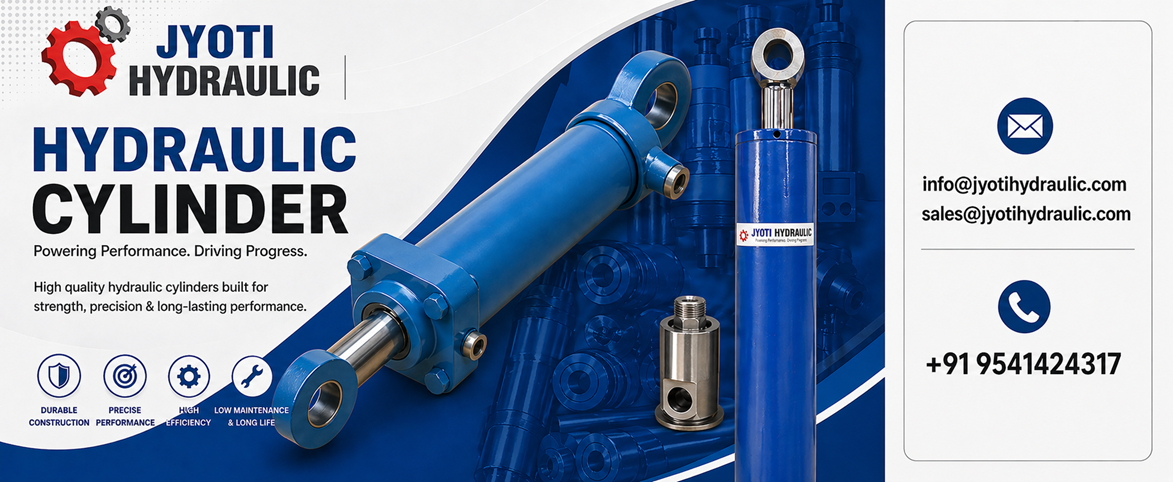
Jyoti Hydraulic understands that choosing the correct hydraulic cylinder is not simply a matter of selecting a larger bore or a longer stroke. The bore diameter and stroke length directly influence force output, speed, stability, mounting space, oil consumption, and the working life of the complete hydraulic system. A correctly sized cylinder delivers reliable linear motion with controlled performance, while an incorrectly selected unit can cause excessive energy use, rod bending, seal failure, poor cycle time, or damage to the machine structure. For industries using presses, lifting systems, material-handling equipment, construction machinery, and automated production lines, proper cylinder sizing is essential for safe and efficient operations.
Introduction to Hydraulic Cylinder Sizing
A hydraulic cylinder converts pressurized hydraulic oil into straight-line mechanical force. Although the construction may appear simple, its performance depends on several carefully matched design factors. The most important of these are bore size, rod diameter, stroke length, operating pressure, mounting arrangement, load condition, and speed requirement.
The bore is the internal diameter of the cylinder barrel. It determines the piston area and therefore the pushing force generated by the cylinder. Stroke is the total distance the piston rod travels from fully retracted to fully extended. Selecting both dimensions correctly helps equipment achieve the required motion without oversizing the hydraulic power pack or compromising machine safety.
Reliable Hydraulic Cylinder Manufacturers in India assess the application in detail instead of offering a standard size based only on load capacity. The nature of the load, direction of movement, cycle frequency, installation space, and environmental conditions all matter during selection.
Industry Overview: Why Correct Cylinder Size Matters
Hydraulic cylinders are widely used because they can generate high force in compact spaces. They support heavy-duty operations in steel plants, cement factories, automobile production units, mining equipment, agricultural machinery, marine systems, injection moulding machines, hydraulic presses, and waste-management equipment.
As industrial automation grows, customers increasingly need cylinders that provide repeatable movement, accurate positioning, and lower maintenance. A cylinder that is too small may fail to produce the necessary force. On the other hand, an oversized cylinder needs more hydraulic oil, larger pumps, increased power consumption, and stronger machine components.
This is why experienced Hydraulic Cylinder Manufacturers focus on an application-based design approach. The best hydraulic cylinder is not always the biggest one; it is the one that delivers the required force and travel with the right safety margin, speed, and structural reliability.
Understanding Hydraulic Cylinder Bore Size
The bore diameter is one of the main factors that determines how much force a hydraulic cylinder can generate.
The basic formula is:
Force = Pressure × Piston Area
The piston area depends on the bore diameter. As the bore increases, the piston area increases, allowing the cylinder to generate greater pushing force at the same hydraulic pressure.
For example, if a machine requires a high pressing force, a larger bore cylinder may be selected. However, a larger bore also requires a greater oil volume to move the piston through the same stroke. This can reduce operating speed if the pump flow rate remains unchanged.
Factors to Consider When Choosing Bore Diameter
- Required push or pull force
- Available hydraulic system pressure
- Cylinder working speed
- Pump flow capacity
- Machine-frame strength
- Space available for installation
- Safety factor for shock loads or load variation
For pushing applications, force is calculated using the full piston area. For pulling applications, the piston rod occupies some area on one side of the piston, so the available annular area is smaller. Therefore, a cylinder produces lower force while retracting than while extending at the same oil pressure.
Calculating Force Requirement
Before selecting a bore size, determine the actual force needed by the application. This should include the working load plus resistance caused by friction, inertia, inclined movement, tooling resistance, and possible shock loads.
For a vertical lifting application, the cylinder must overcome the full weight of the load. In a horizontal movement application, friction and acceleration may be more important than the actual weight. For a press, the required tonnage depends on the material, die design, pressing area, and production process.
A practical safety factor is generally added to ensure reliable operation. However, excessive safety margins should be avoided because they lead to unnecessary oversizing. Hydraulic engineers should calculate the working load accurately and select the bore accordingly.
Understanding Stroke Length
Stroke length refers to the linear distance the piston rod moves during operation. It is selected according to the travel required by the machine or process.
For example:
- A lifting table may need a stroke based on its desired lifting height.
- A hydraulic press may need enough stroke for loading, pressing, and removing the component.
- A clamping machine may require only a short stroke but high force.
- A tipping mechanism may need a long stroke to create the required angle.
The required movement should be measured carefully. It is important to include clearance for loading, unloading, tooling movement, and end-position tolerance.
Why Stroke Length Needs Careful Selection
A longer stroke may appear beneficial, but it can introduce additional engineering challenges. Long-stroke cylinders require greater attention to rod buckling, mounting alignment, guide systems, and overall machine rigidity. If a long piston rod is subjected to compression, it can bend or buckle when the load exceeds its safe limit.
For this reason, the rod diameter is often increased for long-stroke applications. Proper guides may also be required to prevent side loading on the rod and seals.
The Relationship Between Bore, Stroke, and Speed
Bore size and stroke length affect the amount of hydraulic oil required to operate the cylinder. Cylinder speed depends on oil flow rate and effective piston area.
The simplified relation is:
Speed = Oil Flow Rate ÷ Effective Piston Area
A large-bore cylinder needs more oil to move at the same speed. If rapid movement is required, the hydraulic system must provide adequate pump flow. This is especially important for high-cycle industrial machines where slow operation can reduce production output.
For example, a large-bore cylinder may generate excellent force but move slowly with a small pump. In such cases, engineers may use a higher-flow pump, a regenerative circuit, or a different cylinder arrangement to balance speed and force.
Rod Diameter and Buckling Considerations
While bore size determines cylinder force, rod diameter provides strength and stability. The piston rod must withstand tensile and compressive loads during operation.
For a long-stroke cylinder working under compression, rod buckling is a major concern. Buckling occurs when the rod bends under axial load. The risk increases when:
- Stroke length is high
- Rod diameter is small
- Load is compressive
- Mounting is not properly aligned
- Side load acts on the piston rod
- The cylinder is mounted in a pivoting arrangement
A stronger or larger-diameter rod may be required for demanding applications. Selecting suitable mountings, such as flange mounting, trunnion mounting, clevis mounting, or foot mounting, also affects cylinder stability.
Common Applications and Selection Needs
Hydraulic Presses
Presses usually require high pushing force and controlled movement. Bore size is selected according to pressing tonnage and available system pressure. Stroke is selected based on die opening, material thickness, and loading clearance.
Material Handling Equipment
Lifting tables, stackers, scissor lifts, and conveyors require cylinders designed for repeated cycles. Stroke length must match the lifting path, while bore size must safely handle the load.
Construction and Earthmoving Machinery
Excavators, loaders, and tipping equipment operate under shock loads, harsh weather, and demanding duty cycles. Cylinder selection must consider force, stroke, rod strength, seal quality, and contamination resistance.
Industrial Automation
Automated machines need consistent speed and accurate movement. Cylinders should be selected for smooth performance, controlled cushioning, and compatibility with sensors or position-feedback systems.
Marine and Steel Industry Equipment
These industries often require heavy-duty custom cylinders with corrosion-resistant surfaces, special seal arrangements, and high-load capabilities. Proper bore and stroke selection improves reliability in extreme conditions.
Benefits of Selecting the Right Hydraulic Cylinder Size
Choosing the right bore and stroke provides several important benefits:
- Improved machine safety and load-handling ability
- Better cycle time and operational efficiency
- Lower hydraulic oil and energy consumption
- Reduced risk of rod bending and seal damage
- Longer service life of pumps, valves, hoses, and cylinders
- Smooth and controlled linear motion
- Lower maintenance costs and reduced downtime
- Better compatibility with the available hydraulic power pack
A well-designed cylinder also helps maintain stable hydraulic pressure and prevents unnecessary stress on the complete system.
Buying Guide: Questions to Ask Before Ordering
Before finalizing a hydraulic cylinder, provide the manufacturer with complete application details. This allows engineers to recommend the right configuration.
Important information includes:
- Required push and pull force
- Operating pressure
- Required stroke length
- Mounting type
- Cylinder installation position
- Load direction and side-load conditions
- Required extension and retraction speed
- Duty cycle or number of operating cycles
- Available installation space
- Working environment, temperature, moisture, dust, or corrosive exposure
- Need for cushioning, sensors, or position control
- Hydraulic oil type and system connection details
Working with technically capable Hydraulic Cylinder Manufacturers in India helps businesses avoid design errors and obtain a cylinder that matches their machine precisely.
Future Trends in Hydraulic Cylinder Design
Hydraulic cylinder technology is advancing with the demand for smarter and more energy-efficient machinery. Many industries are adopting cylinders with integrated position sensors for real-time monitoring and automation. Advanced sealing systems, high-strength rod coatings, improved welding methods, and precision honing are also improving cylinder life.
Custom-designed hydraulic cylinders are becoming more common because standard models may not meet special load, space, or environmental requirements. Manufacturers are increasingly focusing on compact designs, low-friction seals, corrosion resistance, and predictive maintenance capabilities.
Conclusion
Selecting the right hydraulic cylinder bore and stroke requires more than checking a basic size chart. The ideal choice depends on force requirement, hydraulic pressure, speed, load direction, rod stability, mounting arrangement, and working environment. A properly sized cylinder delivers the required performance with better safety, energy efficiency, and service life.
When choosing from Hydraulic Cylinder Manufacturers, always share complete operating details and seek expert engineering support. This ensures that the cylinder is designed not only to work, but to work reliably for years in real industrial conditions.
Frequently Asked Questions
1. What is hydraulic cylinder bore size?
Hydraulic cylinder bore size is the internal diameter of the cylinder barrel. It determines the piston area and directly affects the pushing force generated by the cylinder.
2. How do I select the right hydraulic cylinder bore?
Calculate the required force, check the available system pressure, and select a bore size that delivers the necessary force with a suitable safety margin.
3. What is the stroke of a hydraulic cylinder?
Stroke is the total distance the piston rod travels from the fully retracted position to the fully extended position.
4. Does a longer stroke require a bigger rod diameter?
In many cases, yes. Long-stroke cylinders working under compression may need a larger rod diameter to reduce the risk of buckling.
5. Why is push force higher than pull force in a double-acting cylinder?
During retraction, the piston rod occupies part of the piston area. This reduces the effective area available for hydraulic oil pressure, resulting in lower pull force.
6. Can a larger cylinder bore affect speed?
Yes. A larger bore requires more oil volume to move the piston. If pump flow remains the same, the cylinder will move more slowly.
7. Why should I choose a custom hydraulic cylinder?
A custom cylinder is beneficial when your application has specific force, stroke, mounting, speed, temperature, or environmental requirements that standard cylinders cannot meet.
Need Expert Help Selecting Your Hydraulic Cylinder?
Jyoti Hydraulic can help you select the right bore, stroke, rod diameter, mounting, and hydraulic configuration for your application. Contact our technical team for expert consultation, custom design support, and a competitive quotation.
📧 info@jyotihydraulic.com
📞 +91 9541424317
Get in touch today to request a quotation and choose a hydraulic cylinder engineered for reliable industrial performance.


