
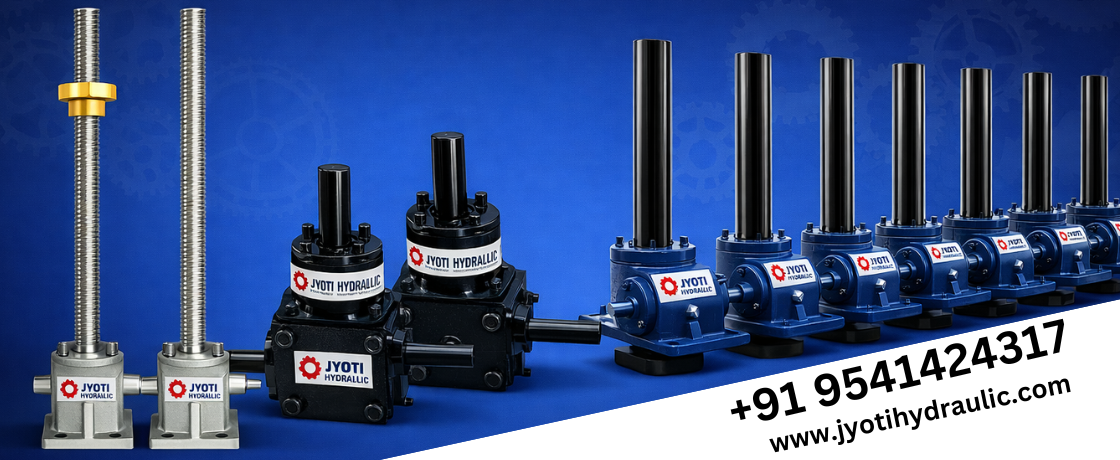
Jyoti Hydraulic delivers precision-engineered industrial lifting and motion control solutions designed for demanding automation, hydraulic, manufacturing, and heavy engineering applications. In industries where controlled lifting, accurate positioning, load holding, tilting, pushing, pulling, and synchronized movement are critical, the Worm Gear Screw Jack plays an essential role. It is a compact yet powerful mechanical actuator that converts rotary motion into linear movement with high torque, stability, and reliability.
Unlike ordinary lifting devices, a worm gear screw jack is designed for controlled industrial motion. It can lift heavy loads vertically, move machine components horizontally, adjust platforms, align equipment, regulate conveyor heights, operate gates, and support hydraulic systems where repeatable and dependable movement is required. This makes it highly valuable in automation plants, hydraulic presses, steel mills, packaging lines, machine tools, construction equipment, and material handling systems.
As industries move toward advanced automation, higher productivity, and safer load management, the demand for high-quality screw jack systems continues to grow. This is why choosing experienced Worm Gear Screw Jack Manufacturers, especially reliable Worm Gear Screw Jack Manufacturers in India, becomes important for industries that need performance, safety, customization, and long service life.
What is a Worm Gear Screw Jack?
A Worm Gear Screw Jack is a mechanical lifting and positioning device that uses a worm shaft, worm wheel, and lifting screw to generate linear motion. When rotary input is applied through a handwheel, electric motor, gearbox, coupling, or hydraulic drive arrangement, the worm shaft rotates the worm gear. This movement drives the screw mechanism, allowing the load to move upward, downward, forward, or backward depending on the design.
The system is widely used because it provides mechanical advantage. A relatively small input torque can generate a large lifting force. This makes worm gear screw jacks ideal for heavy-duty applications where direct lifting by motors or manual effort would be inefficient or unsafe.
A typical worm gear screw jack consists of:
- Worm shaft
- Worm wheel or gear
- Lifting screw
- Load nut or traveling nut
- Gear housing
- Bearings
- Seals
- Lubrication system
- Mounting base
- Optional motor, brake, encoder, limit switch, or coupling
The design may appear simple, but its engineering value lies in accurate gear geometry, screw thread quality, material strength, heat treatment, lubrication control, and load distribution. A professional Screw Jack Manufacturer in India focuses on all these elements to ensure dependable industrial performance.
Importance in Automation & Hydraulic Industries
Automation and hydraulic industries operate under conditions where movement must be controlled, repeatable, safe, and often synchronized across multiple points. A worm gear screw jack is highly suitable for such applications because it combines strength, precision, and mechanical reliability.
Role in Automation Industry
In automation, machines must move with accuracy. Even a small positioning error can affect product quality, machine alignment, production speed, and operator safety. Worm gear screw jacks are used in automated systems for height adjustment, component positioning, conveyor alignment, robotic support platforms, lifting stations, and machine bed movement.
They are especially useful where linear movement is required but hydraulic cylinders may not be ideal due to oil leakage risk, pressure variation, maintenance needs, or lack of precise mechanical holding. Screw jacks provide a cleaner, more controlled, and mechanically stable alternative.
Role in Hydraulic Industry
Hydraulic systems generate powerful force using fluid pressure, but many hydraulic applications still require mechanical support, positioning, locking, or adjustment. Worm gear screw jacks are often used with hydraulic presses, lifting tables, clamping systems, heavy machinery frames, and industrial fixtures.
In hydraulic industries, screw jacks may work as:
- Mechanical load holders
- Height adjustment devices
- Auxiliary lifting systems
- Alignment supports
- Press bed adjustment units
- Gate and valve positioning systems
Because many worm gear screw jacks have self-locking characteristics, they can hold loads safely even when power input stops. This feature is highly valuable in hydraulic and automation environments where load stability is essential.
Working Principle & Technical Insights
The working principle of a worm gear screw jack is based on torque multiplication and motion conversion.
Rotary motion enters through the worm shaft. The worm shaft meshes with the worm wheel at a right angle. Due to the worm gear reduction ratio, speed decreases while torque increases. This high torque is then transferred to the screw mechanism, producing linear motion.
Step-by-Step Working Process
- Input torque is applied by motor, gearbox, handwheel, or drive shaft.
- The worm shaft rotates inside the jack housing.
- The worm wheel receives motion from the worm shaft.
- The screw or nut mechanism converts rotational motion into linear movement.
- The attached load moves in the required direction.
- The system holds the load depending on screw design, gear ratio, friction, and braking arrangement.
Why Worm Gear Mechanism is Preferred
The worm gear arrangement offers high reduction in a compact space. This means the jack can generate high lifting force without requiring a large motor. The gear arrangement also provides smooth movement, stable operation, and controlled speed.
In many machine screw jack designs, the friction between the worm gear and screw thread creates a self-locking effect. This helps prevent the load from moving backward when input power is stopped. However, self-locking depends on screw lead angle, lubrication, vibration, load direction, and operating conditions. For high-vibration or safety-critical applications, additional brakes or locking systems are recommended.
Important Technical Parameters
When selecting a worm gear screw jack, engineers consider:
- Load capacity
- Static load rating
- Dynamic load rating
- Screw diameter
- Screw pitch
- Gear ratio
- Input torque
- Lifting speed
- Travel length
- Duty cycle
- Mounting orientation
- Operating temperature
- Environmental exposure
- Column strength
- Buckling load
- Side load limitations
- Backlash tolerance
- Lubrication method
A high-performance worm gear screw jack is not selected only by load capacity. The application’s speed, frequency, stroke length, environment, alignment, safety factor, and drive arrangement must also be evaluated.
Types of Worm Gear Screw Jacks
Different industries require different screw jack designs. The right type depends on space, load, speed, precision, duty cycle, and installation method.
1. Translating Screw Jack
In a translating screw jack, the screw moves linearly while the worm gear remains inside the fixed housing. The load is usually attached to the end of the screw. This is one of the most common designs used for lifting tables, platforms, presses, and general industrial machinery.
2. Rotating Screw Jack
In this design, the screw rotates but does not move axially. Instead, a traveling nut moves along the screw. This type is preferred where the screw must remain supported or where long travel lengths are required.
3. Keyed Screw Jack
A keyed screw jack prevents screw rotation by using an internal keyway. It is useful where the load is not guided externally and the screw must move in a straight line without rotating.
4. Machine Screw Jack
Machine screw jacks use an acme or trapezoidal thread. They are strong, rugged, and often self-locking. They are widely used in heavy-duty industrial applications where moderate speed and strong load holding are required.
5. Ball Screw Jack
Ball screw jacks use rolling ball elements between the screw and nut. They offer higher efficiency, faster speed, lower friction, and better repeatability than machine screw jacks. However, they are generally not self-locking and may require brakes for load holding.
6. Stainless Steel Screw Jack
Stainless steel screw jacks are designed for corrosive or hygienic environments such as food processing, chemical plants, marine systems, and pharmaceutical equipment.
7. Motorized Worm Gear Screw Jack
A motorized screw jack is integrated with an electric motor, gearbox, brake, encoder, or control system. It is widely used in automated lifting and positioning applications.
Industrial Applications & Use Cases
Worm gear screw jacks are used across many industries because they provide reliable linear motion under demanding working conditions.
Automation Machinery
In automation systems, screw jacks are used for machine height adjustment, robotic cell positioning, conveyor alignment, lifting stations, indexing tables, and automated assembly equipment. They help improve repeatability and reduce manual adjustment time.
Hydraulic Press Systems
In hydraulic press applications, screw jacks are used for press bed adjustment, die positioning, plate alignment, and auxiliary lifting. They help maintain mechanical stability and controlled movement during setup and operation.
Conveyor Systems
Screw jacks adjust conveyor height, angle, and alignment. This is important in packaging lines, warehouses, manufacturing plants, and material handling units where different product sizes or process heights are involved.
Steel and Metal Processing Plants
Steel mills use screw jacks for roller adjustment, furnace doors, tilting platforms, lifting frames, and heavy equipment positioning. These environments require strong materials, heat resistance, dust protection, and rugged construction.
Packaging Industry
Packaging machines require controlled movement for filling heads, sealing units, labeling systems, carton handling, and adjustable guide rails. Worm gear screw jacks provide smooth and accurate adjustment.
Power Plants
Power generation facilities use screw jacks for damper control, valve adjustment, maintenance lifting, and equipment positioning. Their ability to hold load securely makes them suitable for critical plant operations.
Water Treatment and Dam Gate Systems
Screw jacks are used in sluice gates, water control gates, valve systems, and flow regulation equipment. Their mechanical simplicity and high load capacity make them effective in outdoor and heavy-duty environments.
Renewable Energy
Solar tracking systems, wind turbine maintenance platforms, and energy equipment adjustment systems use screw jacks for controlled positioning and alignment.
Construction and Heavy Equipment
In construction machinery, screw jacks are used for leveling, stabilizing, lifting, and mechanical adjustment. Their rugged design helps them perform in harsh site conditions.
Key Benefits & Performance Advantages
A well-designed worm gear screw jack offers several performance advantages for industrial operations.
High Load Handling Capacity
Worm gear screw jacks can lift and support heavy loads with excellent stability. Their mechanical advantage allows compact units to handle significant force.
Precise Linear Movement
They provide controlled movement, making them suitable for applications requiring accurate lifting, lowering, or positioning.
Self-Locking Capability
Many machine screw jack designs can hold load without continuous power input. This improves safety and reduces energy consumption.
Compact and Space-Saving Design
The worm gear arrangement allows high torque transmission in a compact housing, making it ideal for limited-space installations.
Synchronization Capability
Multiple screw jacks can be connected using shafts, couplings, gearboxes, and motors to lift large platforms evenly.
Durable Construction
Quality screw jacks are made using strong materials, precision gears, hardened screws, and robust housings for long service life.
Cost-Effective Operation
Compared to complex hydraulic systems, screw jacks may offer lower maintenance, cleaner operation, and easier installation in many applications.
Selection Guide – How to Choose the Right Screw Jack
Selecting the right worm gear screw jack is critical for safety, performance, and service life.
1. Define Load Requirements
Calculate static load, dynamic load, shock load, and safety factor. Never select a screw jack based only on approximate load estimation.
2. Check Travel Length
The required stroke length affects screw size, buckling strength, guide support, and overall system design.
3. Determine Speed
Higher lifting speed may require ball screw jacks, special gear ratios, or higher-power drive systems.
4. Understand Duty Cycle
For frequent operation, heat generation and lubrication become important. Continuous-duty applications need careful design.
5. Evaluate Mounting Position
Screw jacks may be mounted vertically, horizontally, inverted, or at an angle. Mounting orientation affects lubrication and load behavior.
6. Consider Environmental Conditions
Dust, moisture, chemicals, temperature, and corrosion can affect performance. Protective boots, seals, coatings, or stainless steel construction may be required.
7. Review Control Requirements
Automated applications may need motors, encoders, limit switches, sensors, PLC integration, brakes, and overload protection.
8. Consult Experienced Manufacturers
Working with reliable Worm Gear Screw Jack Manufacturers in India helps ensure correct sizing, customization, material selection, and long-term performance.
Maintenance & Safety Tips
Proper maintenance extends the life of a worm gear screw jack and prevents unexpected breakdowns.
Lubrication
Regular lubrication reduces friction, heat, and wear. Use the recommended grease or oil based on load, speed, and temperature.
Alignment Inspection
Misalignment can cause uneven loading, screw bending, gear wear, and premature failure. Ensure proper alignment during installation.
Load Limit Control
Never exceed the rated capacity. Overloading can damage threads, gears, bearings, and housing.
Check for Backlash
Excessive backlash may indicate thread wear, gear wear, or poor lubrication.
Protect from Contamination
Dust, metal particles, moisture, and chemicals can reduce service life. Use protective covers or bellows where necessary.
Inspect Fasteners and Mountings
Loose mounting bolts can create vibration, uneven loading, and structural damage.
Use Safety Accessories
For critical applications, use brakes, limit switches, load sensors, mechanical stops, and overload protection systems.
Future Trends & Industrial Innovations
The future of worm gear screw jack technology is moving toward smarter, more efficient, and application-specific systems.
Smart Screw Jack Systems
Modern screw jacks are increasingly integrated with sensors, encoders, load monitoring devices, and PLC control systems for real-time performance tracking.
Industry 4.0 Integration
Automation plants now require screw jacks that can communicate with centralized control systems. This helps monitor position, load, wear, and maintenance requirements.
Energy-Efficient Designs
Improved gear profiles, better lubrication, advanced coatings, and optimized screw geometry are helping reduce friction and energy consumption.
Customized Lifting Solutions
Industries are demanding application-specific screw jacks for special loads, harsh environments, compact spaces, and synchronized multi-jack systems.
Advanced Materials
High-strength alloy steels, stainless steels, surface treatments, and anti-corrosion coatings are improving durability in challenging industrial conditions.
Why Jyoti Hydraulic is a Reliable Choice
Jyoti Hydraulic focuses on delivering durable, efficient, and application-focused screw jack solutions for automation, hydraulic, and heavy-duty industrial requirements. As a trusted name among Worm Gear Screw Jack Manufacturers, the company understands that every industry has unique load, speed, mounting, and environmental demands.
Jyoti Hydraulic provides:
- Precision-engineered worm gear screw jacks
- Customized lifting and positioning solutions
- Heavy-duty construction for industrial use
- Reliable performance in automation and hydraulic systems
- Technical guidance for product selection
- Quality-focused manufacturing practices
- Customer-oriented support and consultation
For companies searching for dependable Worm Gear Screw Jack Manufacturers in India or a professional Screw Jack Manufacturer in India, Jyoti Hydraulic offers practical engineering expertise and industry-ready solutions.
Conclusion
The Worm Gear Screw Jack is one of the most practical and reliable mechanical actuators used in automation and hydraulic industries. Its ability to convert rotary motion into powerful linear movement makes it valuable for lifting, lowering, pushing, pulling, tilting, aligning, and positioning heavy loads.
From automated production lines to hydraulic presses, steel plants, conveyor systems, power plants, construction machinery, and water control gates, worm gear screw jacks deliver strength, precision, safety, and long-term dependability.
Choosing the right screw jack requires technical understanding of load capacity, travel length, speed, duty cycle, mounting style, environment, and control requirements. Partnering with experienced manufacturers ensures better performance, safer operation, and reduced downtime.
Jyoti Hydraulic continues to serve industries with robust and customized screw jack solutions built for modern industrial challenges.
FAQs About Worm Gear Screw Jack
1. What is a Worm Gear Screw Jack?
A worm gear screw jack is a mechanical actuator that converts rotary motion into linear motion for lifting, lowering, pushing, pulling, or positioning loads.
2. Where is a Worm Gear Screw Jack used?
It is used in automation machinery, hydraulic presses, conveyor systems, steel plants, packaging machines, dam gates, lifting platforms, and heavy engineering equipment.
3. Why are worm gear screw jacks used in automation?
They provide accurate positioning, smooth movement, load stability, and easy integration with motors, gearboxes, sensors, and PLC systems.
4. Are worm gear screw jacks suitable for hydraulic industries?
Yes. They are widely used in hydraulic industries for mechanical support, press bed adjustment, platform lifting, alignment, and load holding.
5. What is the difference between machine screw jack and ball screw jack?
A machine screw jack is rugged and often self-locking, while a ball screw jack offers higher efficiency, faster movement, and better precision but usually requires a brake for load holding.
6. Can multiple screw jacks work together?
Yes. Multiple screw jacks can be mechanically or electronically synchronized to lift large platforms or structures evenly.
7. How do I choose the right screw jack?
You should consider load capacity, travel length, speed, duty cycle, mounting position, environment, safety factor, and control requirements.
8. Why choose Jyoti Hydraulic?
Jyoti Hydraulic offers durable, customized, and precision-engineered screw jack solutions for automation, hydraulic, and heavy industrial applications.
Contact Jyoti Hydraulic for Expert Screw Jack Solutions
Looking for a reliable Worm Gear Screw Jack for your automation or hydraulic application? Need expert guidance from experienced Worm Gear Screw Jack Manufacturers in India?
Connect with Jyoti Hydraulic today for technical consultation, product selection support, customized solutions, and competitive quotations.
📧 Email: info@jyotihydraulic.com
📞 Phone: +91 9541424317
Contact Jyoti Hydraulic now to request a quotation, discuss your industrial requirements, and get expert consultation for high-performance screw jack solutions.


