
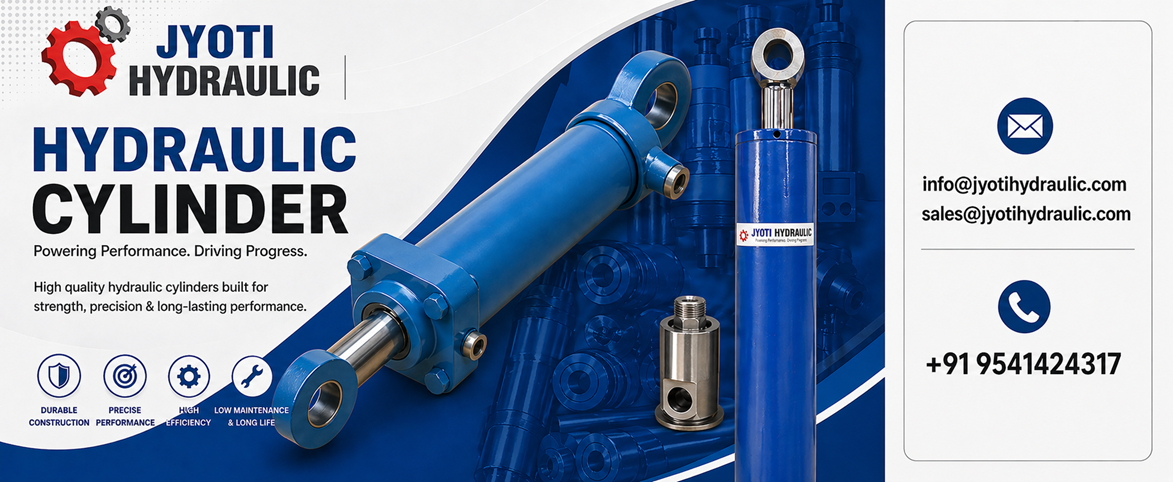
Jyoti Hydraulic designs hydraulic cylinders for press machines and industrial automation systems where force, movement control, and operational reliability are essential. From forming metal components to positioning heavy assemblies, a correctly selected hydraulic cylinder directly influences machine accuracy, cycle time, energy consumption, and maintenance requirements. Therefore, manufacturers should select a cylinder based on actual working conditions rather than choosing only by bore size or price.
Role of Hydraulic Cylinders in Modern Industry
Hydraulic cylinders convert pressurized hydraulic fluid into controlled linear movement. Their ability to generate high force within a relatively compact structure makes them suitable for machines where pneumatic or electric actuators may not provide sufficient load capacity.
In press machines, hydraulic cylinders generate the force required for bending, punching, stamping, deep drawing, straightening, moulding, and component assembly. In industrial automation, they are commonly used for clamping, lifting, pushing, tilting, feeding, positioning, and transferring materials between production stages.
A dependable Hydraulic Cylinder Manufacturer in India must understand both cylinder construction and the machine in which the cylinder will operate. Factors such as load direction, operating speed, pressure variation, side load, duty cycle, oil temperature, and installation space can significantly affect cylinder performance.
Hydraulic Cylinders for Press Machines
Press applications place considerable stress on hydraulic cylinders. The cylinder may need to generate high force, hold a load at a fixed position, and repeat the same movement throughout long production shifts.
A press cylinder should have a strong barrel, accurately machined piston, hardened piston rod, suitable guide arrangement, and seals selected for the working pressure and temperature. Poor alignment between the cylinder and press frame can create side loading, resulting in uneven seal wear, rod scoring, internal leakage, and premature failure.
For press machines, the cylinder should be selected according to:
- Required pressing force
- Maximum system pressure
- Working and return stroke
- Approach and pressing speed
- Available mounting space
- Frequency of operation
- Load-holding requirement
- Type of material being processed
Using a larger cylinder than necessary may increase oil consumption and slow down the machine. An undersized cylinder, however, may operate close to its maximum pressure and experience frequent seal or structural failure.
Double Acting Cylinders in Automation
A double acting cylinder receives hydraulic pressure on both sides of the piston. Pressure extends the piston rod during one part of the cycle and retracts it during the return movement. This provides better control than a single acting design, which normally depends on gravity, an external load, or a spring for retraction.
Experienced Double Acting Hydraulic Cylinder Manufacturers design these cylinders for applications requiring controlled movement in both directions. They are widely used in automated fixtures, material handling systems, hydraulic presses, assembly stations, conveyor mechanisms, lifting devices, and machine loading equipment.
The main advantages of double acting cylinders include controlled return movement, faster cycle completion, consistent positioning, and suitability for repetitive automated operations.
Important Technical Considerations
The bore diameter determines the force generated by the cylinder at a given pressure. The stroke defines the total distance travelled by the piston rod. Rod diameter is equally important because a long or insufficiently supported rod may bend or buckle under compression.
The selected cylinder must also provide adequate safety margins. Machines rarely operate under perfectly stable conditions. Pressure spikes, shock loads, misalignment, contamination, and temperature changes can increase stress on internal parts.
Seal selection should be based on hydraulic fluid, operating pressure, temperature, speed, and duty cycle. High-quality sealing reduces internal bypass, prevents external leakage, and helps the cylinder maintain force during pressing or clamping operations.
Mounting style must allow the cylinder to transfer force without introducing unnecessary side loads. Common arrangements include flange, clevis, trunnion, foot, and threaded mounting.
How to Choose the Right Hydraulic Cylinder
Before requesting a quotation, buyers should prepare clear application details. These should include the required force, system pressure, stroke length, operating speed, mounting orientation, duty cycle, hydraulic oil type, and environmental conditions.
When comparing Industrial Hydraulic Cylinder Manufacturers, buyers should also evaluate:
- Material and barrel specifications
- Piston rod hardness and surface finish
- Seal quality and availability
- Welding and machining accuracy
- Pressure-testing procedure
- Customisation capability
- Technical support
- Availability of replacement parts
The lowest-priced cylinder may not provide the lowest operating cost. Frequent leakage, seal replacement, rod damage, or machine downtime can make an inexpensive cylinder costly over its service life.
Benefits of a Properly Engineered Cylinder
A correctly designed hydraulic cylinder provides smooth motion, stable force, improved machine repeatability, and longer maintenance intervals. It can also reduce energy loss by minimizing internal leakage and unnecessary pressure requirements.
For automated plants, reliable cylinder performance supports predictable cycle times and consistent product quality. In press machines, accurate force generation helps reduce rejected parts and prevents damage to tooling or workpieces.
Future of Hydraulic Cylinders in Automation
Hydraulic cylinders are increasingly being integrated with position sensors, pressure monitoring devices, proportional valves, and programmable control systems. These technologies allow operators to monitor movement, force, and cylinder condition in real time.
Sensor-based maintenance can identify seal leakage, pressure loss, abnormal movement, or increased cycle time before a major breakdown occurs. Future hydraulic systems will focus on energy efficiency, intelligent monitoring, compact construction, and better integration with automated production lines.
Conclusion
Hydraulic cylinders remain essential for press machines and general industrial automation because they combine high force with controlled linear movement. However, cylinder performance depends on correct sizing, quality materials, proper sealing, accurate machining, and suitable installation.
Choosing an experienced manufacturer helps businesses avoid premature failures and obtain a cylinder that matches the machine’s actual operating conditions. Jyoti Hydraulic provides standard and customised hydraulic cylinder solutions for pressing, lifting, clamping, positioning, and automated manufacturing applications.
Frequently Asked Questions
What information is needed to select a hydraulic cylinder?
The required force, working pressure, stroke length, operating speed, mounting type, duty cycle, oil temperature, and available installation space should be provided.
Why are double acting cylinders preferred in automation?
They use hydraulic pressure for both extension and retraction, providing controlled movement, faster cycles, and better repeatability.
Can hydraulic cylinders be customised?
Yes. Bore, stroke, rod diameter, mounting style, port position, seal material, working pressure, and construction materials can be customised.
What causes premature hydraulic cylinder failure?
Common causes include side loading, contaminated oil, incorrect seals, poor alignment, pressure spikes, rod damage, and inadequate maintenance.
How can cylinder service life be improved?
Maintain clean hydraulic fluid, inspect seals and rods regularly, avoid overloading, ensure correct alignment, and follow recommended pressure limits.
Get the Right Hydraulic Cylinder for Your Machine
Need assistance selecting a hydraulic cylinder for a press machine or automated production system? Contact Jyoti Hydraulic for application evaluation, customised recommendations, and a competitive quotation.
📞 +91 9541424317
Contact our technical team today to request a quotation or get expert consultation for your hydraulic cylinder requirement.


