
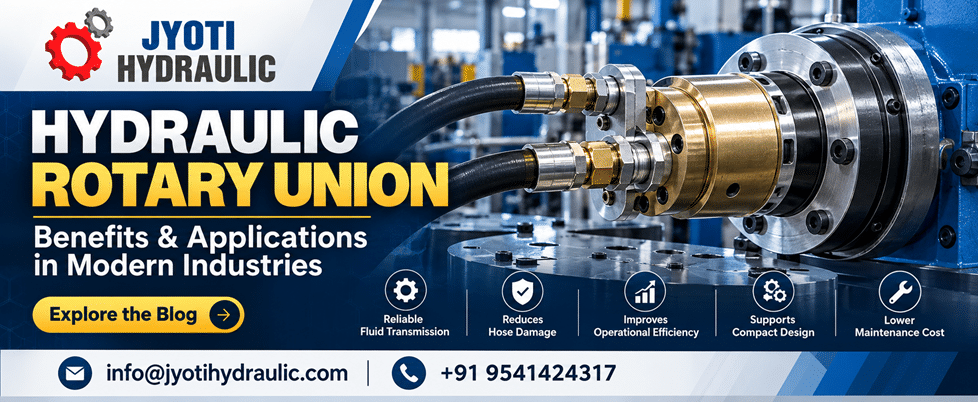
Jyoti Hydraulic understands that modern industrial machinery depends on more than powerful motors and advanced automation. Reliable fluid transmission is equally important, particularly in equipment where hydraulic pressure must be maintained while mechanical components rotate. A Hydraulic Rotary Union makes this possible by transferring pressurized fluid between stationary and rotating machine parts without twisting connected hydraulic hoses. From construction machinery and industrial automation to precision manufacturing systems, this compact engineering component helps maintain controlled hydraulic movement, operational safety, and equipment reliability.
Understanding the Role of Hydraulic Rotary Unions in Modern Industries
Industrial machinery increasingly combines rotational movement with hydraulic actuation. Conventional hydraulic connections cannot accommodate continuous rotation without introducing hose twisting, mechanical strain, or eventual connection failure.
A hydraulic rotary union, also called a hydraulic swivel joint, provides a controlled fluid passage across this rotating interface. It allows hydraulic oil to reach rotating cylinders, motors, and other actuators while the connected assembly moves independently of the stationary supply.
This technology is particularly valuable in automated production lines, heavy equipment, rotary indexing systems, and material-handling machinery, where uninterrupted hydraulic pressure directly influences operational accuracy and productivity.
Technical Insights: How Does a Hydraulic Rotary Union Work?
A hydraulic rotary union operates through a precision-engineered arrangement of stationary and rotating components. Its main elements generally include a housing, rotor or shaft, fluid passages, sealing elements, and, where required, supporting bearings.
Pressurized hydraulic fluid enters through a stationary port and travels through an internal channel toward the rotating outlet. Dynamic seals separate the pressurized fluid from the external environment while accommodating relative rotation.
In multi-passage designs, independent internal channels permit simultaneous transmission through multiple hydraulic circuits.
Several engineering factors determine performance:
Pressure resistance: The housing, seals, and internal components must withstand normal operating pressure and transient pressure spikes without excessive deformation or leakage.
Dynamic sealing: PTFE-based sealing elements, engineered polymers, and application-specific elastomers may be selected according to hydraulic fluid compatibility, temperature, pressure, and rotational speed.
Rotational speed: Higher RPM increases sliding velocity and frictional heating at the sealing interface. Consequently, pressure and speed ratings must be evaluated together.
Flow efficiency: Appropriate passage diameters reduce unnecessary pressure losses, helping hydraulic actuators receive adequate flow.
Bearing alignment: In bearing-supported designs, correct rotor alignment minimizes vibration, uneven seal loading, and premature wear.
An important engineering consideration is that a union rated for high pressure under stationary conditions may not support that same pressure at its maximum rotational speed. Manufacturers must verify the complete operating combination.
Major Applications of Hydraulic Rotary Unions
1. Construction and Earthmoving Equipment
Excavators and other rotating construction machines use hydraulic swivel arrangements to transfer pressurized oil between stationary and rotating assemblies. This enables controlled movement without twisting hydraulic hoses during upper-structure rotation.
2. CNC Machines and Rotary Fixtures
Hydraulically operated rotary tables and machining fixtures require stable pressure for clamping and positioning workpieces. Properly selected rotary unions provide fluid transmission during indexing or continuous rotation, supporting repeatable machining operations.
3. Steel and Metal Processing
Steel processing equipment, rotary handling systems, and automated coil-processing machinery may use hydraulic rotary unions to operate rotating clamping, gripping, or positioning mechanisms.
Their reliability helps maintain controlled material movement under demanding industrial conditions.
4. Material Handling and Industrial Automation
Rotary manipulators, automated assembly systems, and specialized handling equipment frequently require hydraulic power across moving interfaces.
Multi-channel rotary unions can accommodate separate actuator circuits, reducing complicated external hose arrangements.
5. Mining and Drilling Machinery
Mining equipment and drilling installations operate under high mechanical loads, vibration, and contamination exposure. Suitable hydraulic swivel joints support fluid transmission to rotating hydraulic mechanisms while minimizing hose-related restrictions.
Key Benefits of Hydraulic Rotary Unions
Reduced hose damage: By eliminating repeated twisting of hydraulic connections, rotary unions help prevent hose fatigue and premature replacement.
Improved operational continuity: Reliable fluid transfer supports consistent hydraulic actuation during machine rotation.
Compact equipment design: Integrated fluid passages reduce the need for complicated external piping arrangements.
Better pressure control: Correct passage sizing and effective sealing help maintain pressure at connected hydraulic components.
Lower maintenance requirements: Properly engineered unions can reduce maintenance associated with damaged hoses and leaking rotating connections.
Greater design flexibility: Single-passage and multi-passage configurations allow engineers to accommodate different hydraulic circuits and machine layouts.
However, these advantages depend on correct selection, installation, fluid cleanliness, and maintenance practices.
How to Select the Right Hydraulic Rotary Union
Choosing a suitable component requires more than comparing product dimensions or purchase prices.
Start by identifying the operating pressure, including maximum pressure spikes. Then determine whether the machine requires continuous rotation, intermittent indexing, or oscillating movement.
Evaluate the hydraulic fluid’s viscosity, operating temperature, and compatibility with the proposed sealing materials.
Next, calculate the required flow rate and identify the number of independent passages. Insufficient passage diameter can create excessive pressure drop, while inadequate internal sealing may permit cross-port leakage.
Mounting dimensions, thread specifications, shaft alignment, vibration exposure, and filtration quality must also be considered.
When comparing Hydraulic Rotary Union Manufacturers, buyers should prioritize engineering support, application-specific configurations, documented operating limits, and replacement-part availability.
Jyoti Hydraulic offers hydraulic rotary union solutions and technical assistance for industrial requirements. Sharing complete machine specifications helps determine an appropriate configuration rather than relying on general product ratings.
Future Trends in Hydraulic Rotary Union Technology
As manufacturing equipment becomes more automated, hydraulic rotary union design is evolving toward compact construction, improved sealing materials, and more application-specific configurations.
Advanced surface finishes and wear-resistant sealing systems can help reduce friction and extend component service life.
Growing adoption of condition monitoring may also encourage equipment manufacturers to integrate pressure, temperature, and leakage monitoring around critical rotary fluid connections.
Another emerging priority is energy efficiency. Optimized internal flow passages and reduced frictional resistance can help limit unnecessary hydraulic power losses.
Conclusion
A hydraulic rotary union is a critical connection between rotational movement and hydraulic power transmission. Its ability to deliver pressurized fluid across moving interfaces makes it valuable in construction equipment, automated machinery, metal processing, and industrial handling systems.
Long-term performance depends on selecting the correct pressure rating, sealing arrangement, fluid passages, and mounting configuration.
For industries seeking dependable hydraulic components, Jyoti Hydraulic provides an engineering-focused approach to identifying suitable rotary union solutions for demanding applications.
Frequently Asked Questions (FAQs)
Q1. What is the main purpose of a hydraulic rotary union?
A hydraulic rotary union transfers pressurized hydraulic fluid between stationary and rotating machine components, allowing hydraulic systems to operate without twisting connected hoses.
Q2. Can hydraulic rotary unions operate under high pressure?
Yes. High-pressure configurations are available, but permissible pressure depends on the model, sealing arrangement, rotational speed, temperature, and operating conditions.
Q3. What is the difference between single-passage and multi-passage rotary unions?
A single-passage union provides one fluid channel. A multi-passage union contains separate channels for transferring fluid through multiple hydraulic circuits within one rotating assembly.
Q4. What causes hydraulic rotary union failure?
Common causes include contaminated hydraulic oil, unsuitable seals, excessive operating pressure, incorrect alignment, overheating, and operation beyond the specified speed limits.
Q5. How can buyers improve rotary union service life?
Maintain fluid cleanliness, follow correct mounting procedures, prevent excessive mechanical loading, and select a union with suitable pressure, speed, and temperature ratings.
Looking for a Reliable Hydraulic Rotary Union? Contact Jyoti Hydraulic
Improve your machinery’s hydraulic performance with a rotary union selected for your operating conditions.
Whether you need a new industrial hydraulic rotary union, a customized configuration, or assistance selecting the right component, Jyoti Hydraulic is ready to discuss your requirements.
Contact us today to request a quotation or get expert technical consultation.
📧 Email: info@jyotihydraulic.com
📞 Call: +91 9541424317
Jyoti Hydraulic – Precision Hydraulic Solutions for Modern Industrial Applications.


