
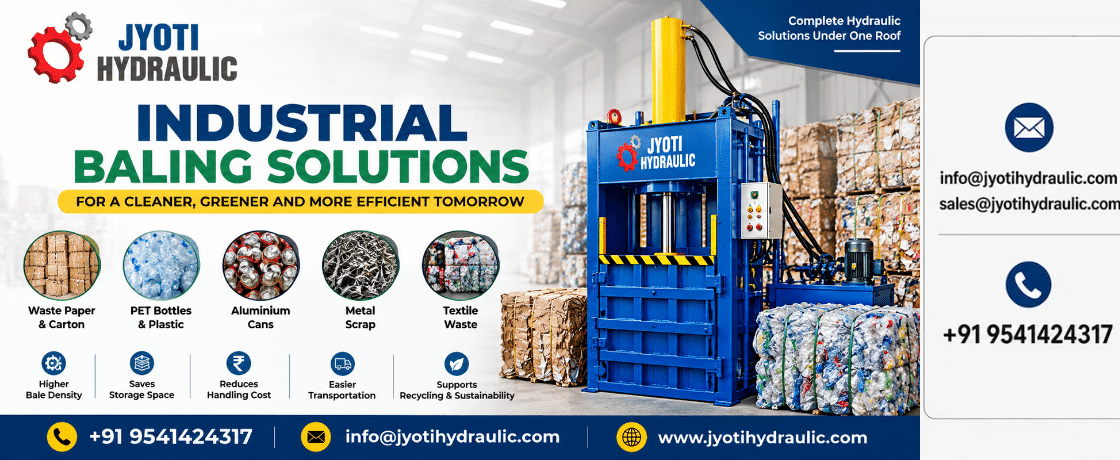
Jyoti Hydraulic delivers practical hydraulic baling solutions for industries looking to manage scrap efficiently, reduce material handling costs, and improve recycling operations. As a Scrap Baling Press Machine Manufacturer in Faridabad, the company focuses on equipment designed to convert loose industrial waste into compact, manageable bales.
For manufacturers, scrap dealers, and recycling facilities, waste management is no longer limited to collecting unwanted material. It involves controlling storage requirements, improving transportation efficiency, and recovering value from recyclable resources. A properly selected Scrap Baling Press Machine helps achieve these objectives without disrupting daily production activities.
Industrial Scrap Management: Why Baling Technology Matters
Faridabad is an important manufacturing centre within the Delhi-NCR industrial region, supporting automotive components, fabrication, engineering, packaging, and metalworking businesses. These operations generate different categories of scrap, including sheet metal offcuts, aluminium pieces, cardboard, plastic packaging, and production rejects.
Loose scrap creates operational difficulties. Irregularly shaped materials occupy excessive floor space, require repeated handling, and increase transportation expenses.
Hydraulic baling technology addresses these challenges through controlled compression. Instead of transporting loosely accumulated material, businesses can prepare compact bales that are easier to count, stack, store, and dispatch.
For recycling businesses, consistent bale dimensions also improve inventory management and downstream material handling.
Technical Working of a Scrap Baling Press Machine
A hydraulic scrap baler converts hydraulic energy into mechanical compression force. Its performance depends on the interaction between the cylinder, hydraulic power pack, compression chamber, structural frame, and control system.
Hydraulic Compression Mechanism
The electric motor drives a hydraulic pump that supplies pressurised oil to the cylinder. The piston moves the compression platen, applying force to material loaded inside the chamber.
Hydraulic force is determined by operating pressure and effective piston area. However, actual compression performance also depends on material resistance, equipment rigidity, and cylinder stroke.
During operation, the machine generally follows this sequence:
- Scrap is loaded into the compression chamber.
- The hydraulic cylinder advances the pressing platen.
- Material is compressed to the required dimensions.
- The compressed material is secured where binding is required.
- The platen retracts, allowing safe bale removal or ejection.
The arrangement varies between vertical, horizontal, and multi-action balers.
Important Engineering Considerations
Compression capacity: Hydraulic press force is commonly expressed in tonnes-force. Higher force may be necessary for difficult materials, but tonnage alone does not determine productivity.
Bale density: Density depends on material weight divided by finished bale volume. Greater compression is useful only when the bale remains stable during handling.
Cycle time: Chamber filling, compression, binding, and ejection together determine actual hourly output.
Machine construction: Reinforced frames, properly aligned cylinders, durable guide surfaces, and suitable welding quality help withstand repeated loading.
Hydraulic reliability: Correct filtration, pressure relief protection, oil temperature control, and seal maintenance support consistent operation.
Jyoti Hydraulic’s published product range includes different press capacities and machine configurations, allowing selection according to specific material-handling requirements.
Industrial Applications of Hydraulic Scrap Balers
A Scrap Baling Press Machine can support several industrial waste streams when configured for the intended material.
- Metal fabrication units: Compacting suitable sheet offcuts, light metal scrap, and manufacturing rejects.
- Automotive component manufacturers: Consolidating segregated production scrap for recycling.
- Plastic recycling plants: Compressing PET bottles and compatible plastic waste.
- Packaging industries: Processing cardboard, corrugated sheets, and paper waste.
- Textile industries: Reducing the volume of fabric offcuts and suitable textile residues.
- Scrap processing yards: Preparing sorted recyclable materials for storage and transportation.
Importantly, a baler intended for cardboard or PET bottles should not automatically be used for heavy steel scrap. Chamber design, force requirements, and wear resistance differ significantly.
Key Benefits of Installing a Scrap Baling Press Machine
Better Storage Utilisation
Compressed material occupies less space than loose scrap, helping businesses maintain organised production and storage areas.
Lower Transportation Costs
Dense, consistently sized bales can improve vehicle loading efficiency and reduce unnecessary transportation movements.
Improved Scrap Handling
Compact bales simplify material movement, stock identification, weighing, and dispatch preparation.
Increased Recycling Efficiency
Properly segregated and compressed scrap is easier to introduce into recycling supply chains. Material cleanliness and grading remain important for achieving better recovery value.
Improved Workplace Organisation
Designated baling areas reduce scattered waste accumulation and support systematic housekeeping. Equipment guarding and safe operating procedures remain essential.
How to Select the Right Scrap Baling Press Machine
Choosing equipment solely on the basis of price or advertised tonnage can result in unnecessary maintenance expenses and inadequate production capacity.
Experienced Scrap Baling Press Machine Manufacturers should evaluate several practical requirements before recommending a configuration.
1. Identify the scrap material: Determine whether the machine will process mild steel, aluminium, plastic, cardboard, or other materials. Note material thickness, shape, contamination, and bulk density.
2. Calculate daily scrap generation: Estimate average and peak waste volumes per shift. Select equipment capable of handling production peaks without excessive waiting time.
3. Specify bale requirements: Confirm acceptable bale dimensions, target weights, and handling arrangements with the downstream recycler or scrap buyer.
4. Assess available space: Vertical balers can suit limited floor areas, while horizontal and automatic systems may be more practical for higher-throughput operations.
5. Evaluate operating costs: Consider installed motor power, actual operating time, maintenance accessibility, consumables, and expected hydraulic component life.
6. Verify safety arrangements: Ask about emergency stops, guarding, interlocks, overload protection, operating instructions, and safe maintenance isolation.
Before finalising a machine, request a trial using representative scrap whenever practical. This reveals more about bale quality and cycle performance than catalogue specifications alone.
Future Trends in Industrial Scrap Baling
Industrial waste management is gradually moving towards more measurable and automated operations.
Modern baling systems increasingly incorporate programmable controls, improved hydraulic power management, automated material feeding, and production monitoring.
Energy-efficient pump arrangements and condition-based maintenance can also help reduce unnecessary machine downtime.
For manufacturers in Faridabad, these developments support a transition from basic waste compression towards more controlled material recovery operations.
Why Consider Jyoti Hydraulic in Faridabad?
Jyoti Hydraulic offers hydraulic baling equipment for industrial and recycling requirements, including options suited to different materials and operating capacities.
Its Faridabad manufacturing presence offers a practical point of contact for discussing machine dimensions, hydraulic capacity, application suitability, and customised requirements.
The right purchasing decision should involve matching the equipment to actual waste characteristics rather than choosing a machine based on maximum pressing force alone.
Conclusion
A reliable Scrap Baling Press Machine plays an important role in reducing waste-handling difficulties while improving industrial recycling efficiency.
For businesses evaluating Scrap Baling Press Machine Manufacturers in Faridabad, the priority should be suitable engineering, consistent compression performance, operational safety, and dependable technical support.
Jyoti Hydraulic provides an option for businesses seeking application-focused hydraulic baling solutions and informed equipment selection.
Frequently Asked Questions (FAQs)
1. What is a Scrap Baling Press Machine used for?
It compresses compatible industrial scrap into compact bales for easier storage, handling, transportation, and recycling.
2. Which materials can hydraulic baling machines process?
Depending on machine design, they can process suitable metal scrap, PET bottles, paper, cardboard, textile waste, and other recyclable materials.
3. What pressing capacity should an industrial scrap baler have?
The required capacity depends on material properties, chamber dimensions, bale density targets, and daily throughput. A technical assessment is necessary before selecting the press force.
4. Is a vertical or horizontal baler better?
Vertical balers are often suitable for smaller batches and limited floor space. Horizontal machines can support greater throughput and more automated material feeding.
5. How can hydraulic baler maintenance costs be reduced?
Regular oil inspection, filtration maintenance, cylinder seal checks, lubrication, and timely attention to hydraulic leakage help prevent avoidable failures.
6. Can Jyoti Hydraulic provide customised baling solutions?
Jyoti Hydraulic advertises standard and customised baling equipment. Buyers should discuss material type, bale size, output requirements, and configuration before requesting a final specification.
Get the Right Industrial Baling Solution from Jyoti Hydraulic
Make industrial scrap handling more efficient with a hydraulic baling machine selected for your actual production needs.
Contact Jyoti Hydraulic today to request a quotation, discuss machine specifications, or get expert consultation for your industrial waste management requirements.
📧 Email: info@jyotihydraulic.com
📞 Call: +91 9541424317
Request your quotation today and take the next step towards organised, efficient, and cost-effective scrap management.


