
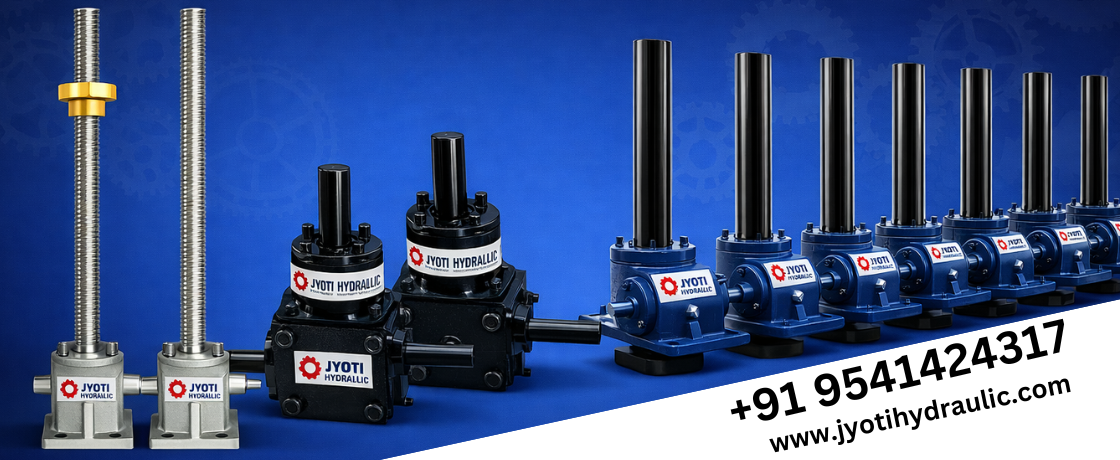
Jyoti Hydraulic understands that industrial lifting is not simply about moving a load upward or downward—it is about controlling heavy loads safely, accurately, and consistently under demanding working conditions. In applications where hydraulic or pneumatic systems may not be the most practical option, a Worm Gear Screw Jack provides a highly dependable mechanical solution. By combining a worm-and-wheel reduction mechanism with a precision screw, this lifting device converts rotary motion into controlled linear movement, making it suitable for machinery positioning, equipment lifting, platform adjustment, material handling, and synchronized industrial systems.
Introduction
Industrial machines often require much more than basic lifting capability. A component may need to move only a few millimetres, remain in the same position for an extended period, or operate repeatedly while supporting a substantial load. Such requirements demand a mechanism capable of translating rotational input into smooth, predictable, and mechanically controlled linear motion.
This is where worm gear screw jacks have established an important role.
Unlike high-speed lifting systems, screw jacks are generally selected when load capacity, positioning accuracy, mechanical simplicity, and controlled movement matter more than rapid travel. They can be powered manually or integrated with electric motors, gearboxes, shafts, couplings, and control systems depending on the installation.
For engineers, plant operators, OEMs, and machine designers, understanding the working principle of a worm gear screw jack makes it easier to select the correct configuration and achieve dependable service life.
Industry Overview: Why Screw Jacks Remain Important
Modern factories depend heavily on automation, but mechanical lifting systems continue to play an essential role within automated equipment.
Industries such as steel processing, packaging, automotive manufacturing, material handling, pharmaceuticals, food processing, paper production, construction equipment, and heavy engineering regularly require linear positioning mechanisms.
A screw jack can provide this movement without requiring a complicated hydraulic power pack or pneumatic infrastructure.
The industrial value of a worm gear screw jack comes primarily from its ability to handle substantial axial loads while offering relatively precise movement.
For example, a manufacturing fixture may need to be raised to a specific working height. A conveyor may require controlled height adjustment. A heavy machine component may need to be aligned during assembly. Several lifting points may also need to operate simultaneously.
In such applications, mechanical screw jack arrangements can provide an effective solution.
Reliable Worm Gear Screw Jack Manufacturers therefore focus not only on rated lifting capacity but also on gear geometry, screw material, lubrication, bearing selection, housing rigidity, backlash, safety factor, and application duty cycle.
What Is a Worm Gear Screw Jack?
A worm gear screw jack is a mechanical actuator designed to convert rotary input into linear lifting or lowering motion.
Its major components typically include:
- Worm shaft
- Worm wheel
- Lifting screw
- Nut mechanism
- Bearings
- Gear housing
- Input shaft
- Lubrication arrangement
- Seals and protective components
Depending on the design, the screw may move axially while the nut remains stationary, or the screw may rotate while a travelling nut moves along its length.
Although these configurations differ mechanically, the basic principle remains the same: rotary energy enters through the worm shaft, the worm gear arrangement increases torque and reduces speed, and the screw mechanism converts that rotation into linear travel.
Working Principle of a Worm Gear Screw Jack
To understand the mechanism properly, it helps to follow the movement of power through the jack.
- Rotary Input Is Supplied
The operating cycle begins when rotational force is applied to the worm shaft.
The input may come from:
- A handwheel
- Electric motor
- Geared motor
- Servo motor
- Mechanical transmission shaft
- Chain or belt arrangement
Manual operation may be adequate for occasional adjustments, while motorized configurations are generally preferred for repetitive industrial duty.
- The Worm Shaft Drives the Worm Wheel
The worm resembles a threaded shaft. As it rotates, its teeth engage with the teeth of the worm wheel.
The worm-and-wheel arrangement provides significant speed reduction.
For example, the motor or handwheel may rotate many times while the worm wheel completes only a small number of revolutions.
This reduction creates an important mechanical advantage: lower output speed with increased torque.
That characteristic enables a relatively modest motor input to operate a lifting mechanism carrying a much heavier load, provided the jack is properly sized.
- The Worm Wheel Transfers Motion to the Screw Mechanism
The worm wheel is mechanically connected to the screw or nut arrangement.
Rotation of the worm wheel therefore causes relative movement between the screw and nut.
The screw thread converts rotary movement into axial displacement.
A simple way to understand this is to consider a nut rotating around a threaded bolt. Depending on which component is prevented from rotating, either the screw or the nut moves linearly.
This principle forms the heart of the screw jack.
- The Load Moves Upward or Downward
As the screw-and-nut mechanism operates, the lifting member moves in a straight line.
Reversing the direction of input rotation reverses the direction of linear movement.
This allows controlled lifting, lowering, pushing, pulling, opening, closing, tilting, or positioning depending on the machinery configuration.
Technical Insights That Affect Screw Jack Performance
Selecting a worm gear screw jack only by tonnage can lead to problems. Several engineering parameters influence actual performance.
Gear Ratio
The worm gear ratio influences input torque, travel speed, and mechanical advantage.
A higher reduction ratio generally provides slower movement and increased torque multiplication. However, application speed and operating efficiency must be considered at the same time.
Screw Pitch and Lead
The lead determines how far the screw or travelling nut moves during one revolution.
A smaller lead generally produces slower, finer movement, while a larger lead allows faster linear travel.
For precision positioning applications, screw lead selection can significantly affect machine performance.
Static and Dynamic Load
A jack may support a load while stationary as well as move the load during operation.
These are different operating conditions.
Engineers should therefore consider both:
- Static load capacity
- Dynamic lifting capacity
Shock loading, vibration, uneven load distribution, and sudden machine movement may require additional safety margin.
Duty Cycle
A screw jack operating a few times per day experiences very different thermal and wear conditions from one operating continuously in an automated production line.
Friction within the screw and gearing generates heat.
High-frequency applications therefore require careful consideration of:
- Duty cycle
- Operating speed
- Lubrication
- Ambient temperature
- Heat dissipation
- Screw type
Column Strength and Buckling
When a long screw is subjected to compression, there is a risk of buckling.
This becomes particularly important when the jack has a long stroke.
The screw must therefore be checked not only for axial load capacity but also for column strength based on unsupported length, mounting arrangement, screw diameter, and end conditions.
Ignoring buckling calculations can result in premature failure even when the nominal load appears to be within the jack’s rated capacity.
Side Loading
Most screw jacks are designed primarily for axial loads.
Significant lateral or side forces can increase wear, cause misalignment, damage bearings, and create uneven thread loading.
Machine guides or external linear guidance should therefore be used where necessary so that the jack handles the axial lifting force rather than acting as the primary guide for the load.
Common Applications of Worm Gear Screw Jacks
The flexibility of the mechanism allows screw jacks to be used across many industries.
Industrial Lifting Platforms
Multiple screw jacks can be installed beneath a platform and synchronized mechanically or electronically to lift the structure evenly.
Conveyor Height Adjustment
Production lines often require conveyor heights to change according to package size, machine configuration, or process requirements.
Screw jacks make controlled height adjustment possible.
Steel and Metal Processing Equipment
Rolling mills, coil handling equipment, furnace mechanisms, cutting systems, and heavy fabrication machinery frequently require robust linear positioning arrangements.
Packaging Machinery
Screw jacks can adjust filling heads, sealing units, guides, conveyor sections, and other machine components when production changes from one package size to another.
Automotive Manufacturing
Assembly fixtures, welding equipment, material positioning systems, and testing equipment may use screw jacks for controlled movement.
Solar Tracking and Positioning Systems
Mechanical actuators can be incorporated into structures where angular or linear positioning is required, depending on system design and environmental conditions.
Material Handling Systems
Lift tables, transfer mechanisms, work platforms, and positioning equipment can use worm gear screw jacks when predictable mechanical movement is required.
Machine Tool Adjustment
Heavy machine components may require vertical positioning or alignment. Mechanical screw jacks offer a practical solution for many such applications.
Benefits of Using a Worm Gear Screw Jack
High Mechanical Advantage
The combination of worm gearing and screw threads enables substantial lifting force from comparatively moderate rotary input.
Controlled Linear Movement
Screw jacks provide predictable movement per input revolution, making them useful where controlled positioning is necessary.
Compact Mechanical Arrangement
A relatively compact gearbox can produce considerable mechanical advantage, helping designers integrate the jack into machines with restricted space.
Multiple Jack Synchronization
Several screw jacks can be linked using connecting shafts, couplings, bevel gearboxes, and drive arrangements.
This allows one motor to operate several lifting points simultaneously.
Load Holding Characteristics
Certain screw jack configurations may have self-locking characteristics under defined conditions, particularly with suitable trapezoidal or Acme screw designs and gear geometry.
However, self-locking should never be assumed solely from the product category. Vibration, lubrication, screw lead, wear, efficiency, and external forces can influence back-driving behaviour. Where personnel or valuable equipment are involved, additional braking or locking arrangements may be necessary.
Easy Integration
Screw jacks can be combined with:
- Limit switches
- Encoders
- Motors
- Gearboxes
- Position sensors
- PLC systems
- Mechanical couplings
- Bevel gearboxes
This makes them compatible with both traditional machinery and modern automated systems.
How to Select the Right Worm Gear Screw Jack
Choosing the correct jack requires more than knowing the total weight being lifted.
- Calculate the Actual Load
Determine the working load at each jack location.
If four jacks support a platform, do not automatically assume each receives exactly 25% of the total load. Structural deflection, uneven loading, centre-of-gravity changes, and installation tolerances can create unequal load distribution.
Apply an appropriate design safety factor.
- Determine the Required Stroke
Specify the total linear travel required.
Long-stroke applications should also be evaluated for screw buckling, critical speed, and guidance requirements.
- Define Required Lifting Speed
The desired linear speed affects:
- Motor speed
- Gear ratio
- Screw lead
- Heat generation
- Power requirement
Excessive speed can reduce service life if the system is not designed for the resulting thermal load.
- Check Duty Cycle
Tell the manufacturer how often the jack will operate and how long each operating cycle lasts.
This is particularly important in automated equipment.
- Understand the Mounting Position
Vertical lifting, horizontal pushing, and angular mounting can create different loading conditions.
The complete arrangement should therefore be considered during jack selection.
- Evaluate Environmental Conditions
A screw jack operating inside a clean factory requires different protection from one exposed to:
- Dust
- Moisture
- Chemicals
- High temperature
- Outdoor weather
- Metal particles
- Food-processing washdowns
Seals, coatings, lubrication, screw protection boots, and material selection should match the actual operating environment.
- Determine Synchronization Requirements
When several jacks lift one structure, synchronization becomes critical.
Mechanical synchronization using shafts and bevel gearboxes can provide positive linkage between lifting points.
Electronic synchronization using separate motors and feedback devices may provide greater system flexibility but requires appropriate control engineering.
- Consider Maintenance Access
Even a well-designed jack requires inspection and lubrication.
The installation should allow technicians to access lubrication points, couplings, bearings, motors, and protective components without unnecessary machine dismantling.
Importance of Lubrication and Preventive Maintenance
Lubrication is one of the most important factors affecting screw jack life.
The worm gearing and screw threads operate under significant contact pressure. Proper lubrication helps reduce friction, heat generation, wear, and surface damage.
Maintenance schedules should consider operating hours rather than relying only on calendar intervals.
Operators should periodically inspect:
- Gearbox lubrication
- Screw condition
- Thread wear
- Unusual noise
- Backlash
- Couplings
- Shaft alignment
- Mounting bolts
- Seals
- Protective boots
- Motor and brake operation
Increasing backlash, abnormal vibration, excessive heat, or metal contamination in lubricant can be indicators of developing mechanical problems.
Early inspection is generally far less expensive than unplanned production downtime.
Worm Gear Screw Jack vs Hydraulic Lifting
Both systems have valid industrial applications.
Hydraulic cylinders are often preferred for applications requiring high force, rapid movement, and compact actuator dimensions. However, they require hydraulic fluid, pumps, valves, hoses, seals, and associated maintenance.
A mechanical screw jack can be advantageous when:
- Precise mechanical positioning is important
- Leakage must be avoided
- The load must remain stationary for extended periods
- Several lifting points require mechanical synchronization
- Movement speed is relatively moderate
- A mechanically simple drive arrangement is preferred
The correct solution should therefore be selected according to the application rather than assuming one technology is universally superior.
Future Trends in Worm Gear Screw Jack Technology
Mechanical screw jacks are increasingly being integrated into digitally monitored machinery rather than functioning only as standalone lifting devices.
One significant trend is the use of position feedback systems.
Encoders and linear position sensors can provide real-time movement information to machine controllers, improving repeatability and allowing automated positioning.
Condition monitoring is another growing area.
Temperature sensors, vibration monitoring, motor current analysis, and automated lubrication monitoring can help maintenance teams identify abnormal operating conditions before a failure occurs.
Designers are also increasingly focusing on energy efficiency, lower-friction components, optimized gear geometry, advanced coatings, improved sealing systems, and longer maintenance intervals.
Another important development is the integration of screw jacks with servo-driven systems. Where accurate motion profiles are required, servo motors and feedback controls can provide highly controlled acceleration, deceleration, positioning, and synchronization.
As factories become more connected, the traditional mechanical actuator is therefore becoming part of a broader intelligent motion-control system.
Why Manufacturer Expertise Matters
Two screw jacks with the same nominal lifting capacity may perform very differently depending on their internal design and manufacturing quality.
A dependable manufacturer must pay attention to:
- Gear machining accuracy
- Screw thread geometry
- Bearing quality
- Housing rigidity
- Material selection
- Heat treatment
- Surface finish
- Lubrication
- Alignment
- Quality inspection
Experienced Worm Gear Screw Jack Manufacturers should also understand the machine in which the jack will operate.
Application engineering is particularly important for multi-jack systems, long-stroke installations, high-duty-cycle machinery, harsh environments, and applications involving personnel safety.
Providing complete operating information at the quotation stage allows the manufacturer to recommend a more appropriate configuration instead of simply supplying a jack based on nominal tonnage.
Conclusion
A Worm Gear Screw Jack is a highly practical mechanical actuator that combines worm gear reduction with a precision screw mechanism to transform rotary input into controlled linear motion. Its ability to provide substantial mechanical advantage, predictable movement, compact installation, and multi-point synchronization makes it valuable across a wide range of industrial machinery.
However, reliable performance depends on correct engineering selection.
Load distribution, stroke, speed, duty cycle, screw buckling, lubrication, mounting arrangement, side loading, synchronization, and environmental conditions must all be considered before selecting a jack.
When properly designed into a machine and maintained correctly, a worm gear screw jack can provide dependable lifting and positioning performance for years of industrial service.
For OEMs, machine builders, maintenance engineers, and plant operators, working with an experienced manufacturer also helps ensure that the jack is selected according to real operating conditions rather than relying on capacity alone.
Frequently Asked Questions (FAQs)
- What is the main function of a worm gear screw jack?
A worm gear screw jack converts rotary motion from a handwheel, motor, or transmission shaft into linear movement. It is primarily used for lifting, lowering, positioning, pushing, or adjusting industrial loads.
- How does a worm gear increase lifting capacity?
The worm-and-wheel arrangement reduces rotational speed while multiplying torque. That increased torque drives the screw mechanism, allowing substantial axial force to be developed.
- Can several worm gear screw jacks operate together?
Yes. Multiple jacks can be synchronized using connecting shafts, couplings, bevel gearboxes, or electronically controlled individual motors. This arrangement is commonly used for lifting platforms and large machine structures.
- Can a screw jack hold a load without power?
Some screw jack arrangements can resist back-driving because of their screw geometry and mechanical efficiency. However, self-locking should not be assumed for every installation. Application conditions, vibration, lubrication, lead angle, wear, and loading should be reviewed carefully. Safety-critical systems may require brakes or additional locking mechanisms.
- What is the difference between a translating screw jack and a rotating screw jack?
In a translating screw jack, the screw moves axially while being prevented from rotating.
In a rotating screw configuration, the screw rotates while a travelling nut moves linearly along the screw.
The correct type depends on machine layout, available space, load attachment method, and motion requirements.
- What information should be provided when requesting a screw jack quotation?
For accurate selection, provide details including:
- Required lifting capacity
- Number of jacks
- Stroke length
- Lifting speed
- Duty cycle
- Mounting orientation
- Operating environment
- Motor preference
- Required synchronization
- Safety requirements
More complete application data allows the manufacturer to recommend a more suitable configuration.
- How often should a worm gear screw jack be lubricated?
Lubrication frequency depends on duty cycle, speed, load, operating environment, and manufacturer recommendations. Heavy-duty or high-cycle machinery may require more frequent lubrication than an intermittently operated system.
- Can worm gear screw jacks be used for horizontal movement?
Yes, depending on the design. Screw jacks can be installed for lifting, lowering, pushing, pulling, or horizontal positioning. Proper guidance is essential to prevent unwanted side loads from acting on the screw.
- What causes premature screw jack failure?
Common causes include overloading, insufficient lubrication, misalignment, excessive side loading, poor synchronization, screw buckling, contamination, incorrect duty-cycle selection, and inadequate maintenance.
- How do I choose reliable Worm Gear Screw Jack Manufacturers?
Look for a manufacturer capable of understanding application load, stroke, duty cycle, speed, safety factor, mounting arrangement, synchronization, and environmental conditions—not simply supplying equipment according to nominal tonnage. Manufacturing quality, technical support, material selection, machining accuracy, and after-sales assistance are equally important.
Need the Right Worm Gear Screw Jack for Your Application?
Choosing the correct screw jack can improve machine reliability, positioning accuracy, safety, and service life. Jyoti Hydraulic can help you evaluate your lifting capacity, stroke, operating speed, mounting arrangement, synchronization requirements, and application conditions to identify a suitable solution.
Contact Jyoti Hydraulic today to discuss your requirement, request a quotation, or get expert consultation for your industrial lifting and positioning application.
📞 +91 9541424317
Send your application details today and get expert assistance in selecting the right Worm Gear Screw Jack for your machinery or project.


