
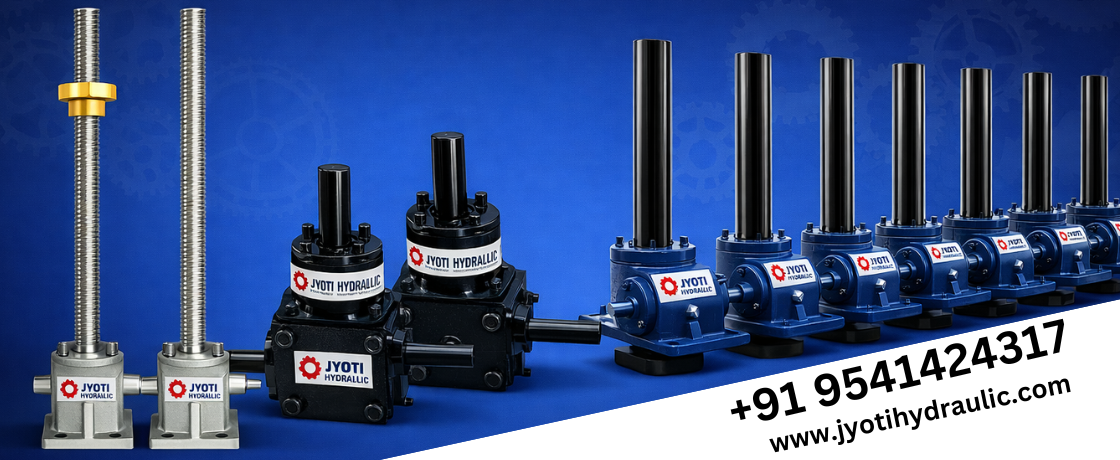
Jyoti Hydraulic provides engineered lifting and positioning solutions for industries where controlled movement, mechanical reliability, and load stability are critical. Among these solutions, the Worm Gear Screw Jack is widely used for lifting, lowering, positioning, pushing, pulling, and supporting heavy loads with precision. For industrial plants looking for dependable Worm Gear Screw Jack Manufacturers in India, choosing a manufacturer with strong engineering capability, material knowledge, machining accuracy, and application expertise is essential.
Introduction
Industrial machinery often requires more than simple vertical lifting. Equipment may need synchronized movement, accurate positioning, controlled travel, or dependable load holding under demanding operating conditions.
A worm gear screw jack converts rotary input from a motor, gearbox, handwheel, or drive shaft into linear motion. Its compact mechanical design makes it suitable for installations where hydraulic or pneumatic systems may not be practical.
Depending on the application, screw jack systems can also be connected through shafts, couplings, bevel gearboxes, and motors to operate multiple lifting points simultaneously.
Industry Overview
Manufacturing, material handling, infrastructure, steel processing, automation, packaging, and heavy engineering industries are increasingly adopting mechanical lifting systems that offer repeatable and controlled motion.
A Worm Gear Screw Jack is particularly useful where machinery requires:
- Precise linear positioning
- Controlled lifting and lowering
- Multiple synchronized lifting points
- Reliable operation at moderate speeds
- Compact installation
- Mechanical load support
Indian industries today require screw jacks capable of operating under varied load conditions, dusty environments, high temperatures, repetitive production cycles, and customized machinery layouts.
This has increased the importance of technically capable Worm Gear Screw Jack Manufacturers who can recommend equipment based on actual load, duty cycle, lifting speed, travel length, mounting arrangement, and operating environment rather than simply supplying a standard unit.
Technical Insights: How a Worm Gear Screw Jack Works
The basic operating principle involves a worm shaft driving a worm wheel inside the jack housing. The worm wheel interacts with the lifting screw mechanism and converts rotational motion into controlled linear movement.
Depending on the design, screw jacks are generally configured with either a translating screw or rotating screw arrangement.
In a translating screw design, the lifting screw moves axially through the jack while the worm wheel rotates internally. In a rotating screw design, the screw rotates while a travelling nut moves along its length.
Important technical parameters include:
Load Capacity: The jack must safely handle both static and dynamic loads.
Travel Length: Screw length and unsupported extension must be considered carefully because longer screws can be affected by column strength and buckling.
Gear Ratio: Gear reduction influences lifting speed, input torque, and positioning control.
Duty Cycle: Frequent starts, long operating periods, or continuous movement may require special design considerations.
Input Speed: Excessive operating speed can generate heat and accelerate wear.
Screw Material and Machining: Thread quality, material strength, surface finish, and dimensional accuracy directly affect operating life.
Lubrication: Appropriate lubrication of the worm gearing and screw mechanism helps minimize friction and wear.
For applications involving multiple jacks, proper alignment is equally important. Misaligned shafts, couplings, or mounting surfaces can create unnecessary side loads and reduce system life.
Industrial Applications
Worm gear screw jacks are used across a wide range of industrial equipment, including:
- Conveyor height adjustment systems
- Industrial presses and fixtures
- Steel and metal processing machinery
- Material handling systems
- Assembly and production lines
- Packaging machinery
- Heavy-duty platforms
- Machine tool positioning
- Adjustable work tables
- Furnace and foundry equipment
- Textile and paper machinery
- Solar tracking and positioning systems
- Gate and dam operating mechanisms
- Automotive manufacturing equipment
They are especially valuable when several lifting points must move together while maintaining the alignment of a platform or machine structure.
Benefits of Worm Gear Screw Jacks
One of the major advantages of a screw jack is its ability to provide controlled mechanical movement in a relatively compact package.
High Positioning Accuracy
The mechanical screw system enables controlled and repeatable linear movement, making it useful for industrial positioning operations.
Synchronized Lifting
Multiple screw jacks can be mechanically interconnected to raise or lower large platforms while maintaining balanced movement.
Flexible Drive Options
Systems can be powered through electric motors, handwheels, geared motors, shafts, or other suitable mechanical drives.
Compact Installation
Compared with some alternative lifting technologies, worm gear jacks can be integrated into machinery where installation space is restricted.
Reliable Mechanical Construction
Properly selected and maintained systems can provide dependable operation in demanding industrial environments.
Custom Engineering Possibilities
Mounting configurations, screw lengths, drive arrangements, ratios, accessories, and system layouts can be adapted to suit specific machinery requirements.
Buying Guide: How to Select the Right Worm Gear Screw Jack
Selecting equipment only according to tonnage can result in poor performance. Buyers should evaluate the complete operating condition.
Before contacting Worm Gear Screw Jack Manufacturers, determine the following:
- Maximum operating load: Include the actual load as well as possible shock or uneven loading.
- Number of lifting points: Large structures may need multiple synchronized jacks.
- Required stroke: Specify the complete lifting or positioning travel.
- Lifting speed: Faster movement can influence motor power, gearing, temperature, and service life.
- Duty cycle: Define how frequently and how long the system will operate.
- Mounting orientation: Vertical, horizontal, inverted, or other orientations may require different configurations.
- Environmental conditions: Dust, heat, moisture, chemicals, and outdoor exposure should be considered.
- Load type: Check whether the application involves compression, tension, or both.
- Drive arrangement: Determine whether operation will be manual, motorized, or synchronized through transmission shafts.
- Safety requirements: Consider limit switches, brakes, overload protection, guarding, and other machine safety provisions where required.
Providing this information allows the manufacturer to recommend a more reliable and economical system.
Future Trends in Industrial Screw Jack Systems
Modern industrial automation is moving toward smarter and more integrated motion systems. Screw jack installations are increasingly being combined with geared motors, encoders, sensors, PLC-controlled equipment, and automated positioning systems.
Industries are also placing greater emphasis on energy efficiency, predictive maintenance, improved lubrication technology, compact machinery design, and higher positioning accuracy.
As automation expands across Indian manufacturing, mechanically synchronized lifting solutions are likely to remain important because they can combine robust construction with accurate positioning and straightforward integration.
Conclusion
Choosing the right Worm Gear Screw Jack requires more than comparing load ratings. Screw diameter, stroke, input torque, operating speed, gear ratio, mounting arrangement, duty cycle, lubrication, alignment, and environmental conditions all influence system performance.
Working with experienced Worm Gear Screw Jack Manufacturers helps industries develop lifting and positioning systems that match real operating requirements rather than relying on an oversized or incorrectly selected standard solution.
Jyoti Hydraulic focuses on industrial applications where dependable engineering, practical design, and application-specific selection are essential for reliable equipment performance.
Frequently Asked Questions
1. What is a Worm Gear Screw Jack?
A Worm Gear Screw Jack is a mechanical device that uses worm gearing and a threaded screw mechanism to convert rotary motion into controlled linear movement for lifting, lowering, positioning, or supporting loads.
2. Where are worm gear screw jacks commonly used?
They are used in industrial machinery, conveyors, lifting platforms, steel plants, packaging machines, assembly systems, material handling equipment, presses, and synchronized positioning applications.
3. Can multiple screw jacks operate together?
Yes. Multiple screw jacks can be connected using drive shafts, couplings, bevel gearboxes, and a common drive source to create synchronized lifting systems.
4. How do I select the correct screw jack capacity?
Selection should consider operating load, safety factor, stroke, screw length, duty cycle, lifting speed, mounting orientation, side loads, environmental conditions, and required service life.
5. Can a Worm Gear Screw Jack be motorized?
Yes. Depending on system requirements, screw jacks can be operated using electric motors, geared motors, handwheels, or interconnected mechanical drive arrangements.
6. Why is alignment important in a screw jack system?
Incorrect alignment can place unwanted side loads on the lifting screw and transmission components, resulting in increased friction, wear, operating torque, and reduced service life.
7. Why choose Jyoti Hydraulic for industrial screw jack requirements?
Jyoti Hydraulic supports industrial users with application-focused solutions where load capacity, travel, mounting, operating conditions, synchronization, and other technical factors can be evaluated before selecting the appropriate lifting arrangement.
Get the Right Worm Gear Screw Jack for Your Application
Planning a new lifting system, replacing an existing screw jack, or developing a customized industrial positioning solution?
Contact Jyoti Hydraulic for technical guidance, product selection, and application-specific support. Request a quotation or speak with an expert to identify the right screw jack configuration for your machinery.
📞 +91 9541424317
Contact Jyoti Hydraulic today for a quotation and expert consultation for your industrial Worm Gear Screw Jack requirements.


