
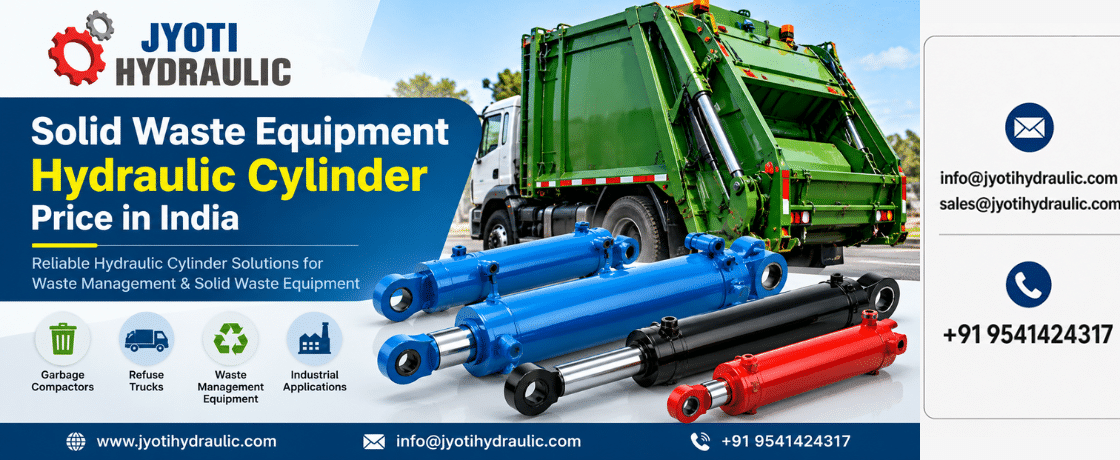
Jyoti Hydraulic understands that hydraulic cylinders used in solid waste handling equipment are not ordinary industrial components. They work in demanding environments where high pressure, repetitive operating cycles, shock loads, dust, moisture, corrosive waste, temperature changes, and irregular loading conditions are part of everyday operation. Choosing the right Solid Waste Equipment Hydraulic Cylinder therefore involves much more than comparing prices. Buyers need to evaluate cylinder construction, load capacity, sealing technology, mounting arrangement, materials, working pressure, duty cycle, serviceability, and the manufacturer’s ability to customize the cylinder for the actual machine.
For waste management companies, municipal contractors, OEMs, fleet operators, garbage-compactor manufacturers, recycling plants, and equipment maintenance teams, hydraulic cylinder quality directly influences machine uptime and operating cost. This complete guide explains the factors affecting solid waste equipment hydraulic cylinder prices in India, important technical considerations, common applications, benefits, selection criteria, maintenance requirements, and future trends shaping the industry.
Introduction to Solid Waste Equipment Hydraulic Cylinders
Modern waste-management machinery depends heavily on hydraulic power. Whether a machine is compacting municipal waste, lifting a refuse container, opening a tailgate, operating a hook loader, ejecting compressed material, or handling recyclable scrap, hydraulic cylinders convert hydraulic pressure into controlled linear force.
A Solid Waste Equipment Hydraulic Cylinder normally consists of a precision-machined cylinder tube, piston, piston rod, gland, seals, wear rings, end caps, mounting components, hydraulic ports, and other supporting parts. Hydraulic oil enters one side of the cylinder and acts on the piston surface, generating linear movement.
The fundamental hydraulic force can be represented as:
Force = Hydraulic Pressure × Effective Piston Area
However, designing a reliable waste-equipment cylinder involves considerably more than calculating theoretical force.
Engineers must also consider:
- Load direction and side loading
- Impact or shock loads
- Cylinder stroke length
- Rod buckling resistance
- Operating frequency
- Maximum hydraulic pressure
- Contamination levels
- Temperature range
- Mounting geometry
- Seal compatibility
- Corrosion exposure
- Required operating speed
- Safety factor
- Maintenance accessibility
Ignoring any of these factors can result in seal leakage, rod bending, barrel damage, excessive wear, mounting failure, or premature cylinder breakdown.
Solid Waste Management Equipment Industry Overview
India’s waste-management infrastructure continues to expand as municipalities, industries, residential developments, commercial facilities, recycling companies, and waste-processing plants adopt increasingly mechanized systems.
Manual handling of large volumes of waste is inefficient, labour-intensive, and difficult to scale. Hydraulic equipment allows waste to be lifted, compacted, transported, transferred, sorted, and discharged more efficiently.
Common hydraulic waste-management equipment includes:
- Garbage compactors
- Refuse collection vehicles
- Rear-loader garbage trucks
- Front-loader refuse vehicles
- Side-loader waste collection vehicles
- Stationary compactors
- Portable compactors
- Hook loaders
- Skip loaders
- Roll-on/roll-off systems
- Waste balers
- Recycling presses
- Scrap handling machines
- Transfer station equipment
- Bin lifting systems
- Container handling systems
Almost every movement requiring substantial controlled force in these machines can involve hydraulic actuation.
Because equipment reliability is critical in municipal and industrial waste operations, experienced Solid Waste Equipment Hydraulic Cylinder Manufacturers focus increasingly on durability, contamination resistance, precise engineering, and application-specific customization rather than supplying generic cylinders.
Solid Waste Equipment Hydraulic Cylinder Price in India
The price of a hydraulic cylinder for solid waste equipment cannot usually be determined from bore diameter alone.
A compact bin-lifting cylinder, for example, has very different manufacturing requirements from a long-stroke ejector cylinder installed inside a heavy refuse compactor.
In the Indian market, prices can range from relatively economical levels for smaller standard cylinders to substantially higher amounts for heavy-duty, long-stroke, high-pressure, customized or OEM-specific cylinders.
Instead of selecting a cylinder purely on the lowest initial quotation, buyers should compare the complete technical specification.
Important price-determining factors include the following.
1. Cylinder Bore Diameter
The bore is the internal diameter of the cylinder barrel.
A larger bore produces greater force at the same hydraulic pressure but requires:
- More steel
- Larger piston components
- Larger seals
- Heavier end structures
- Additional machining
- Higher-capacity testing
Consequently, price generally increases with bore size.
2. Piston Rod Diameter
The piston rod must withstand tensile, compressive, bending, and buckling loads.
Waste equipment can experience uneven material distribution and sudden resistance during compaction. Insufficient rod diameter can therefore lead to bending or permanent deformation.
Larger and higher-strength piston rods increase material and machining costs but can significantly improve reliability.
3. Stroke Length
Stroke represents the total linear travel of the piston rod.
Long-stroke cylinders used in compactors, ejector systems, hook loaders, and container handling equipment require longer:
- Honed tubes
- Piston rods
- Machining operations
- Straightness control
- Surface finishing
- Assembly facilities
Longer cylinders may also require more careful engineering against rod buckling.
4. Working Pressure
The operating pressure of the hydraulic circuit directly affects cylinder design.
Higher-pressure cylinders can require thicker cylinder barrels, stronger end caps, suitable seals, stronger mountings, and carefully engineered weld joints.
Designing a cylinder for actual system pressure plus appropriate safety margins is essential.
5. Material Grade
Material selection affects both cylinder price and service life.
Depending on the application, manufacturers may use appropriately selected grades of:
- Seamless steel tubing
- Honed hydraulic cylinder tubes
- High-strength piston rod material
- Alloy steel
- Forged mounting components
- Hardened pins and bushes
A cheaper material specification may reduce purchasing cost initially but can increase downtime and replacement frequency.
6. Piston Rod Surface Treatment
Rod condition is extremely important because it travels repeatedly through the sealing system.
Common rod treatments may include:
- Hard chrome plating
- Precision grinding
- Polishing
- Induction hardening where required
- Specialized corrosion-resistant coatings for aggressive environments
Rod surface quality influences sealing performance, friction, corrosion resistance, and seal life.
7. Seal Quality
Waste-handling machines often operate in contaminated environments.
Hydraulic seals may encounter:
- Mud
- Dust
- Fine abrasive particles
- Moisture
- Chemicals
- Organic waste
- Temperature variation
High-quality rod seals, piston seals, wipers, guide rings, and static seals usually increase cylinder cost slightly but can prevent far more expensive hydraulic leakage and downtime.
8. Mounting Arrangement
Common cylinder mounting configurations include:
- Clevis mounting
- Trunnion mounting
- Flange mounting
- Pin-eye mounting
- Cross-tube mounting
- Custom welded mounts
Custom mounting arrangements require additional engineering and fabrication, which can affect pricing.
9. Quantity
OEM bulk orders normally offer manufacturing efficiencies compared with one-off replacement cylinders.
Production volume can influence:
- Raw-material purchasing
- Setup time
- CNC programming
- Inspection procedures
- Assembly efficiency
Therefore, buyers purchasing cylinders in larger quantities should request volume-based quotations.
10. Customization
Custom hydraulic cylinders may require additional design work including:
- Special bore and rod combinations
- Non-standard strokes
- Special port positions
- Integrated cushioning
- Position sensors
- Specialized mounting brackets
- Corrosion-resistant finishes
- Special sealing materials
- OEM dimensional interchangeability
These features influence the final price but can significantly improve machine compatibility and performance.
Technical Insights: What Makes a Waste-Equipment Hydraulic Cylinder Reliable?
A well-designed Solid Waste Equipment Hydraulic Cylinder must survive repetitive, high-load service.
Several engineering factors deserve particular attention.
Honed Cylinder Bore
The internal cylinder surface should provide controlled smoothness and dimensional accuracy.
A correctly honed bore helps:
- Reduce seal wear
- Maintain lubrication
- Minimize friction
- Improve pressure sealing
- Extend piston seal life
Poor internal surface finish can damage seals rapidly.
Piston-to-Barrel Clearance
Correct internal clearances are essential.
Excessive clearance can cause instability and seal extrusion, while insufficient clearance can increase friction or cause seizure under temperature variation.
Rod Straightness
Long piston rods require excellent straightness.
Even relatively small misalignment can cause uneven wear on the gland, seals, bearings, and rod surface.
Welding Quality
Many heavy-duty waste cylinders contain welded components.
Critical weld areas may include:
- Cylinder base
- Port connections
- Clevis mounting
- Cross tubes
- Rod-end attachments
Weld quality must be consistent because failure can occur under repeated loading cycles.
Hydraulic Cushioning
Large cylinders can generate considerable kinetic energy toward the end of their stroke.
Optional cushioning can slow the piston before reaching the end position, helping reduce:
- Mechanical shock
- Noise
- Mounting stress
- Component fatigue
This can be particularly beneficial for heavy tailgates, ejectors, and compaction systems.
Contamination Control
Hydraulic contamination remains one of the biggest causes of premature component failure.
A strong wiper system prevents external contaminants from entering the cylinder as the rod retracts.
Equipment operators should also maintain proper hydraulic filtration because internal contamination damages sealing surfaces and precision components.
Major Applications of Solid Waste Equipment Hydraulic Cylinders
Garbage Compactor Cylinders
Compactors use hydraulic force to compress waste and maximize container capacity.
Compaction cylinders must tolerate high repeated forces, making rod strength, barrel thickness, piston sealing, and mounting design extremely important.
Ejector Cylinders
Some refuse bodies discharge material using an ejector plate.
These applications often require long-stroke cylinders capable of moving substantial loads smoothly.
Rod buckling calculations become particularly important in long compression strokes.
Tailgate Cylinders
Hydraulic cylinders raise, lower, lock, or control the tailgate.
Reliability is especially important because uncontrolled movement can damage the equipment and create safety hazards.
Bin-Lifting Cylinders
Bin lifters repeatedly raise waste containers for emptying into collection vehicles.
These cylinders frequently operate through many cycles every working day.
Hook Loader Cylinders
Hook loaders require powerful cylinders for loading and unloading containers.
They need excellent structural strength because forces can change significantly throughout the loading geometry.
Skip Loader Cylinders
Hydraulic cylinders control lifting arms and stabilization systems in skip loaders.
Correct synchronization and mounting alignment are critical.
Waste Balers
Balers use hydraulic cylinders to compress recyclable materials such as:
- Cardboard
- Plastic
- Paper
- Packaging waste
- Textile waste
- Light scrap materials
High compaction forces demand cylinders designed for pressure stability and repetitive cycles.
Recycling Equipment
Material recovery facilities use hydraulic cylinders in sorting, pressing, feeding, clamping, and material-handling systems.
Benefits of High-Quality Solid Waste Equipment Hydraulic Cylinders
Investing in properly engineered hydraulic cylinders offers several operational advantages.
Higher Equipment Uptime
Cylinder failure can take an entire garbage truck, compactor, or processing machine out of operation.
Reliable cylinders reduce unplanned downtime.
Longer Service Life
Proper materials, machining, rod finishing, seals, and manufacturing tolerances improve durability.
Improved Compaction Performance
Efficient force transmission enables garbage compactors and balers to achieve consistent compression.
Reduced Oil Leakage
Precision machining and appropriate sealing technology reduce external leakage and hydraulic oil consumption.
Lower Maintenance Cost
An inexpensive cylinder that requires repeated seal replacement, rod repair, or complete replacement may ultimately cost significantly more than a correctly engineered cylinder.
Better Operational Safety
Correctly designed cylinders help maintain predictable movement and structural integrity under load.
OEM Compatibility
Customized cylinders can be manufactured according to machine drawings, samples, dimensions, operating conditions, or application requirements.
Buying Guide: How to Select the Right Hydraulic Cylinder
When evaluating Solid Waste Equipment Hydraulic Cylinder Manufacturers, avoid choosing only on the basis of price.
Provide the manufacturer with complete application details.
Check Bore and Rod Diameter
Specify:
- Cylinder bore
- Piston rod diameter
- Stroke
- Closed length
- Extended length
For new designs, these dimensions should be calculated based on required force and mechanical geometry.
Confirm Operating Pressure
Provide both normal operating pressure and maximum system pressure.
A hydraulic cylinder must be designed for realistic peak loads rather than nominal working pressure alone.
Explain the Application
Tell the manufacturer whether the cylinder operates a:
- Compactor
- Tailgate
- Ejector
- Bin lifter
- Hook loader
- Baler
- Container system
- Lifting mechanism
Application information helps engineers identify potential shock loading, side loading, contamination, and duty-cycle requirements.
Mention Operating Frequency
A cylinder operating ten times per day has different service requirements from one operating several hundred cycles per shift.
Duty cycle influences sealing, bearing, lubrication, and heat considerations.
Specify Mounting Requirements
Mounting dimensions need to match machine geometry accurately.
Incorrect alignment can create side loads and cause premature rod and seal wear.
Check Port Size and Position
Hydraulic port type, orientation, and size affect installation and oil-flow performance.
Incorrect port sizing may restrict flow and reduce cylinder operating speed.
Ask About Seal Specifications
Seal material should suit:
- Pressure
- Speed
- Hydraulic fluid
- Temperature
- Contamination level
Waste applications often require strong rod wiping and contamination protection.
Evaluate Manufacturing Capability
A capable hydraulic-cylinder manufacturer should have suitable facilities for:
- Precision machining
- Tube honing
- Rod grinding
- Welding
- Assembly
- Dimensional inspection
- Pressure testing
- Leak testing
Consistency in manufacturing is as important as the original design.
Why the Cheapest Hydraulic Cylinder Can Become Expensive
Purchase price represents only one part of cylinder cost.
Consider a refuse collection vehicle that becomes unavailable because of cylinder leakage.
The real cost may include:
- Vehicle downtime
- Labour cost
- Hydraulic oil loss
- Cylinder removal
- Repair expenses
- Transportation
- Missed waste collection
- Replacement vehicle requirement
- Reduced fleet availability
This is why professional buyers increasingly evaluate total cost of ownership rather than comparing only the initial hydraulic cylinder price.
A durable cylinder with better sealing, correct material selection, accurate machining, and suitable surface finishing may have a higher initial cost but provide much better lifecycle value.
Common Causes of Hydraulic Cylinder Failure in Waste Equipment
Understanding failure modes also helps buyers make better purchasing decisions.
Side Loading
Misaligned mounting can force the rod against the gland and accelerate wear.
Bent Piston Rod
Overloading, impact, improper cylinder sizing, or buckling can permanently bend the rod.
Seal Failure
Seal failure may result from contamination, excessive temperature, incorrect installation, damaged rod surfaces, or unsuitable seal materials.
Rod Corrosion
Corrosion creates pits that damage seals every time the rod passes through the gland.
Contaminated Hydraulic Oil
Abrasive particles damage seals, piston surfaces, and cylinder bores.
Excessive Pressure
Pressure spikes beyond the design limit can damage seals, barrels, ports, and structural components.
Poor Mounting Pin Condition
Worn pins and bushes can create abnormal movement and additional side forces.
Weld Fatigue
Repeated high-load cycles can expose weaknesses in poorly designed or executed welded joints.
Maintenance Tips for Longer Hydraulic Cylinder Life
Proper maintenance can substantially extend cylinder service life.
Operators should regularly:
- Inspect piston rods for scratches and corrosion.
- Check cylinders for external oil leakage.
- Keep the exposed rod area clean.
- Replace damaged wipers before contamination reaches internal seals.
- Maintain correct hydraulic oil levels.
- Change hydraulic filters according to maintenance schedules.
- Inspect mounting pins, bushes, and retainers.
- Investigate unusual cylinder noise or jerky motion.
- Avoid operating equipment continuously above rated loads.
- Repair damaged rods before they destroy new seals.
Seal replacement alone may not permanently solve leakage if the underlying problem is a scratched rod, worn gland, damaged bore, misalignment, or contaminated hydraulic system.
Standard vs Customized Hydraulic Cylinders
Standard cylinders can be economical when machine dimensions and performance requirements match available products.
However, waste-management equipment often requires customized solutions because machine layouts differ between manufacturers.
A custom Solid Waste Equipment Hydraulic Cylinder can be engineered around:
- Required force
- Available mounting space
- Stroke requirement
- Pressure
- Load direction
- Machine geometry
- Operating environment
- Cycle frequency
- Existing pin dimensions
- Port orientation
For replacement applications, an experienced manufacturer may also develop a cylinder based on an existing sample or detailed dimensional information.
Future Trends in Solid Waste Equipment Hydraulics
Waste-management machinery is becoming more efficient, automated, and data-driven.
Several trends are likely to influence hydraulic cylinder engineering.
Smart Position Monitoring
Hydraulic cylinders can increasingly be integrated with position sensors to provide real-time feedback for automated equipment.
Predictive Maintenance
Sensor-based monitoring of pressure, movement, temperature, and machine cycles can help identify developing problems before complete failure occurs.
Improved Surface Technologies
Advanced rod coatings may provide improved corrosion and wear resistance in demanding waste-management environments.
Higher Energy Efficiency
Manufacturers are working to reduce hydraulic energy losses through better system design, efficient pumps, improved valves, controlled flow, and optimized cylinder dimensions.
Increased Automation
Automated waste-sorting plants and material-recovery facilities require precise and repeatable hydraulic movement.
Greater Focus on Lifecycle Cost
Fleet operators and OEMs are increasingly considering reliability, repairability, downtime, and lifecycle performance rather than selecting components only on purchase price.
Why Manufacturer Experience Matters
Waste-management cylinders present engineering challenges that may not be obvious from drawings alone.
Experienced Solid Waste Equipment Hydraulic Cylinder Manufacturers understand practical issues including:
- Rod buckling
- Side loading
- Impact loads
- High-cycle operation
- Dirty operating environments
- Corrosion
- Seal wear
- Long-stroke stability
- Mounting stresses
- Field maintenance requirements
A strong manufacturer should therefore be able to discuss the application rather than simply ask for bore, rod, and stroke dimensions.
At Jyoti Hydraulic, the objective is to provide hydraulic cylinder solutions developed around practical equipment requirements, operating conditions, machine geometry, reliability, and service life.
How to Request an Accurate Hydraulic Cylinder Quotation
To receive an accurate quotation quickly, provide as much technical information as possible.
Useful information includes:
- Equipment type
- Cylinder application
- Bore diameter
- Rod diameter
- Stroke length
- Closed length
- Working pressure
- Maximum pressure
- Mounting type
- Pin dimensions
- Port type and position
- Required quantity
- Existing cylinder photographs
- Technical drawing, if available
- Machine model
- Operating environment
When information is incomplete, technical consultation can help identify the required cylinder configuration before manufacturing.
Frequently Asked Questions
1. What is a Solid Waste Equipment Hydraulic Cylinder?
A Solid Waste Equipment Hydraulic Cylinder is a hydraulic actuator specifically designed for garbage compactors, refuse vehicles, waste balers, hook loaders, skip loaders, bin lifters, ejectors, recycling machines, and other waste-handling systems. It converts hydraulic fluid pressure into controlled linear movement and force.
2. What is the price of a solid waste equipment hydraulic cylinder in India?
The price depends on bore diameter, rod diameter, stroke, operating pressure, materials, mounting arrangement, seal system, rod treatment, quantity, and customization. Smaller cylinders generally cost considerably less than large-bore, long-stroke, heavy-duty or custom OEM cylinders. Providing complete specifications is the best way to receive an accurate quotation.
3. Which specifications are required before ordering a hydraulic cylinder?
Important specifications include bore, rod diameter, stroke, closed length, working pressure, mounting arrangement, hydraulic ports, application type, operating frequency, quantity, and environmental conditions.
4. Can a hydraulic cylinder be manufactured from an old sample?
Yes. In many replacement applications, a manufacturer can study the old cylinder’s dimensions, mounting geometry, stroke, ports, and construction to develop a compatible replacement. Operating pressure and application details should also be provided.
5. Which cylinders are used in garbage compactors?
Garbage compactors may use compaction cylinders, ejector cylinders, tailgate cylinders, locking cylinders, bin-lifting cylinders, and other auxiliary hydraulic cylinders depending on machine design.
6. What causes hydraulic cylinders to leak?
Common causes include damaged seals, scratched or corroded piston rods, contaminated hydraulic oil, worn guide components, excessive pressure, incorrect alignment, overheating, and damaged sealing surfaces.
7. How can hydraulic cylinder life be increased?
Maintain clean hydraulic oil, use suitable filtration, inspect rods regularly, repair leaks quickly, maintain pins and bushes, avoid overloading, protect rods against corrosion, and follow proper maintenance practices.
8. Why is piston rod diameter important?
Rod diameter affects load capacity, stiffness, and resistance to buckling. This is especially important for long-stroke cylinders operating under compression.
9. Are customized hydraulic cylinders better than standard cylinders?
Not necessarily for every application. Standard cylinders are suitable when their dimensions and ratings match the machine. Customized cylinders are preferable when special mounting, force, stroke, environmental, or dimensional requirements exist.
10. What should I look for when comparing Solid Waste Equipment Hydraulic Cylinder Manufacturers?
Compare engineering capability, manufacturing quality, material specifications, machining accuracy, sealing technology, pressure testing, customization capability, technical support, and experience with heavy-duty applications—not just price.
11. Can hydraulic cylinders be designed for high-cycle waste-management equipment?
Yes. High-cycle applications can be engineered using appropriate bearing areas, sealing systems, surface finishes, materials, alignment provisions, and operating-pressure considerations.
12. Why does the same-size hydraulic cylinder have different prices from different manufacturers?
Two cylinders with identical bore and stroke dimensions may use different steel grades, rod materials, coatings, seal brands, wall thicknesses, machining tolerances, welding procedures, testing processes, and mounting designs. Their service life and reliability can therefore differ significantly.
Conclusion
Selecting a hydraulic cylinder for waste-management machinery requires a balance between price, engineering quality, reliability, and lifecycle cost. Bore size and stroke are important, but they represent only part of the complete cylinder specification.
Operating pressure, rod strength, material grade, seals, surface finish, mounting geometry, contamination resistance, duty cycle, welding quality, and manufacturing accuracy can all determine whether a cylinder operates reliably for years or becomes a recurring maintenance problem.
For OEMs, municipal waste contractors, recycling plants, equipment manufacturers, maintenance companies, and fleet operators, working with experienced Solid Waste Equipment Hydraulic Cylinder Manufacturers can reduce downtime and help achieve better long-term equipment performance.
Whether you require a replacement Solid Waste Equipment Hydraulic Cylinder, an OEM cylinder, a customized heavy-duty solution, or technical support for a new waste-handling machine, Jyoti Hydraulic can assist with application-focused hydraulic cylinder solutions.
Get a Hydraulic Cylinder Quotation from Jyoti Hydraulic
Looking for a reliable hydraulic cylinder for a garbage compactor, refuse collection vehicle, hook loader, skip loader, waste baler, bin lifter, ejector system, recycling machine, or other solid waste equipment?
Contact Jyoti Hydraulic to discuss your application with our team.
Request a quotation for your required cylinder, share your drawing or existing cylinder specifications, or get expert consultation to determine the right hydraulic cylinder configuration for your equipment.
📞 +91 9541424317
Contact Jyoti Hydraulic today for a quotation, custom hydraulic cylinder requirements, replacement-cylinder support, or expert technical consultation for your solid waste equipment.


