
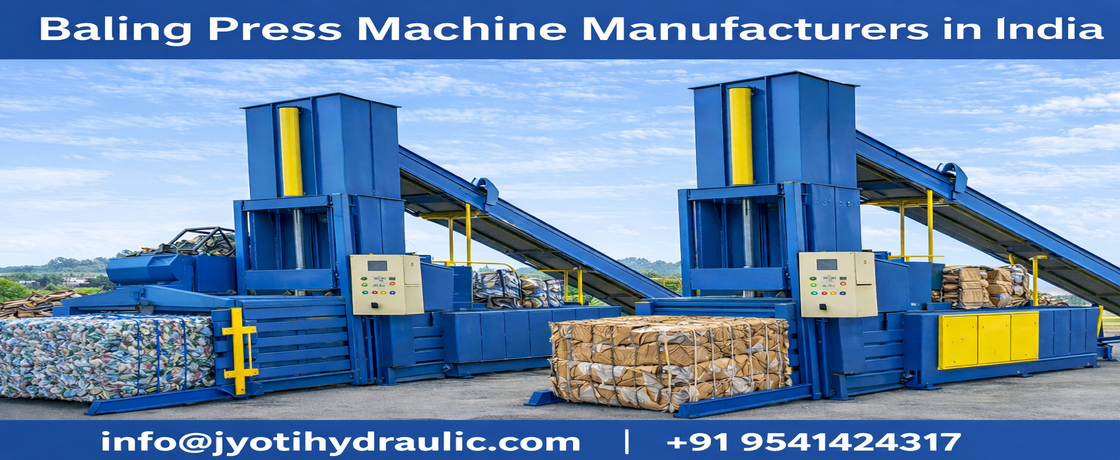
Jyoti Hydraulic understands that efficient scrap handling is no longer just a supporting activity for industries—it has become an essential part of cost control, recycling, workplace safety, and sustainable manufacturing. In today’s industrial environment, where metal scrap, production waste, packaging waste, and recyclable materials are generated in large volumes, a baling press machine plays a crucial role in converting loose waste into compact, manageable, and transport-friendly bales.
A baling press machine is an industrial machine designed to compress loose scrap or recyclable material into dense blocks or bundles known as bales. These bales are easier to store, handle, transport, sell, and recycle. The machine uses hydraulic force, mechanical structure, and controlled pressing movement to reduce the volume of materials such as iron scrap, aluminum scrap, steel waste, cardboard, plastic, textile waste, and other recyclable materials.
For industries dealing with heavy metal waste, selecting reliable Baling Press Machine Manufacturers is extremely important. A well-designed hydraulic baling press improves operational efficiency, reduces scrap storage problems, and helps businesses get better value from recyclable materials. This is why many companies search for trusted Iron Scrap Baling Machine Manufacturers in India and Scrap Baling Machine Manufacturers in India to meet their industrial recycling needs.
Industry Overview: Scrap Recycling and Waste Management
The scrap recycling and waste management industry has become a key part of modern industrial operations. Manufacturing plants, automobile units, fabrication workshops, steel mills, foundries, and metal processing industries generate significant quantities of scrap every day. Without proper handling, this scrap occupies valuable floor space, creates safety hazards, increases transportation costs, and reduces overall productivity.
Hydraulic baling machines solve these problems by compressing bulky waste into uniform bales. In the recycling supply chain, compact bales are easier to weigh, stack, load, transport, and process. This makes the recycling operation faster, cleaner, and more profitable.
In India, the demand for advanced scrap processing equipment has increased due to industrial growth, stricter waste management practices, and the rising value of recyclable metals. This has created strong demand for professional Scrap Baling Machine Manufacturers in India who can provide durable, high-capacity, and application-specific machines.
Hydraulic baling press machines are widely used because they offer:
- High compression force
- Consistent bale density
- Better scrap storage
- Reduced labor dependency
- Smooth industrial recycling workflow
- Improved return on scrap value
For metal scrap industries, working with experienced Iron Scrap Baling Machine Manufacturers in India ensures that the machine is designed for tough materials, continuous operation, and long service life.
Working Principle of Baling Press Machine
A baling press machine works on a simple but powerful principle: applying controlled hydraulic pressure to compress loose material into compact bales. Although the basic function is straightforward, the actual working process involves several important mechanical and hydraulic stages.
1. Material Feeding
The process begins by loading scrap or recyclable material into the machine’s compression chamber. Depending on the machine type, feeding can be manual, conveyor-based, or automatic.
Common materials fed into baling machines include:
- Iron scrap
- Steel scrap
- Aluminum scrap
- Copper scrap
- Tin sheets
- Plastic waste
- Cardboard
- Textile waste
- Production waste
In heavy-duty metal baling machines, the chamber is built with strong steel plates to withstand high-pressure compression.
2. Chamber Functioning
The compression chamber is the main working area of the baling press machine. It holds the loose material before and during compression. The chamber size determines the amount of material that can be processed in one cycle and also influences the final bale size.
For scrap metal applications, the chamber must be rugged, wear-resistant, and properly reinforced. Reputed Baling Press Machine Manufacturers design the chamber based on the type of scrap, required bale density, and production capacity.
3. Hydraulic System Operation
The hydraulic system is the heart of the baling press machine. It usually consists of:
- Hydraulic cylinders
- Hydraulic power pack
- Electric motor
- Hydraulic oil tank
- Control valves
- Pressure gauges
- Pipes and hoses
- Directional control system
When the machine starts, the electric motor drives the hydraulic pump. The pump pushes hydraulic oil under pressure toward the cylinder. This pressure moves the ram or pressing plate forward, applying force on the material inside the chamber.
Hydraulic systems are preferred because they can generate very high force with smooth, controlled movement. This makes them ideal for compressing tough and irregular materials such as iron scrap and steel waste.
4. Compression Process
Once the hydraulic ram moves forward, it presses the loose material against the fixed walls of the chamber. The material gradually reduces in volume and becomes denser. In three-way compression balers, multiple rams may apply pressure from different directions to produce a highly compact bale.
The compression force depends on the machine design and application. Light-duty machines may require lower pressure, while heavy-duty iron scrap balers need high hydraulic force to compress dense metal scrap effectively.
5. Bale Formation
After the material is fully compressed, it forms a compact bale. The bale can be rectangular, square, or customized depending on the machine design. Bale size and weight vary according to chamber dimensions, material density, hydraulic pressure, and cycle time.
A good-quality bale should be:
- Compact
- Uniform in shape
- Easy to lift
- Easy to stack
- Suitable for transportation
- Acceptable for recycling plants or buyers
6. Bale Ejection Process
Once compression is complete, the machine ejects the bale from the chamber. Bale ejection can be manual, hydraulic, or automatic depending on the machine model. In automatic baling machines, the bale may be pushed out through a discharge door or conveyor system.
The complete cycle then repeats for the next batch of scrap.
Types of Baling Press Machines
Different industries require different types of baling machines depending on space availability, material type, production volume, and automation needs.
Horizontal Baling Press Machine
A horizontal baling press machine compresses material horizontally. It is commonly used for high-volume scrap handling and continuous industrial operations.
Key features include:
- Large feeding chamber
- High production capacity
- Suitable for bulky materials
- Easy integration with conveyors
- Ideal for scrap yards and recycling plants
Horizontal balers are preferred when industries need fast processing, consistent bale output, and lower manual handling.
Vertical Baling Press Machine
A vertical baling press machine compresses material from top to bottom. It usually requires less floor space and is suitable for small to medium-scale applications.
Common uses include:
- Packaging waste
- Cardboard
- Plastic
- Textile waste
- Light metal scrap
Vertical balers are cost-effective, easy to operate, and suitable for businesses with moderate scrap generation.
Automatic and Semi-Automatic Baling Machines
Automation level plays an important role in machine selection.
Semi-automatic baling machines require some manual involvement in feeding, tying, or bale removal. They are suitable for medium-capacity applications and businesses looking for cost-effective solutions.
Automatic baling machines reduce manual work by automating feeding, compression, bale tying, and ejection. These machines are ideal for large recycling plants, steel industries, and high-volume scrap processing units.
Scrap Metal Baling Machines
Scrap metal baling machines are specifically designed to compress metal waste such as iron, steel, aluminum, copper, and mixed scrap. These machines require strong hydraulic power, reinforced structure, and heavy-duty components.
Industries looking for reliable metal balers often prefer experienced Iron Scrap Baling Machine Manufacturers in India because metal scrap compression demands technical expertise and robust machine design.
Technical Insights into Hydraulic Baling Press Machines
Hydraulic Pressure System
The hydraulic pressure system determines the machine’s compression strength. Higher hydraulic pressure allows the machine to compress dense and heavy materials efficiently. For iron and steel scrap, the machine must have a powerful hydraulic cylinder, reliable pump, and strong frame design.
Power Consumption
Power consumption depends on machine capacity, motor size, hydraulic pressure, cycle time, and automation features. A well-designed machine balances energy use with productivity. Energy-efficient hydraulic systems help reduce operating costs over time.
Bale Size and Capacity
Bale size is one of the most important technical factors. Smaller bales are easier to handle manually, while larger bales are suitable for bulk transportation and industrial recycling. Capacity is usually measured in terms of bale weight, cycle output, or tons processed per day.
Automation Features
Modern baling press machines may include:
- PLC control panel
- Touchscreen interface
- Auto cycle operation
- Conveyor feeding
- Auto bale ejection
- Safety interlocks
- Emergency stop system
- Pressure monitoring
- Oil temperature control
Automation improves consistency, reduces labor dependency, and increases production efficiency.
Material Compatibility
A machine should be selected based on the type of material it will process. A baler designed for cardboard may not be suitable for iron scrap. Similarly, a heavy-duty metal baler may be unnecessary for light packaging waste. This is why consulting professional Baling Press Machine Manufacturers is important before purchase.
Applications of Baling Press Machines
Baling press machines are used across multiple industries where scrap and recyclable materials are generated regularly.
Scrap Yards
Scrap yards use baling machines to compress loose metal scrap into dense bales for easy storage, handling, and resale.
Metal Recycling Plants
Recycling plants depend on baling machines to prepare scrap for melting, sorting, transportation, and further processing.
Automobile Industry
Automobile manufacturing and dismantling units generate sheet metal waste, rejected parts, and production scrap. Baling machines help manage this waste efficiently.
Steel Industry
Steel plants and rolling mills use heavy-duty balers for processing steel scrap, iron waste, and metal cuttings.
Waste Management Plants
Waste management facilities use baling machines for plastic, paper, cardboard, textile, and mixed recyclable waste.
Manufacturing Industries
Fabrication units, engineering workshops, appliance manufacturers, and metal processing companies use balers to maintain organized and efficient scrap handling systems.
Benefits of Using a Baling Press Machine
Space Saving
Loose scrap occupies large storage space. A baling press machine compresses the material into compact bales, allowing industries to use their floor space more efficiently.
Easy Scrap Handling
Compact bales are easier to lift, move, stack, and load. This reduces manual effort and improves material handling speed.
Reduced Transportation Cost
Compressed bales occupy less truck space. This allows more material to be transported in fewer trips, reducing logistics costs.
Increased Recycling Efficiency
Uniform bales are easier for recycling plants to process. This improves sorting, weighing, melting, and downstream handling.
Improved Workplace Safety
Loose scrap can create sharp edges, tripping hazards, and cluttered work areas. Baling machines help keep the workplace cleaner and safer.
Higher Scrap Value
Properly compressed and organized scrap often has better market acceptance. Buyers prefer dense, clean, and transport-ready bales, which can help industries achieve better scrap value.
Buying Guide: How to Choose the Right Baling Press Machine
Selecting the right machine requires practical evaluation of your material, production needs, and long-term operating goals.
1. Identify the Material Type
The first step is to know what material you need to bale. Iron scrap, aluminum scrap, plastic, cardboard, and textile waste all require different machine specifications.
2. Check Production Capacity
Choose a machine based on daily or hourly scrap generation. Under-capacity machines slow down production, while oversized machines increase unnecessary investment.
3. Decide the Automation Level
For small operations, a semi-automatic machine may be enough. For large recycling plants or high-volume industries, automatic machines offer better productivity and reduced labor cost.
4. Evaluate Power Requirements
Check motor capacity, power supply availability, hydraulic system efficiency, and operating cost. Energy-efficient models are better for long-term industrial use.
5. Consider Maintenance Support
A baling press machine works under heavy load, so maintenance support is essential. Choose manufacturers who provide spare parts, service support, installation guidance, and operator training.
6. Review Manufacturer Reputation
When comparing Scrap Baling Machine Manufacturers in India, look for experience, machine quality, customization capability, after-sales service, and technical expertise. The right manufacturer will recommend a machine based on your actual application rather than offering a generic model.
Future Trends in Baling Press Machines
Automation and Smart Controls
The future of baling machines is moving toward smarter operation. PLC-based control systems, automated cycles, and digital interfaces are becoming more common in modern machines.
Energy-Efficient Hydraulic Systems
Manufacturers are focusing on hydraulic systems that deliver high force with lower energy consumption. Better pump design, optimized oil flow, and efficient motors can reduce operating costs.
IoT-Enabled Monitoring
IoT-enabled machines can monitor pressure, cycle count, oil temperature, motor performance, and maintenance alerts. This helps prevent breakdowns and improves machine uptime.
Sustainable Recycling Technologies
As industries move toward sustainability, baling machines will continue to support circular economy goals by improving scrap recovery, reducing waste volume, and making recycling more efficient.
Conclusion
A baling press machine is one of the most important machines for modern scrap management, recycling, and industrial waste handling. It converts loose, bulky, and difficult-to-handle scrap into compact bales that are easy to store, transport, and recycle. From hydraulic pressure generation to chamber compression and bale ejection, every part of the machine is designed to improve efficiency and reduce operational challenges.
For industries dealing with metal waste, selecting trusted Iron Scrap Baling Machine Manufacturers in India is essential for long-term performance. Similarly, businesses handling mixed recyclable waste should work with experienced Scrap Baling Machine Manufacturers in India who understand industrial applications, machine customization, and reliable service support.
A well-built baling press machine helps industries save space, reduce transportation costs, improve workplace safety, increase recycling efficiency, and achieve better scrap value. As automation, smart controls, and energy-efficient systems continue to evolve, hydraulic baling machines will remain a key part of sustainable industrial operations.
Frequently Asked Questions
1. What is a baling press machine used for?
A baling press machine is used to compress loose scrap or recyclable material into compact bales. It is commonly used for metal scrap, iron scrap, aluminum scrap, plastic waste, cardboard, textile waste, and other industrial recyclable materials.
2. How does a hydraulic baling press machine work?
A hydraulic baling press machine works by using hydraulic pressure to move a ram or pressing plate inside a chamber. The material is loaded into the chamber, compressed under high force, formed into a dense bale, and then ejected for storage or transportation.
3. Which industries use scrap baling machines?
Scrap baling machines are used in scrap yards, metal recycling plants, automobile industries, steel plants, manufacturing units, fabrication workshops, waste management plants, and industrial recycling facilities.
4. What is the price of a baling press machine in India?
The price of a baling press machine in India depends on machine capacity, hydraulic power, automation level, bale size, material type, and customization requirements. Heavy-duty metal balers usually cost more than light-duty vertical balers. For accurate pricing, it is best to request a quotation from experienced manufacturers.
5. How to choose the best scrap baling machine manufacturer?
To choose the best manufacturer, check their industry experience, machine design quality, hydraulic system expertise, customization options, after-sales service, spare parts availability, and customer support. Reliable Baling Press Machine Manufacturers will guide you based on your material type, production capacity, and operational needs.
Contact Jyoti Hydraulic for Expert Guidance
Looking for a reliable hydraulic baling press machine for your industrial scrap handling needs? Get expert assistance from experienced professionals who understand machine design, scrap processing, hydraulic systems, and real industrial requirements.
For product consultation, technical guidance, or quotation requests, contact:
📧 info@jyotihydraulic.com
📞 +91 9541424317


