
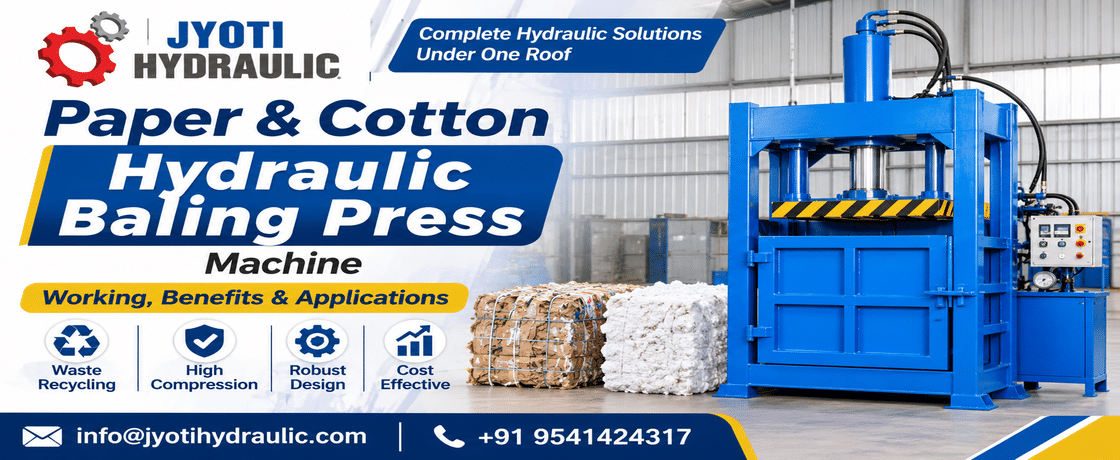
Jyoti Hydraulic manufactures hydraulic baling equipment for businesses handling waste paper, cardboard, cloth and cotton materials. For these operations, the challenge is not simply compressing waste—it is producing manageable bales that fit the way material is collected, stored and dispatched. Choosing the right Paper and Cotton Hydraulic Baling Press Machine therefore begins with understanding the material, the required output and the expectations of the next buyer in the recycling chain.
A useful starting question is: What should the finished bale achieve? It may need to fit a particular handling system, meet a recycler’s size requirements or clear a production area before the next shift. These practical requirements should guide machine selection rather than pressing force alone.
What Is a Paper and Cotton Hydraulic Baling Press Machine?
A Paper and Cotton Hydraulic Baling Press Machine uses a hydraulically driven pressing plate, also called a platen, to compress approved loose material inside a chamber. The compressed material is secured with suitable ties or straps and discharged as a bale for storage, transport or further processing. Depending on the design, compression takes place vertically or horizontally.
The description does not mean paper and cotton should be mixed in the same bale. It also does not mean every paper baler is suitable for cotton. Material compatibility must be confirmed for the selected machine, while separate material grades should be maintained according to the receiving buyer’s requirements.
Industry Overview: Where Baling Fits into Material Recovery
Baling occupies an important position between material collection and recycling. In the paper recovery chain, collected material is sorted, contaminants are removed, and paper grades are prepared for shipment to mills. Bales make that movement more organised, but the press does not replace sorting or the recycling process itself.
Textile operations have a related but distinct requirement. Cotton waste, fabric offcuts and used textiles may need compact packaging for movement to another processor. However, cotton-waste baling and ginned-cotton packaging are different applications. Ginned lint requires a coordinated packaging system designed around cotton quality, plant capacity, bale configuration and suitable covering and ties. A general-purpose waste baler should not automatically be treated as a substitute.
For a buyer, this creates a simple rule: describe the actual material—not merely “paper” or “cotton”—before requesting a machine recommendation.
How Does a Hydraulic Baling Press Work?
Although individual operating sequences differ, the basic process involves loading, compression, bale formation and discharge.
Material Loading and Preparation
Approved material enters the chamber through the designated loading opening. Loading may be manual or integrated with a feeding arrangement, depending on machine configuration. For paper recycling, material preparation should include segregation and removal of unwanted items before baling; compressing contamination does not make it acceptable to a paper mill.
Hydraulic Compression
The hydraulic power unit supplies oil flow to the cylinder. As the cylinder moves the platen against the material, resistance creates pressure and the platen applies compressive force. Cylinder force depends on pressure and effective piston area, while movement speed depends on oil flow and cylinder area.
Repeated Filling and Bale Formation
Many batch balers require several filling and pressing cycles before a complete bale is formed. Where fitted, retaining devices help keep previously compressed material down as the platen retracts. Consequently, one press stroke should not be confused with the production of one finished bale.
Securing and Discharge
Once the bale is complete, it is secured using the machine’s approved tying arrangement and discharged through the designated mechanism. Tying and ejection procedures vary, so operators must follow the supplied instructions rather than apply a sequence learned on a different baler. Guarding, training and safe access remain essential throughout operation.
Technical Insights: What Determines Baling Performance?
Pressing Force Is Not Bale Weight
A machine described in tonnes of pressing force is not stating how many tonnes of material it processes per hour or the weight of its finished bale.
For a simplified cylinder calculation:
Theoretical force = hydraulic pressure × effective piston area
For example, a 160 mm bore cylinder receiving 200 bar on its full piston area develops approximately 402 kN, or 41 tonnes-force, before accounting for opposing pressure and mechanical losses. This is an illustrative engineering calculation—not a Jyoti Hydraulic model specification.
The practical lesson is to compare pressing force separately from bale weight, bale dimensions and demonstrated production output.
Paper Quality and Cotton Quality Need Different Attention
For recovered paper, bale condition, moisture and unwanted material are important acceptance considerations. A tightly compressed bale can still be unsuitable when its contents do not meet the receiving mill’s requirements. Ask the buyer which grades, contaminants and moisture conditions are acceptable before finalising the baling process.
For cotton, packaging must protect material quality as well as maintain bale integrity. Excessive moisture and concentrated wet areas can damage cotton quality, while unsuitable covering materials can introduce contamination. The correct approach is to specify an acceptable moisture condition and suitable packaging—not to pursue the heaviest possible bale.
Bale Density Should Be Measured After Discharge
Bale density expresses how much material occupies a given volume:
Bale density = bale mass ÷ bale volume
As a hypothetical example, a 200 kg bale measuring 1.0 × 0.8 × 0.8 metres has a volume of 0.64 cubic metres and an average density of approximately 313 kg/m³.
For acceptance testing, record the dimensions of the secured, discharged bale. This makes the measurement relevant to actual storage and transport rather than relying only on the space occupied inside the press.
Press-Cycle Time Is Not Production Capacity
A quoted press-cycle time generally describes the platen’s operating movement, not every activity required to produce and remove a bale. Loading, repeated compression, tying and handling must also be considered when estimating practical output.
Consider a facility generating 2,400 kg of material per day with six hours available for baling:
Required average output = 2,400 ÷ 6 = 400 kg/hour
That calculation establishes a starting requirement. The purchase specification should then address peak arrivals, interruptions and the actual labour available. Ask for a timed trial using representative material, not an estimate based solely on unloaded cylinder movement.
Structural Design Matters Alongside Hydraulic Capacity
Baling presses experience repeated loading. Cyclic stress and uneven bale formation can affect machine performance and reliability. This makes frame design, platen guidance and material distribution relevant considerations—not just cylinder size or the pressure shown on a gauge.
Applications Across Paper and Textile Operations
Printing, Packaging and Corrugated-Box Manufacturing
These facilities can use suitable balers for paper trimmings, rejected board and corrugated packaging waste. When discussing an installation, specify whether the feed consists of large sheets, flattened cartons, small offcuts or a combination, because the loading arrangement should suit the actual material presentation.
Textile Mills and Garment Manufacturing
Cloth baling equipment can handle approved fabric scraps, used clothing and cotton materials. In a garment unit, a useful purchasing brief should identify the fibre composition, scrap form and intended downstream processor rather than treating all textile waste as one uniform product.
Warehouses and Distribution Centres
Packaging waste from unpacking and dispatch operations is another common application. Baler placement should be planned around the collection route and finished-bale movement, with the selected configuration matched to available space and material volume.
Recycling and Material-Aggregation Facilities
Recycling businesses may require equipment capable of handling larger quantities or more continuous feeding. Horizontal balers are commonly considered for these conditions, although the correct arrangement still depends on the material, feeding method and required bale characteristics.
Benefits of a Correctly Selected Baling Press
More Effective Use of Storage and Transport Space
Compaction reduces the volume occupied by loose material and creates more manageable units for storage and dispatch. This can improve transport utilisation and reduce the space devoted to uncompressed waste. However, the actual benefit should be measured against the starting material and the finished bale—not assumed from a universal percentage.
For example, reducing a particular batch from 10 cubic metres to 2 cubic metres represents an 80% volume reduction. It does not automatically establish an 80% saving in transport costs, because the transport calculation also depends on load limits, vehicle layout and commercial arrangements.
Better Organisation of Recyclable Material
A practical baling system can support separate storage and dispatch of identified material grades. This aligns with the wider paper-recycling emphasis on keeping paper separate from other recyclables and maintaining suitable quality for the receiving mill.
The operational objective should be clear identification: what is in the bale, how much it weighs and where it is going.
Easier Handling—with Appropriate Controls
Bales provide defined units for mechanical handling, but compactness does not automatically make them safe to stack. Bale shape, weight, density, material properties and storage conditions affect stability. Damaged ties, water exposure and poorly planned stacks can create additional hazards.
Better Preparation for Sale, Not a Guaranteed Price Premium
Baling can prepare material for an established recycling route, but density alone does not determine acceptance or value. Bale condition, moisture and unwanted contents remain important quality considerations. Obtain the buyer’s acceptance criteria and commercial terms before calculating any additional revenue.
How to Compare Paper and Cotton Hydraulic Baling Press Machine Manufacturers
When evaluating Paper and Cotton Hydraulic Baling Press Machine Manufacturers, turn the enquiry into a measurable production requirement. A quotation becomes much more useful when every supplier is responding to the same material, output target and installation conditions.
Start with a Clear Specification
Use the following information as the basis of the enquiry:
| Selection Area | Information to Provide or Request |
|---|---|
| Material | Exact paper grade or cotton/textile waste type, including photographs and representative samples. |
| Production requirement | Kilograms generated per day, peak arrival periods and hours available for baling. |
| Finished bale | Buyer-approved dimensions, target weight range, tying material and handling method. |
| Site conditions | Installation space, operating height, access route, floor requirements and electrical supply. |
| Automation | Who performs loading, compression control, tying and bale removal. |
| Support | Installation scope, operator training, maintenance documentation, spare parts and warranty terms. |
Treat this as a discussion checklist rather than a substitute for the manufacturer’s engineering assessment.
Choose Vertical or Horizontal Equipment Around the Workflow
Vertical balers are commonly used where compact installation and batch handling are priorities. Horizontal systems are generally associated with larger material streams and greater integration with feeding equipment. These are broad tendencies, not a reason to select a machine without assessing the site.
Also define what “automatic” includes. Automatic compression does not necessarily establish that loading, tying and discharge are all automated.
Request a Material Trial with Recorded Results
A useful acceptance trial should answer a practical question: Can this machine repeatedly produce acceptable bales from our material at the required rate?
Ask the supplier to record incoming material condition, completed bale weights, discharged dimensions, total elapsed time, operator involvement and any interruptions. Agree on the measurement method before testing so that a successful demonstration can become a meaningful purchase criterion.
For mixed operations, request separate trials for paper and cotton. Do not assume that a result achieved with one material predicts performance with the other.
Compare Total Operating Cost
Purchase price is only one part of the decision. Build a comparison that includes installation, electricity, labour, tying consumables, planned maintenance and anticipated service requirements.
A useful internal measure is:
Baling cost per tonne = total baling-related operating cost ÷ tonnes processed
For payback calculations, count only defensible savings and additional income. Avoid counting the same labour benefit twice or assigning a cash saving to floor space that will remain unused.
Jyoti Hydraulic’s published product information includes configurable baling arrangements and support provisions such as installation assistance, technical support, spare-parts availability and maintenance guidance. Confirm the precise scope in the quotation for the selected model.
Maintenance and Safety: Essential to Reliable Operation
A baler should be operated only by trained personnel with its protective systems in place. Before cleaning, clearing a blockage or carrying out maintenance, use the machine-specific isolation procedure covering electrical, hydraulic and other stored energy. Pressing an emergency-stop button is not a substitute for secure isolation.
Follow the manufacturer’s inspection and servicing schedule. Include attention to the hydraulic system, oil level and machine cleanliness, while keeping a record of defects and corrective work. Do not continue operating around a known fault simply because the machine can still complete a pressing stroke.
Paper and certain textile dusts can also present combustible-dust hazards under suitable conditions. Dust accumulation, ignition sources and housekeeping therefore need a site-specific assessment; installing a baler does not remove the need for fire and dust controls.
Future Trends: Features Worth Evaluating
Future-ready purchasing should focus on measurable improvements rather than technology labels.
Variable-speed hydraulic drives and condition-monitoring sensors are already available in industrial hydraulic systems. Depending on the design and duty cycle, these technologies can help match hydraulic supply to demand and provide information about operating condition. Their suitability should be evaluated against the actual baling workload.
For buyers, useful questions include whether energy consumption can be measured, operating faults can be recorded and maintenance information can be accessed easily. These are specification options to discuss—not features to assume are standard on every Jyoti Hydraulic machine.
Conclusion
The right Paper and Cotton Hydraulic Baling Press Machine should be selected around a complete handling process: incoming material, available operating time, finished-bale requirements and safe movement out of the machine.
Start with representative material and the recycler’s requirements. Then evaluate the proposed equipment through a recorded trial and a clear quotation. The strongest purchasing decision is not necessarily the machine with the highest stated force—it is the configuration that consistently meets the operation’s defined needs.
Frequently Asked Questions
Can One Hydraulic Baling Press Handle Both Paper and Cotton?
Potentially, but only when the manufacturer approves the selected machine for both materials. Material compatibility varies by baler design. Request confirmation for the actual waste streams and establish appropriate changeover and segregation procedures.
Does a 50-Ton Baling Press Produce a 50-Ton Bale?
No. A pressing-force rating describes force, not finished-bale mass. Hydraulic force is related to operating pressure and effective cylinder area; bale weight is a separate specification that must be established for the material and machine configuration.
Can Wet Paper or Cotton Be Baled Without Affecting Quality?
Moisture must be evaluated against the material and buyer’s requirements. Recovered-paper quality control includes moisture assessment, while excessive moisture and concentrated wet areas can harm cotton quality. Do not assume that successful compression means the material is suitable for storage or sale.
Is a Cotton-Waste Baler Suitable for Ginned Cotton?
Not automatically. Ginned-cotton packaging involves a system designed to preserve lint quality and produce appropriately configured bales with suitable packaging. The application should be assessed separately rather than selected solely because a machine can compress textile material.
What Bale Weight Should a Business Select?
Begin with the receiving buyer’s requirements and the available handling equipment. Bale weight varies with material and baler size, so request a demonstrated range for the actual feedstock rather than relying on a figure achieved with another waste type.
How Can Actual Hourly Output Be Verified?
Run a representative trial and divide the total mass of completed bales by the total elapsed operating time. Define whether loading, tying, ejection and normal interruptions are included. This gives a clearer purchasing measure than press-cycle time alone.
What Information Is Needed for a Useful Quotation?
Provide the material type, daily quantity, operating hours, target bale dimensions, available space, electrical details and preferred automation level. Add photographs, samples and the receiving buyer’s requirements so the proposed machine can be evaluated against a specific job.
Request a Quotation and Expert Consultation from Jyoti Hydraulic
Make your next baling investment around clear production requirements—not guesswork. Contact Jyoti Hydraulic to request a quotation and get expert consultation on a Paper and Cotton Hydraulic Baling Press Machine for your operation.
Share your material details, daily processing requirement and preferred bale size to begin a focused technical discussion.
📧 info@jyotihydraulic.com
📞 +91 9541424317
Turn your baling requirement into a practical equipment specification—contact Jyoti Hydraulic today.


