
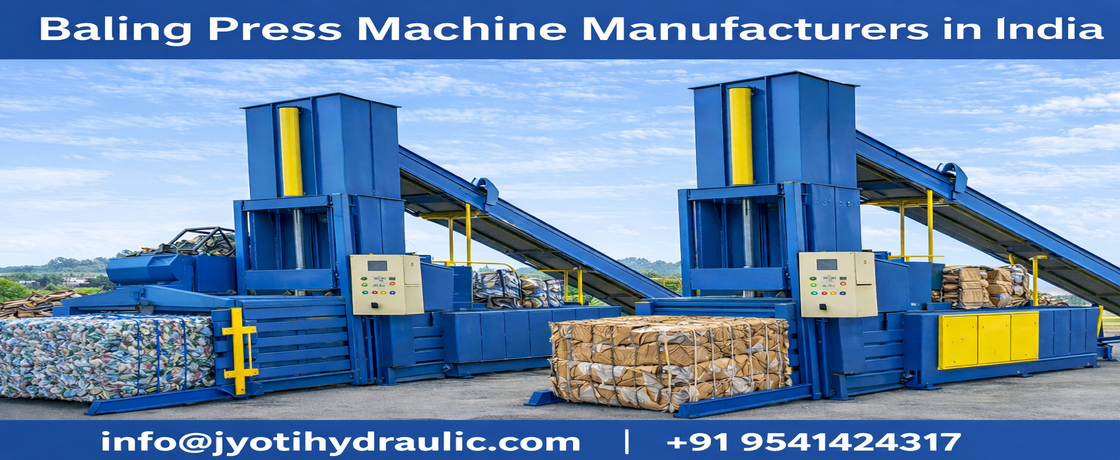
Jyoti Hydraulic is a trusted name in industrial hydraulic machinery, delivering robust and performance-driven baling press solutions for recycling, packaging waste management, paper scrap handling, and industrial material compaction. In today’s manufacturing and recycling environment, paper waste is no longer treated as ordinary scrap. It is a valuable recyclable resource that can reduce disposal costs, improve factory cleanliness, generate resale value, and support sustainable business operations.
A paper baling press machine plays a vital role in this process. It compresses loose paper, corrugated cartons, cardboard boxes, newspaper waste, paperboard, and packaging scrap into dense, stackable bales. These bales are easier to store, transport, weigh, sell, and recycle. For industries dealing with large volumes of paper or carton waste, a hydraulic baling press is not just a machine; it is a cost-saving asset.
As demand grows for reliable Carton Baling Machines Manufacturer in India, experienced Scrap Baling Machine Manufacturers in India, and advanced Baling Press Machine Manufacturers, industrial buyers are now looking for machines that offer strength, energy efficiency, safety, automation, and long service life. This complete guide explains everything decision-makers need to know before investing in a paper baling press machine for recycling.
What is a Paper Baling Press Machine?
A paper baling press machine is a hydraulic waste compacting system designed to compress loose paper-based materials into compact bales. These materials may include corrugated cartons, paper sheets, kraft paper, duplex board, newspapers, magazines, office paper, paper bags, cardboard packaging, and mixed recyclable paper scrap.
The machine uses hydraulic pressure to reduce the volume of bulky waste. Loose paper and carton scrap naturally occupy a large amount of space because of air gaps between materials. A baling press removes this excess volume by applying controlled compression force through a hydraulic ram.
The final output is a dense rectangular or compact bale that can be tied with wire, plastic strap, or other binding material.
In simple terms:
A paper baling press machine converts messy, loose, space-consuming waste into organized, compact, transport-ready bales.
This makes it highly useful for recycling plants, packaging industries, warehouses, retail chains, logistics centers, paper mills, printing units, and manufacturing facilities.
Industry Overview of Recycling & Waste Management
Industrial waste management has changed significantly in recent years. Earlier, many businesses treated paper and packaging waste as a disposal problem. Today, it is viewed as a recoverable industrial resource.
The growth of e-commerce, retail packaging, FMCG distribution, manufacturing, printing, and logistics has increased the generation of carton and paper waste. At the same time, businesses are under pressure to reduce landfill dependency, improve environmental compliance, and adopt sustainable recycling practices.
Paper recycling helps reduce the demand for virgin raw materials, lowers storage burden, and supports circular economy goals. However, recycling becomes efficient only when waste is properly collected, sorted, compressed, and transported.
This is where hydraulic baling machines become essential.
Industries that generate large volumes of paper waste face common challenges such as:
- Excessive storage space consumption
- High transportation cost due to loose waste volume
- Manual handling difficulty
- Fire and housekeeping risks
- Poor scrap value due to unorganized waste
- Inefficient recycling workflow
- Labor-intensive waste collection
A well-designed baling press machine solves these issues by creating compact bales with uniform shape, higher density, and better handling efficiency.
For this reason, businesses actively search for dependable Scrap Baling Machine Manufacturers in India and Baling Press Machine Manufacturers that can deliver machines suitable for heavy-duty industrial use.
Working Principle of Paper Baling Press Machines
The working principle of a paper baling press machine is based on hydraulic force transmission. Hydraulic systems use pressurized oil to generate high mechanical force. This force is applied through a cylinder and ram plate to compress the material inside the baling chamber.
Step-by-Step Working Process
1. Material Loading
Paper waste, cartons, cardboard, or corrugated scrap is loaded into the baling chamber. Loading may be done manually, through a conveyor, or by using a feeding trolley, depending on the machine design.
2. Chamber Filling
The material is evenly distributed inside the compression chamber. Proper filling helps achieve uniform bale density and better compaction.
3. Hydraulic Compression
The hydraulic pump sends pressurized oil to the cylinder. The cylinder pushes the ram plate forward or downward, depending on machine type. This ram compresses the paper waste against a fixed surface.
4. Pressure Holding
The machine maintains pressure for a short period to remove trapped air from the material. This improves bale compactness and reduces rebound after compression.
5. Bale Tying
Once the desired bale size and density are achieved, the bale is tied using wire, rope, or strapping material. Automatic machines may include auto-tying mechanisms.
6. Bale Ejection
The finished bale is ejected from the machine and moved for stacking, storage, transportation, or recycling.
The quality of the hydraulic system directly affects bale density, cycle time, power consumption, and machine reliability. That is why industrial buyers should always evaluate hydraulic cylinder quality, pump capacity, power pack design, and frame strength before selecting a baling machine.
Types of Paper & Carton Baling Machines
Different industries have different waste volumes, floor space availability, manpower levels, and automation needs. Therefore, paper baling machines are available in several designs.
1. Vertical Paper Baling Press Machine
A vertical baler compresses material from top to bottom. It is compact, economical, and suitable for small to medium waste volumes.
Best Suitable For:
- Retail stores
- Small warehouses
- Printing shops
- Packaging units
- Supermarkets
- Small recycling centers
- Offices with high paper waste
Key Benefits:
- Requires less floor space
- Easy to operate
- Lower investment cost
- Suitable for batch operation
- Simple maintenance
Vertical balers are ideal where waste generation is moderate and continuous automatic feeding is not required.
2. Horizontal Paper Baling Press Machine
A horizontal baler compresses material from one side to the other. It is generally used for higher production capacities and larger recycling operations.
Best Suitable For:
- Large recycling plants
- Paper mills
- Distribution centers
- E-commerce warehouses
- Corrugated box manufacturers
- Large manufacturing units
Key Benefits:
- High processing capacity
- Better bale density
- Suitable for conveyor feeding
- Faster cycle time
- Ideal for continuous operation
Horizontal balers are preferred by industries that handle large quantities of paper, carton, and cardboard waste every day.
3. Semi-Automatic Baling Press Machine
A semi-automatic baler offers a balance between manual operation and automation. Material feeding may be manual or conveyor-based, while compression is hydraulic and controlled through an electrical panel.
Advantages:
- Cost-effective automation
- Reduced labor effort
- Consistent bale formation
- Suitable for medium-scale industries
4. Fully Automatic Baling Press Machine
A fully automatic baling machine is designed for high-volume recycling lines. It can include conveyor feeding, PLC controls, automatic compression cycles, auto-tying, bale length control, and continuous output.
Advantages:
- Minimal manual intervention
- High productivity
- Uniform bale size
- Lower labor dependency
- Ideal for industrial-scale recycling
Fully automatic balers are suitable for businesses where waste processing speed and consistency are critical.
Technical Specifications & Features
A paper baling press machine must be selected based on waste volume, bale size, required pressure, available space, and production goals.
Common Technical Features
| Parameter | Typical Range |
|---|---|
| Pressing Force | 10 Ton to 150 Ton or more |
| Bale Weight | 30 kg to 1000 kg |
| Motor Power | 3 HP to 50 HP |
| Operation Type | Manual, Semi-Automatic, Automatic |
| Material Type | Paper, Carton, Cardboard, Plastic, Packaging Scrap |
| Bale Tying | Manual or Automatic |
| Chamber Size | Standard or Customized |
| Control System | Push Button, Relay Panel, PLC Control |
| Power Source | Electric Hydraulic Power Pack |
Important Machine Components
Hydraulic Cylinder
The cylinder is the heart of the baling machine. It converts hydraulic pressure into mechanical compression force. Heavy-duty cylinders ensure stable pressing and long service life.
Hydraulic Power Pack
The power pack includes the motor, pump, oil tank, valves, filters, and control elements. A properly designed power pack improves energy efficiency and prevents overheating.
Compression Chamber
The chamber holds the material during pressing. It must be made from high-strength steel to withstand repeated compression loads.
Ram Plate
The ram plate pushes and compresses the material. Its alignment, thickness, and structural strength affect bale quality.
Control Panel
The electrical control panel manages machine functions such as start, stop, compression, reverse movement, emergency stop, and automation sequence.
Bale Ejection System
The ejection system removes the finished bale safely and efficiently. It may be manual, hydraulic, or automatic depending on machine type.
Industrial Applications
Paper baling press machines are widely used across industries where paper or carton waste is generated in bulk.
Packaging Industry
Carton manufacturers and packaging units generate corrugated sheet waste, trimming waste, rejected boxes, and paperboard scrap. Baling machines help organize this waste for recycling.
Recycling Plants
Recyclers use balers to process collected paper waste into high-density bales before selling or sending them to paper mills.
Warehouses and Logistics Centers
Distribution centers receive and dispatch goods in cartons. As packaging waste accumulates quickly, balers help maintain clean and organized facilities.
E-Commerce Fulfillment Centers
E-commerce warehouses handle huge quantities of carton packaging. A carton baling machine reduces waste volume and improves material handling efficiency.
Printing and Publishing Units
Printing presses generate paper cuttings, rejected prints, newspaper waste, magazines, and paper rolls. Baling press machines make this scrap easier to sell and recycle.
Manufacturing Plants
Factories using paper-based packaging materials benefit from balers by reducing waste handling costs and improving workplace safety.
Advantages & Business Benefits
Investing in a paper baling press machine provides measurable operational and financial benefits.
1. Reduces Waste Volume
Loose paper and carton waste occupy large storage areas. A baling machine can reduce the volume significantly, creating more usable factory or warehouse space.
2. Lowers Transportation Cost
Transporting loose waste is inefficient because trucks carry more air than material. Compact bales allow more material to be transported in fewer trips.
3. Improves Scrap Value
Recycling buyers often prefer properly compressed and tied bales. Clean, dense, and organized bales can improve handling efficiency and may offer better resale value.
4. Enhances Workplace Safety
Loose cartons and paper waste can create slip hazards, fire risks, and poor housekeeping conditions. Baling keeps waste organized and controlled.
5. Reduces Labor Dependency
Manual waste handling is time-consuming. A baling press reduces repeated lifting, shifting, and storage work.
6. Supports Sustainability Goals
By improving recycling efficiency, companies can strengthen their environmental responsibility and reduce landfill waste.
Energy Efficiency & Cost Savings
Modern hydraulic baling machines are designed to provide strong compression without unnecessary energy wastage. Energy efficiency depends on motor selection, hydraulic circuit design, cycle time, oil flow control, and machine usage pattern.
How Baling Machines Save Cost
Reduced Storage Cost
Compact bales occupy less area, reducing the need for additional storage space.
Reduced Fuel and Freight Cost
Higher bale density means fewer vehicle trips, lower fuel consumption, and better transport planning.
Lower Manual Handling Cost
Automation reduces manpower requirements and improves daily productivity.
Better Waste Monetization
Organized recyclable bales are easier to weigh, sell, and process.
Long-Term ROI
Although a baling press requires initial investment, the savings in labor, space, transport, and scrap management often justify the cost over time.
This makes hydraulic baling machines a practical investment for B2B buyers, recycling contractors, paper mills, packaging companies, and industrial waste handlers.
Safety Features & Maintenance Tips
Safety is extremely important in hydraulic machinery. A reliable baling press should include operator-friendly safety systems and easy maintenance access.
Essential Safety Features
Emergency Stop Button
Allows the operator to stop machine operation immediately during an unsafe condition.
Door Safety Interlock
Prevents machine operation if the chamber door is open or not properly locked.
Pressure Relief Valve
Protects the hydraulic system from excessive pressure.
Motor Overload Protection
Prevents electrical damage caused by overload or abnormal current.
Safety Guards
Protect operators from moving parts and compression zones.
Controlled Ram Movement
Ensures smooth and stable pressing action.
Maintenance Tips for Long Machine Life
Check Hydraulic Oil Regularly
Low or contaminated oil can damage the pump, valves, and cylinder seals.
Inspect Hoses and Fittings
Hydraulic leakage reduces pressure and creates safety risks.
Clean the Chamber
Remove leftover material buildup to ensure smooth bale formation.
Lubricate Moving Parts
Proper lubrication reduces wear and improves machine performance.
Check Electrical Connections
Loose wiring can cause operational faults or downtime.
Monitor Bale Quality
Sudden changes in bale density may indicate hydraulic pressure loss or mechanical wear.
Preventive maintenance is always more economical than emergency repair. A well-maintained baling machine can deliver reliable performance for many years.
Buying Guide / Machine Selection Tips
Choosing the right paper baling press machine requires technical and practical evaluation.
1. Identify Daily Waste Volume
Estimate how much paper, carton, or cardboard waste your facility generates daily. Small volumes may require a vertical baler, while large volumes may need a horizontal or automatic baler.
2. Check Material Type
Different materials compress differently. Corrugated cartons, mixed paper, hard cardboard, and laminated packaging may require different pressure levels.
3. Decide Bale Size and Weight
Bale size affects storage, transport, and buyer preference. Choose a machine that produces bales suitable for your handling system.
4. Consider Available Floor Space
Vertical balers save space, while horizontal balers require larger installation areas but offer higher capacity.
5. Evaluate Labor Availability
If manpower is limited, semi-automatic or fully automatic machines can improve productivity.
6. Review Power Consumption
Select machines with efficient hydraulic systems and suitable motor ratings.
7. Think About Future Growth
Choose a machine that can handle increased waste volume as your business expands.
How to Choose the Right Manufacturer
Selecting the right manufacturer is critical for long-term performance, service support, and machine reliability.
Key Points to Evaluate
Industry Experience
Experienced manufacturers understand real operating conditions and design machines accordingly.
Hydraulic Expertise
Since baling machines depend heavily on hydraulic performance, the manufacturer must have strong knowledge of cylinders, pumps, valves, and power packs.
Customization Capability
Every industry has different requirements. A good manufacturer can customize chamber size, pressing force, feeding style, automation level, and bale output.
Build Quality
Check machine frame strength, welding quality, steel thickness, cylinder design, and overall construction.
After-Sales Service
Reliable service support ensures minimum downtime and smooth operation.
Spare Parts Availability
Availability of hydraulic seals, hoses, valves, electrical components, and mechanical parts is essential for long-term use.
As one of the dependable Carton Baling Machines Manufacturer in India, Jyoti Hydraulic focuses on delivering practical, durable, and application-specific baling press solutions for industrial customers.
Comparison-Based Insight: Vertical vs Horizontal Baling Machine
| Factor | Vertical Baler | Horizontal Baler |
|---|---|---|
| Space Requirement | Low | High |
| Investment Cost | Lower | Higher |
| Production Capacity | Small to Medium | Medium to High |
| Feeding Method | Mostly Manual | Manual or Conveyor |
| Automation Level | Basic to Semi-Automatic | Semi-Automatic to Fully Automatic |
| Best For | Small industries, warehouses | Recycling plants, large factories |
| Bale Density | Moderate | Higher |
For low to medium waste generation, a vertical baler is usually sufficient. For continuous and high-volume recycling operations, a horizontal baling press is a better choice.
Future Trends in Recycling Machinery
The recycling machinery sector is moving toward smarter, safer, and more energy-efficient systems.
1. Automation in Waste Handling
Automatic feeding, compression, tying, and bale ejection are becoming increasingly popular in large recycling plants.
2. PLC-Based Control Systems
PLC controls improve operational accuracy, cycle consistency, and fault diagnosis.
3. Energy-Efficient Hydraulic Design
Modern machines are being designed to reduce energy consumption while maintaining high compression force.
4. Data Monitoring
Future machines may include sensors for monitoring cycle count, oil temperature, pressure levels, and maintenance alerts.
5. Integrated Recycling Lines
Balers are increasingly being integrated with shredders, conveyors, sorting systems, and material handling equipment.
6. Sustainable Manufacturing
Industries are choosing machinery that supports cleaner operations, lower emissions, and improved recycling efficiency.
Companies that invest early in advanced baling technology can improve productivity, reduce costs, and strengthen their position in sustainable manufacturing.
Why Choose Jyoti Hydraulic
Jyoti Hydraulic is committed to delivering high-performance hydraulic baling machines engineered for demanding industrial environments. The company understands that every customer has different waste handling requirements, which is why machine design, pressure capacity, chamber size, and automation level can be customized as per application.
Key Strengths of Jyoti Hydraulic
Strong Hydraulic Engineering
Machines are built with reliable hydraulic systems for consistent compression and long-term performance.
Heavy-Duty Construction
Robust machine frames are designed to handle repeated industrial loads and tough working conditions.
Custom Machine Solutions
Jyoti Hydraulic offers application-specific baling solutions for paper, carton, cardboard, packaging scrap, and other recyclable materials.
Energy-Efficient Operation
Machines are designed to deliver effective compression with optimized power usage.
Industrial-Grade Components
Quality components help improve machine life, reduce downtime, and support continuous operation.
Customer-Focused Support
From machine selection to after-sales guidance, Jyoti Hydraulic supports customers with practical technical expertise.
For businesses searching for trusted Baling Press Machine Manufacturers, Scrap Baling Machine Manufacturers in India, or a reliable Carton Baling Machines Manufacturer in India, Jyoti Hydraulic offers dependable solutions backed by industrial experience.
Conclusion
A paper baling press machine is an essential investment for industries that generate paper, carton, cardboard, and packaging waste. It reduces waste volume, improves storage efficiency, lowers transportation cost, enhances workplace safety, and supports profitable recycling operations.
Whether your business operates a warehouse, recycling plant, packaging unit, paper mill, printing press, or manufacturing facility, choosing the right baling press machine can significantly improve waste management performance.
With strong expertise in hydraulic systems and industrial machinery, Jyoti Hydraulic provides durable, efficient, and customized baling press solutions for modern recycling needs. By selecting the right machine and manufacturer, businesses can achieve better productivity, cleaner operations, and long-term cost savings.
FAQs – Paper Baling Press Machine for Recycling
1. What is a paper baling press machine used for?
A paper baling press machine is used to compress loose paper, cardboard, cartons, corrugated boxes, newspaper waste, and packaging scrap into compact bales for easy storage, transportation, and recycling.
2. Which industries use carton baling machines?
Carton baling machines are used in packaging industries, warehouses, logistics centers, e-commerce fulfillment centers, recycling plants, manufacturing units, supermarkets, and paper mills.
3. What is the difference between a paper baler and a scrap baling machine?
A paper baler is mainly designed for paper, carton, and cardboard waste. A scrap baling machine may be designed for various recyclable materials such as paper, plastic, metal scrap, textile waste, or other industrial waste, depending on the machine structure and hydraulic capacity.
4. How do I choose the right paper baling press machine?
You should consider daily waste volume, material type, required bale size, available floor space, automation level, power availability, and future expansion needs before selecting a baling press machine.
5. Is a hydraulic baling press machine suitable for heavy-duty industrial use?
Yes. Hydraulic baling press machines are ideal for heavy-duty industrial applications because they provide high compression force, stable operation, strong bale density, and reliable performance.
6. Can Jyoti Hydraulic customize baling machines?
Yes. Jyoti Hydraulic can provide customized baling press machines based on chamber size, pressing force, bale output, feeding method, automation level, and industrial application requirements.
7. Why should businesses invest in a paper baling machine?
Businesses should invest in a paper baling machine to reduce waste volume, lower transportation costs, improve workplace cleanliness, increase recycling value, reduce labor effort, and support sustainable waste management.
8. What maintenance is required for a paper baling press machine?
Regular maintenance includes checking hydraulic oil, inspecting hoses and seals, cleaning the chamber, lubricating moving parts, checking electrical connections, and monitoring machine pressure and bale quality.
Contact Jyoti Hydraulic for Expert Baling Press Solutions
If you are planning to upgrade your recycling process, reduce waste handling costs, or invest in a reliable paper and carton baling machine, Jyoti Hydraulic can guide you with the right industrial solution.
Get expert support for machine selection, customized design, quotation, installation guidance, and technical consultation.
Contact Details
📧 info@jyotihydraulic.com
📞 +91 9541424317
Contact Jyoti Hydraulic today to request a quotation, discuss your custom machine requirements, and get professional industrial consultation for advanced hydraulic recycling machinery.


