From Fixture Loading to Component Release
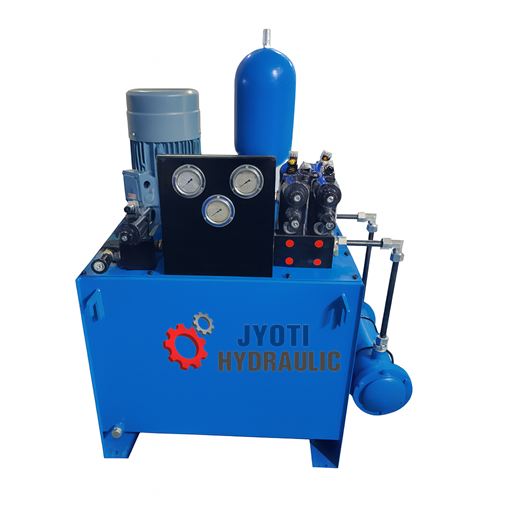
A CNC clamping power pack typically brings together an electric motor, hydraulic pump, reservoir, control valves and filtration components. Its role extends beyond moving a clamp forwards and backwards. The hydraulic arrangement must support the complete workholding sequence.
Clamp: After the component is correctly located, the circuit directs oil to the clamping elements. Their movement secures the workpiece against the fixture’s locating and supporting surfaces.
Hold: During machining, the system must maintain the required holding condition. How this is achieved depends on the clamp design, valve arrangement and pressure-maintenance strategy.
De-clamp: Once machining has stopped and the machine permits release, the circuit allows the clamps to retract or release according to their design.
Single-acting clamps commonly use hydraulic pressure in one direction and spring return in the other. Double-acting clamps use hydraulic pressure for both movements. The power pack’s valve arrangement must match the installed clamping elements.
The Right Force Matters More Than Maximum Pressure
Excessive clamping force can distort a workpiece, particularly when machining thin walls or less rigid components. Insufficient force can allow movement under cutting loads.
The correct operating pressure therefore depends on the fixture design, clamp characteristics, workpiece geometry and machining forces. A higher-pressure unit is not automatically a better choice.
Flow also matters. It influences clamp movement time, but excessive flow can exceed a clamping element’s permitted operating speed. Pump selection should account for the total oil volume required by the fixture and the recommended movement rates of its components.
Specify the Functions Your Fixture Needs
When discussing a CNC hydraulic power pack with Jyoti Hydraulic, identify which functions your application requires:
- Pressure adjustment: To establish the approved clamping pressure for the fixture.
- Directional control: To operate the clamp and release movements.
- Pressure monitoring: To provide a gauge reading or an electrical signal where specified.
- Multiple circuits: Where separate fixture groups require independent control.
- Sequenced operation: Where supports, locating devices and clamps must act in a defined order.
- Pressure maintenance: To maintain the required hydraulic condition during the machining cycle.
- Filtration and oil management: To support reliable operation of the selected valves and actuators.
- Machine-control interface: To coordinate hydraulic commands and feedback with the CNC or PLC.
These are configuration requirements to review, rather than a statement that every unit includes every function. The approved quotation should identify the supplied equipment and controls.
Connecting the Power Pack to a CNC Machine
Electrical compatibility is as important as hydraulic compatibility. Confirm the valve-coil voltage, available command signals, feedback requirements and machine interlocks before installation.
Where supported by the machine controller, clamp and de-clamp commands may be coordinated through programmed functions. The required interface must be agreed with the machine builder or controls integrator.
A pressure signal alone does not prove that the workpiece is correctly seated or that every clamp has reached its intended position. Depending on the fixture, additional position or seating detection may be necessary.
The intended response to power loss or pressure loss must also be defined during circuit design; it should not be assumed from the power pack’s name.
Suitable Workholding Applications
Depending on the selected fixture and hydraulic circuit, these power packs can serve:
- Hydraulic fixtures on vertical and horizontal machining centres.
- Drilling, milling and boring fixtures.
- Compatible swing clamps, link clamps and hydraulic cylinders.
- Multi-component fixtures requiring coordinated clamping.
- Dedicated machining stations with hydraulic workholding.
Chuck actuation, rotating fixtures and pallet systems can introduce additional requirements. Confirm their specific compatibility before selecting a unit.
Get a Quotation Based on Your Fixture
Send Jyoti Hydraulic your fixture drawing or hydraulic diagram, together with the following details:
Clamping equipment: Clamp type, quantity, operating pressure and oil-volume requirements.
Production cycle: Required clamping time, machining duration and cycles per hour.
Control arrangement: Number of independent circuits, movement sequence and feedback signals.
Installation details: Electrical supply, available space and connection requirements.
For a replacement power pack, include photographs of the existing unit and its nameplate.
Pricing depends on the pump and motor selection, reservoir, valve arrangement, monitoring devices, electrical controls and accessories. Confirm the inclusion of hoses, connectors, oil and installation support when comparing offers.
Practical Questions Before Ordering
Can one unit operate several clamps?
Yes, if it is correctly sized for the combined oil demand and required sequence. Connecting several clamps to one circuit does not guarantee identical movement timing.
Does de-clamping always require hydraulic pressure?
No. Some clamps return by spring force when pressure is released; others require hydraulic pressure for the return stroke. The circuit must suit the clamp design.
Can the same pressure setting be used for every component?
Only where the fixture and machining assessment permit it. Different component geometries or materials may require different clamping conditions.
Will hydraulic clamping improve machining accuracy?
It can support more consistent workholding, but accuracy also depends on locating surfaces, fixture rigidity, tooling, machine condition and cutting parameters.
Talk to Jyoti Hydraulic
Share your CNC fixture requirements to discuss the appropriate hydraulic configuration, supply scope and price.
Phone: +91 9541424317
Email: info@jyotihydrauli.com
Request a CNC Clamping Power Pack Quotation

 19 Oct
 15 Oct
 13 Oct


