Start with the Press Cycle
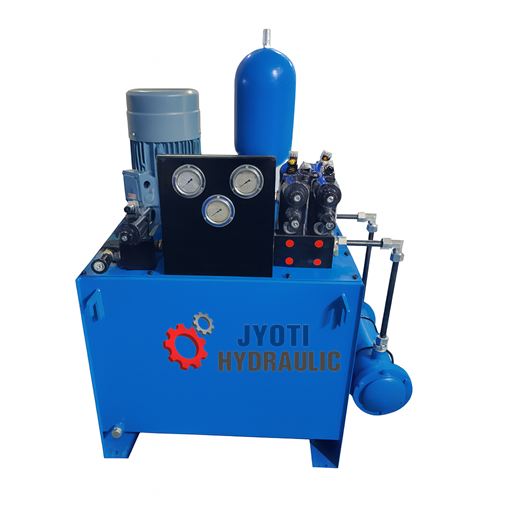
A hydraulic press power pack supplies oil flow to the press cylinder, with pressure developing as the system encounters resistance. The motor, pump, reservoir and control valves work together to produce the required ram movement and pressing action.
Each stage of the cycle places a different demand on the hydraulic system:
| Cycle stage | What the hydraulic system must provide |
|---|
| Approach | Oil flow for the specified ram movement towards the workpiece |
| Pressing | Pressure and flow appropriate to the required force and working speed |
| Dwell, where required | The specified holding condition for an agreed duration |
| Decompression, where required | Controlled release of stored hydraulic pressure |
| Return | Oil routing and flow to retract the ram |
| Idle | A suitable operating state between cycles |
Not every press requires every stage. The circuit should reflect the actual process, including any ejector, cushion or additional cylinder movements.
Matching Force, Speed and Motor Power
Pressing Force
Cylinder force depends on hydraulic pressure and the effective piston area. The same power pack pressure can produce different forces when connected to cylinders of different sizes.
For this reason, specifying only the press tonnage is insufficient. Cylinder bore, rod diameter, operating direction and mechanical losses must also be considered.
Ram Speed
Ram speed depends on oil flow and the effective cylinder area. A larger pump may increase movement speed, but the valves, pipework and cylinder must accommodate that flow.
Approach speed and pressing speed often differ. The selected circuit must manage the transition according to the process requirements.
Motor Capacity
Motor selection depends on the pressure and flow required together, along with efficiency and duty cycle. Choosing a motor by horsepower alone can overlook the most demanding part of the press cycle.
Where rapid movement and high pressing force occur at different stages, an appropriately designed pump and control arrangement can match the hydraulic output to each stage.
What to Specify in Your Power Pack
The final configuration should identify the components and functions needed for your press.
- Pump arrangement: Selected according to operating pressure, flow and cycle demands.
- Electric motor: Matched to hydraulic power requirements and the available electrical supply.
- Reservoir: Sized with consideration for system oil volume, circulation and operating conditions.
- Pressure-control valves: Specified to regulate and limit pressure within the approved circuit design.
- Directional valves: Arranged to control the required cylinder movements.
- Filtration: Selected to meet the cleanliness requirements of the hydraulic components.
- Monitoring: Gauges, switches or sensors according to the required indication and feedback.
- Temperature management: Cooling provision where the assessed heat load requires it.
- Electrical interface: Defined for the agreed manual, relay-based or PLC-controlled operating sequence.
These items form a selection checklist. Included components, ratings and control functions should be confirmed in Jyoti Hydraulic’s technical quotation.
Applications: Select by Process, Not Just Press Size
Hydraulic press power packs can serve pressing, assembly, straightening, forming and compression operations when configured for the connected machine.
A bearing-fitting application may require controlled movement and a defined stopping point. A forming process may need several pressure and speed stages. A compression operation may require a dwell period before release.
The power pack must also work with the press frame, tooling, cylinders and machine controls. Installing a higher-pressure unit does not increase the approved capacity of the complete press.
Replacing an Existing Unit?
Before ordering a replacement, establish what the current system delivers and what needs to change.
Provide the existing hydraulic diagram, motor and pump nameplates, cylinder dimensions, working pressure and observed cycle times. Explain whether the objective is to replace worn equipment, improve a specific movement or support a revised process.
Slow movement, pressure loss and overheating can originate in cylinders, valves or pipework as well as the power pack. Reviewing the complete circuit helps avoid replacing a unit without addressing the underlying problem.
Hydraulic Press Power Pack Price
Price depends on the approved operating requirements and included equipment. Pump type, motor rating, reservoir size, valve arrangement, controls, cooling and additional circuits all influence the quotation.
For a meaningful comparison, check that offers cover the same pressure and flow requirements, duty cycle and accessories. Confirm whether hoses, electrical panels, hydraulic oil, commissioning and installation assistance are included.
Send Jyoti Hydraulic these details for a quotation:
- Press application and required force.
- Cylinder bore, rod diameter and stroke.
- Approach, pressing and return speeds.
- Dwell time and cycles per hour.
- Number of cylinders and movement sequence.
- Electrical supply and control requirements.
- Installation space and operating environment.
Frequently Asked Questions
Can a power pack be selected from press tonnage alone?
No. Tonnage describes force, while power-pack selection also requires cylinder dimensions, movement speeds, operating pressure and duty-cycle information.
Can it maintain pressure during a dwell period?
A suitably designed circuit can provide a specified pressure-holding function. Holding duration, acceptable pressure variation and leakage behaviour must be defined before selection.
Does constant hydraulic pressure mean constant pressing force?
Pressure provides an indication of cylinder force, but friction, return-side pressure and mechanical effects influence the force delivered. Applications requiring verified force control may need additional measurement and control equipment.
Is an oil cooler always required?
No. Cooling requirements depend on heat generation, operating hours, ambient conditions and the system’s ability to dissipate heat.
Does the power pack include complete press safety controls?
The supply scope must state the included controls. Pressure relief alone does not provide all the safeguarding required for a complete press; hydraulic functions must be coordinated with the machine’s protective systems.
Request a Technical Offer from Jyoti Hydraulic
Share your press specifications or existing equipment details to discuss a suitable hydraulic power pack and project pricing.
Phone: +91 9541424317
Email: info@jyotihydrauli.com
Enquire About Your Press Application

 8 Oct
 7 Oct
 6 Oct


