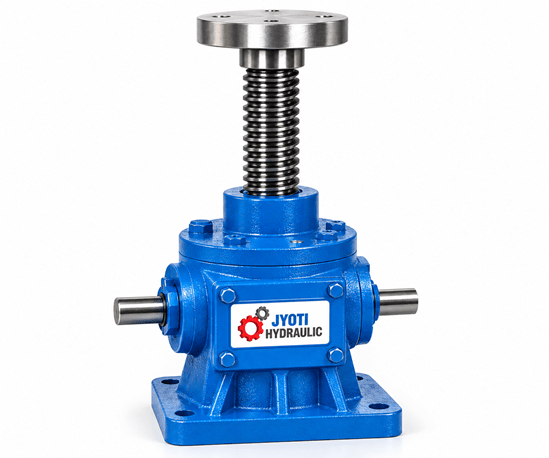
Worm Gear Screw Jack 15 Ton
Moving a heavy machine component is only part of the job. Bringing it to the required height, maintaining alignment and making controlled adjustments are equally important. The Worm Gear Screw Jack 15 Ton from Jyoti Hydraulic is intended for industrial lifting and positioning applications where a mechanical screw drive provides controlled linear movement.
A worm gear screw jack converts rotary input into the movement of a lifting screw or travelling nut. This arrangement can be incorporated into machinery for raising, lowering, levelling and adjusting heavy assemblies. Selecting the right configuration involves more than checking the load rating: stroke length, operating speed, mounting arrangement and frequency of use all affect the suitability of the unit.
The 15-ton designation identifies the nominal capacity class. The permissible working load for a particular installation must be confirmed against the selected screw, extension length and operating conditions.
📞 Get in Touch
📞 +91 9541424317
📧 jyotihydraulic@gmail.com
Get Your Quote Instantly
How the Worm Gear Screw Jack Works
The mechanism combines a worm shaft, worm wheel and threaded lifting assembly. Turning the input shaft drives the worm wheel, which transfers motion through the screw mechanism to produce linear travel. Gear reduction allows the input to move a substantial axial load at a controlled rate.
The movement depends on the screw arrangement:
- Translating screw: The lifting screw moves through the housing. It must be restrained from rotating, either by the connected load or by a suitable anti-rotation arrangement.
- Rotating screw: The screw rotates while a restrained travelling nut moves along its length. The nut connects to the component being positioned.
Reversing the input direction reverses the movement. The distance travelled per input revolution depends on the screw lead and gear ratio. These values determine how much input rotation is needed to achieve the required adjustment.
Key Features and Practical Benefits
- 15-ton nominal capacity class: For heavy axial load applications, subject to confirmation of the working conditions.
- Worm gear reduction: Converts input rotation into slower, controlled movement through the screw mechanism.
- Progressive height adjustment: Allows operators or a drive system to approach the required position gradually.
- Mechanical actuation: Produces movement through gears and threads without requiring a hydraulic pressure circuit for the jack itself.
- Machine integration: Can form part of a guided lifting, levelling or positioning assembly.
- Drive selection: Manual or motor-driven operation can be evaluated according to input torque, travel distance and operating frequency.
- System configuration: Single-jack and linked arrangements can be considered according to the load geometry and lifting points.
Drive arrangements, accessories and construction details should be confirmed for the Jyoti Hydraulic configuration being ordered.
Technical Specifications to Confirm
Only the product name, brand and nominal capacity have been provided. The remaining specifications should be completed from the approved product drawing or quotation.
| Parameter | Product detail |
|---|---|
| Product name | Worm Gear Screw Jack 15 Ton |
| Brand | Jyoti Hydraulic |
| Nominal capacity designation | 15 ton; confirm rated axial load and applicable operating conditions |
| Mechanism | Worm gear and screw drive |
| Stroke length | To be specified for the application |
| Screw arrangement | Translating or rotating, subject to configuration |
| Gear ratio and screw lead | To be confirmed |
| Operating speed | Based on screw lead, gear ratio and permitted input speed |
| Input torque | To be calculated for the selected load and configuration |
| Drive arrangement | To be confirmed: manual or motor-driven |
| Mounting and end connection | According to the approved installation drawing |
| Materials and surface protection | To be confirmed |
| Duty cycle and lubrication | According to the supplied operating instructions |
Where a 15 Ton Screw Jack Can Be Used
Typical applications to evaluate include:
- Raising and lowering guided industrial platforms.
- Adjusting the height of heavy machine beds and assemblies.
- Positioning workpieces in fabrication and assembly fixtures.
- Setting the elevation of conveyor sections and transfer equipment.
- Aligning heavy components during machinery installation.
- Adjusting process equipment where controlled linear travel is required.
- Operating linked lifting points within an engineered jacking system.
The jack should provide the intended axial movement, while the surrounding structure guides and stabilises the load. Application selection should account for load guidance, side forces, stroke, speed and required positioning accuracy. These are also identified as selection inputs in Power Jacks’ application analysis guidance.
Understanding the 15 Ton Capacity
A capacity figure does not describe every condition in which a jack can operate. A load centred over a short, guided screw presents a different requirement from the same load on a long, extended screw.
For a screw operating in compression, increasing the unsupported length can make buckling a limiting factor. The mounting arrangement and end support therefore matter alongside the load itself. A tensile application requires a separate check of the screw, attachments and supporting structure.
The load calculation should include the moving platform, fixtures and equipment as well as the workpiece. Starting, stopping, vibration and uneven loading may also affect the forces acting on the system.
In a multiple-jack installation, dividing the total weight by the number of jacks is only an initial estimate. An offset centre of gravity or a flexible platform can place a larger share of the load on one lifting point.
Choosing the Stroke, Speed and Drive
The required stroke is the usable travel needed to complete the movement. Installation planning must also allow space for the screw in its retracted and extended positions, protective covers and the connected load.
For occasional adjustments over a short distance, manual operation may be practical if the required input effort is acceptable. Longer travel or frequent adjustment may justify a motor-driven arrangement. Motor selection must consider starting torque, running torque, desired travel speed and transmission losses.
Higher speed also increases the importance of thermal performance. Worm gearing and sliding screw threads generate heat, so a heavy load rating should not be interpreted as a continuous-running rating. Some machine screw jack ranges are specifically intended for low-duty lifting and positioning, as described by Power Jacks. The permitted duty cycle of the selected Jyoti Hydraulic unit should be confirmed before specifying repeated operation.
Positioning Accuracy and Load Holding
Controlled movement and guaranteed positioning accuracy are different requirements. Actual positioning performance depends on screw lead accuracy, backlash, structural stiffness, load variation and the method used to stop the drive.
Backlash can become noticeable when the direction reverses: the input may turn slightly before the load begins moving in the opposite direction. Applications involving repeated approach from both directions should specify an acceptable backlash or positioning tolerance.
Load holding also requires confirmation. A worm gear arrangement should not automatically be described as self-locking under every condition. Screw geometry, gearing, lubrication and vibration can influence resistance to back-driving. Where the application requires positive holding, the brake or mechanical locking arrangement should be established during system design.
Using Multiple Jacks Together
A linked jacking system can move a broad platform or long assembly through several lifting points. Depending on the design, shafts, couplings and bevel gearboxes can distribute the drive between jacks.
Successful operation depends on matching travel characteristics, setting the initial positions correctly and maintaining alignment. The supporting structure must be sufficiently rigid, and the load must remain within the permitted value at each jack. Separately driven motors require an appropriate synchronisation method if the lifting points must maintain the same position.
Installation and Maintenance
Mount the jack on a rigid, accurately aligned surface and position the load connection so that the force acts along the screw axis. Guide rails or another suitable arrangement should manage lateral movement and prevent the screw from becoming the primary guide for the load.
Routine maintenance should include:
- Lubricating the screw and gearbox with the specified lubricant.
- Inspecting exposed threads for contamination, damage and wear.
- Checking mounting bolts, couplings and load connections.
- Watching for increasing backlash, unusual noise or rising operating effort.
- Inspecting screw covers and other protective components.
- Checking travel controls and holding devices where fitted.
Maintenance intervals should reflect the load, operating frequency and environment. Dust, moisture and abrasive particles can increase wear when they reach the working threads.
Frequently Asked Questions
Can this screw jack lift 15 tons through its full stroke?
The permissible load over the full stroke must be confirmed for the selected screw length, mounting and operating conditions. Long compression strokes may be limited by screw buckling.
Can it be operated with an electric motor?
A motor-driven arrangement can be evaluated. Motor power, starting torque, speed, coupling and any brake requirement must be matched to the application.
Will it hold the load when the drive stops?
Confirm the holding characteristics of the supplied configuration. Do not assume that every worm gear screw jack is self-locking.
Can it operate horizontally?
Horizontal positioning may be possible with a suitable configuration. Selection should use the required pushing or pulling force, guidance arrangement and mounting conditions.
Can several units lift one platform?
Yes, as part of an engineered system. Load distribution, matched travel, alignment and synchronisation must be addressed.
What determines the price?
Price depends on stroke, screw arrangement, materials, gear ratio, drive components, end fittings and accessories. A quotation should define the complete supply scope.
Discuss Your Requirement with Jyoti Hydraulic
For a Worm Gear Screw Jack 15 Ton, share the total moving load, required stroke, lifting speed, mounting orientation and operating frequency with Jyoti Hydraulic. Include a drawing or layout showing the lifting points and available space so the proposed configuration can be checked against the actual application.
Blogs
-
Hydraulic Cylinder with Power Pack Manufacturers in India – Jyoti Hydraulic
Read MoreJyoti Hydraulic brings the conversation about hydraulic cylinders and power…
-
PET Bottle Hydraulic Baling Press Machine: Working, Benefits & Applications – Jyoti Hydraulic
Read MoreJyoti Hydraulic offers PET bottle baling equipment for businesses that…
-
Hydraulic Jack Price in India – Latest 2026 Guide | Jyoti Hydraulic
Read MoreJyoti Hydraulic offers industrial hydraulic lifting solutions designed for strength,…