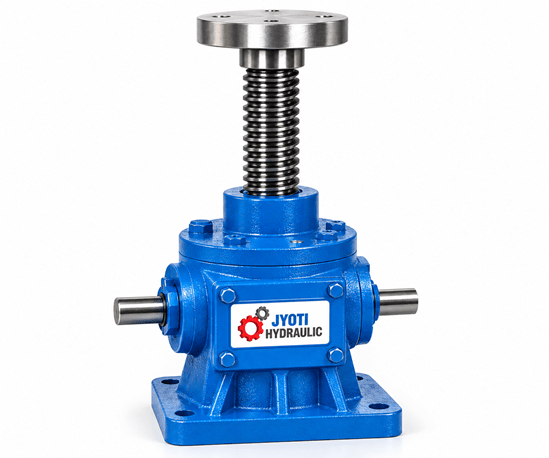
Worm Gear Screw Jack 75 Ton
The Worm Gear Screw Jack 75 Ton from Jyoti Hydraulic is a mechanical lifting and positioning solution for heavy industrial equipment. It uses a worm gear mechanism and threaded screw arrangement to convert rotary input into controlled linear movement. Typical requirements include adjusting machine assemblies, positioning heavy components and moving guided platforms.
Selecting a heavy-duty screw jack requires more than matching its capacity to the weight of a load. Stroke length, mounting arrangement, operating speed and load distribution all influence the correct configuration. The 75-ton designation should therefore be considered alongside the approved operating limits for the specific application.
📞 Get in Touch
📞 +91 9541424317
📧 jyotihydraulic@gmail.com
Get Your Quote Instantly
How Does a Worm Gear Screw Jack Work?
The input shaft drives a worm, which engages with a worm wheel inside the gearbox. The gear reduction transfers motion to the screw mechanism, producing lifting or lowering movement.
In a translating screw arrangement, the lifting screw moves through the housing and requires restraint against rotation. In a rotating screw arrangement, the screw rotates while a restrained travelling nut moves along its length. The appropriate design depends on the installation space, load connection and machine layout.
Movement per input revolution depends on screw lead and gear reduction. This relationship allows engineers to select a combination of travel speed and mechanical advantage for the required task. Jyoti Hydraulic’s mechanism guide
What Does the 75-Ton Capacity Mean?
The capacity designation identifies the load class of the product. It does not establish that every stroke, speed or mounting arrangement can operate at that load.
Before ordering, confirm whether the specified rating applies to moving loads, stationary loads, compression, tension or a particular combination of conditions. Also confirm the unit convention used for “ton” in the approved datasheet.
For a lifting platform, the load calculation must include the platform, fixtures and carried material. Where several jacks support one structure, each jack’s load depends on the centre of gravity and support layout. Dividing the total weight equally between the lifting points may underestimate the load at the most heavily loaded position.
Key Features and Configuration Choices
The main functional characteristics of this type of screw jack include:
- Worm gear reduction for controlled mechanical movement.
- A threaded lifting mechanism that converts rotation into linear travel.
- Integration into machinery for lifting, lowering or position adjustment.
- Selection of screw arrangement to suit the machine layout.
- Drive selection based on required input torque and operating frequency.
- Potential integration into a coordinated multiple-jack system.
Discuss motorised operation, manual drive, screw protection, position feedback and travel controls with Jyoti Hydraulic. Their availability and suitability should be confirmed for the quoted 75-ton configuration. Jyoti Hydraulic product range
Technical Specifications to Confirm
Use the approved quotation and dimensional drawing to finalise the following details:
| Parameter | Specification or confirmation required |
|---|---|
| Product | Worm Gear Screw Jack 75 Ton |
| Brand | Jyoti Hydraulic |
| Capacity designation | 75 ton; confirm rating basis and operating conditions |
| Mechanism | Worm gear and screw drive |
| Working stroke | Required travel in millimetres |
| Screw arrangement | Translating or rotating, as offered |
| Permitted loading | Compression, tension and mounting restrictions |
| Gear reduction | Ratio selected for the application |
| Screw dimensions | Diameter, thread form and lead |
| Drive requirements | Starting torque, running torque and permissible input speed |
| Motor selection | Power, speed, brake and electrical supply, where applicable |
| Operating limits | Travel speed, duty cycle and thermal restrictions |
| Installation dimensions | Closed height, extended height, mounting and shaft details |
| Materials and finish | Confirm component grades and environmental protection |
| Position control | Confirm limit switches, feedback and stopping requirements |
| Lubrication | Approved lubricant and service interval |
Selecting the Correct Stroke and Mounting Arrangement
Stroke is the distance through which the load must move. Installation drawings must also account for the screw’s full extended position, retracted envelope and clearance around connected components.
A longer screw in compression can be more susceptible to buckling. Consequently, the permitted load must be checked against unsupported screw length and end restraint. A nominal capacity alone is insufficient for approving a long-stroke installation.
The load should act along the intended screw axis. Separate guides should control sideways movement and prevent the lifting screw from becoming the platform’s lateral guide. Alignment must be maintained throughout the full travel, including under load when the supporting structure may deflect. Jyoti Hydraulic’s selection guidance
Drive Selection, Speed and Operating Frequency
Motor power should be selected from the actual torque and speed requirements. The motor must start the loaded mechanism reliably and provide the required travel rate within the jack’s operating limits.
For mechanically connected systems, selection must also consider losses through shafts, couplings and gearboxes. Increasing motor size does not increase the jack’s permissible load.
Operating frequency matters because friction generates heat during movement. A jack used for occasional machine adjustment may have a very different thermal requirement from one that repeatedly lifts and lowers throughout a production shift. Specify movement duration, rest periods and cycles per hour when requesting a quotation.
Machine screw jacks are generally associated with slower movement and low to moderate duty cycles; the exact operating limits remain model dependent. Machine screw jack characteristics
Load Holding and Self-Locking
Self-locking describes a mechanism’s resistance to being driven backwards by the applied load. It must be verified for the selected screw and gearing combination.
Do not assume that every worm gear screw jack will hold its load under every operating condition. Vibration and the mechanism’s efficiency can affect the need for a brake. Where unintended movement could create a hazard, the machine design must include suitable holding and protective measures.
A holding brake, travel limit switch and mechanical support serve different purposes. Their selection should follow the requirements of the complete lifting installation. Technical explanation of self-locking
Application Areas
A 75-ton screw jack may be evaluated for applications such as:
- Height adjustment of heavy machine beds.
- Positioning of large fabrication fixtures.
- Movement of guided industrial platforms.
- Alignment of heavy assemblies during production.
- Adjustment mechanisms within material-handling systems.
- Engineered maintenance and equipment-positioning arrangements.
Suitability depends on the actual forces, travel requirements and installation design. The application name alone does not establish that a particular configuration is suitable.
Using Several Jacks in One System
Large structures may require several lifting points. Mechanically linked jacks can share a drive through suitable transmission components, while separately driven systems require an appropriate coordination strategy.
The design must account for unequal loading, shaft twist, backlash and structural flexibility. Matching nominal jack capacities does not, by itself, establish a safe system capacity or guarantee that a platform will remain level.
Provide the support-point spacing, load location and allowable level difference when discussing a multiple-jack installation.
Inspection and Maintenance
A maintenance plan should follow the supplied operating manual and actual service conditions. Useful inspection points include:
- Screw condition and lubricant coverage.
- Mounting security and load alignment.
- Coupling and drive-shaft condition.
- Changes in operating noise or input effort.
- Backlash or deterioration in positioning behaviour.
- Condition of guards and screw protection.
- Operation of fitted brakes and travel controls.
Record inspection findings so gradual changes can be identified. Maintenance work should only begin after the load and drive system have been secured according to the installation’s procedures.
Worm Gear Screw Jack 75 Ton Price
The price depends on the supplied configuration. Stroke length, screw arrangement, drive equipment, mounting details, protective accessories and control requirements can change the scope considerably.
For a meaningful quotation comparison, check whether each offer includes the jack alone or a complete operating assembly. Also compare drawings, documentation, inspection requirements, delivery terms and installation responsibilities.
Request a Quotation from Jyoti Hydraulic
Share the following information to help define the required configuration:
- Maximum working load and its distribution.
- Required stroke and travel speed.
- Number and position of lifting points.
- Mounting orientation and available space.
- Operating cycles and movement duration.
- Manual or motorised drive preference.
- Environmental conditions.
- Required positioning tolerance and holding arrangement.
- Machine drawing or installation sketch.
A clearly defined requirement helps establish the correct screw jack, drive and supporting equipment before manufacturing or installation.
Frequently Asked Questions
Can the jack move a 75-ton load through any stroke?
The permitted load must be checked for the specified stroke and mounting conditions. Long extensions, load direction and operating requirements can affect suitability.
Is this a hydraulic jack?
The worm gear screw jack operates mechanically through gears and a threaded screw. “Jyoti Hydraulic” is the brand name; the product name does not imply hydraulic actuation.
Can it be supplied with a motor?
Discuss a motorised configuration with Jyoti Hydraulic. Motor selection requires the jack’s torque, speed and duty information, together with the electrical supply and control requirements.
Does it hold the load when power is switched off?
That depends on the selected mechanism and holding arrangement. Obtain confirmation of self-locking behaviour and any required brake before approving the application.
How accurate is the positioning?
No numerical accuracy should be assumed without a specification. Backlash, structural deflection, drive control and load conditions all influence the position achieved.
Can it be used for continuous operation?
Continuous operation requires explicit manufacturer approval for the intended load and speed. Request the permitted duty cycle and thermal limits for the quoted model.
What should I send for the correct quotation?
Send the load, stroke, speed, mounting layout, operating frequency and number of lifting points. Include a drawing wherever possible so the installation can be assessed accurately.
Blogs
-
Hydraulic Cylinder with Power Pack Manufacturers in India – Jyoti Hydraulic
Read MoreJyoti Hydraulic brings the conversation about hydraulic cylinders and power…
-
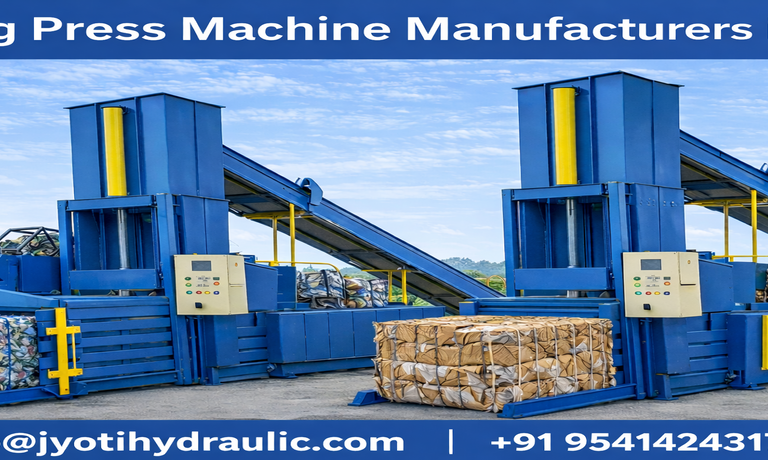
PET Bottle Hydraulic Baling Press Machine: Working, Benefits & Applications – Jyoti Hydraulic
Read MoreJyoti Hydraulic offers PET bottle baling equipment for businesses that…
-
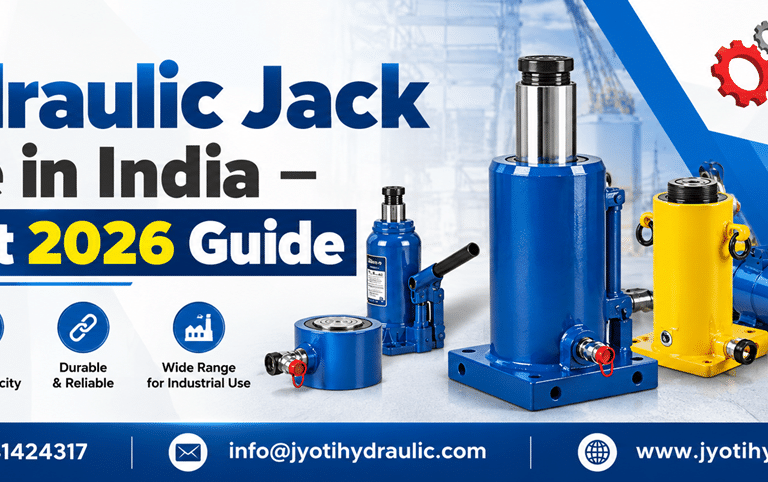
Hydraulic Jack Price in India – Latest 2026 Guide | Jyoti Hydraulic
Read MoreJyoti Hydraulic offers industrial hydraulic lifting solutions designed for strength,…