
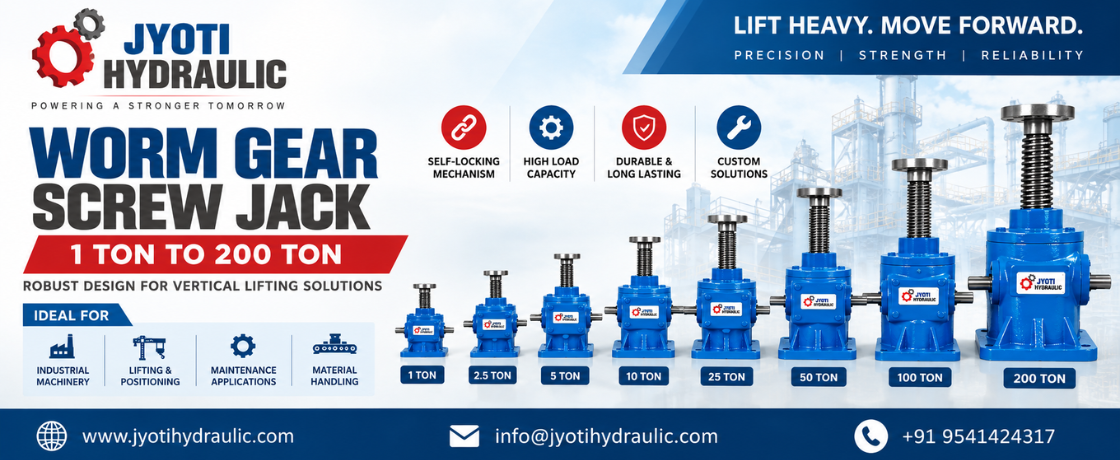
Jyoti Hydraulic helps industries solve one of the most demanding motion-control challenges: lifting, lowering, positioning, and holding heavy loads with mechanical accuracy. A Worm Gear Screw Jack converts rotary input from a hand wheel, motor, or gearbox into controlled linear movement. Because of its compact construction, load-handling ability, and precise travel, it is widely used where reliable mechanical positioning is required.
Industry Overview
India’s growth in automation, steel, cement, material handling, food processing, water management, machine building, and renewable-energy equipment has increased demand for reliable screw-jack systems. Buyers today are not only comparing load capacity; they are looking at service life, synchronization, safety, maintenance requirements, and compatibility with automated machinery.
The Indian market includes economical manual units as well as engineered motorized and multi-jack systems. Current market listings indicate that many standard industrial models fall roughly in the ₹10,000–₹30,000 range, while high-capacity or specialized units can reach ₹75,000 or more. Actual prices vary considerably because industrial screw jacks are often configured according to the application.
Technical Insights
A worm gear screw jack typically consists of a worm shaft, worm wheel, lifting screw, bearings, and a rigid housing. When the worm shaft rotates, the gear arrangement drives the screw or travelling nut to create linear movement.
For engineering selection, five parameters deserve particular attention:
- Load capacity: Consider static and dynamic loads, including shock and uneven loading.
- Stroke length: Longer strokes require checks for screw buckling, column strength, and critical speed.
- Travel speed: Higher speeds influence motor power, heat generation, and lubrication requirements.
- Duty cycle: Frequent operation creates heat within the worm gear and screw interface.
- Screw configuration: Translating screw, rotating screw, and travelling-nut arrangements suit different machine layouts.
Self-locking should not be assumed simply because a worm gear is used. Screw lead, friction, vibration, loading direction, and operating conditions must be considered. Where personnel or valuable equipment is involved, suitable braking or additional load-holding arrangements should be evaluated.
Worm Gear Screw Jack Price in India: What Affects the Cost?
The price depends on much more than tonnage. Important cost factors include lifting capacity, stroke, screw diameter and pitch, gear ratio, construction material, stainless-steel requirements, bellows, limit switches, mounting arrangement, electric motor, gearbox, and synchronization requirements.
For example, a manually operated jack used occasionally for machine adjustment will generally cost less than a motorized jack with long travel, stainless-steel construction, limit switches, and synchronized lifting points.
That is why buyers should compare the technical scope of quotations rather than selecting equipment only on the lowest price.
Applications of Worm Gear Screw Jacks
Worm gear screw jacks are widely used in:
- Industrial lifting platforms and tables
- Machine-tool positioning systems
- Press and fixture adjustment
- Steel and cement plants
- Conveyor height adjustment
- Valve and gate operation
- Stage lifting systems
- Solar tracking equipment
- Food-processing machinery
- Material-handling systems
Multi-jack systems are particularly valuable when large platforms or machinery must remain level while being raised or lowered.
Key Benefits
A properly selected Worm Gear Screw Jack offers precise mechanical positioning, substantial load-handling capability, controlled movement, compact construction, and flexible installation.
It can be operated manually or integrated with electric motors, gearboxes, shafts, couplings, and automation systems. Mechanical screw-jack arrangements can also be attractive where users want controlled linear motion without depending on a hydraulic circuit.
Buying Guide: How to Select the Right Screw Jack
Before approaching Worm Gear Screw Jack Manufacturers, prepare complete operating data. Specify the load per jack, total lifting points, required stroke, travel speed, mounting orientation, available power source, duty cycle, operating temperature, and environmental conditions.
Also determine whether the load is properly guided. Ideally, a screw jack should handle axial thrust; excessive side loading can reduce screw, bearing, and nut life.
For long strokes, ask the manufacturer to evaluate buckling. For motorized systems, check motor torque, starting load, gearbox ratio, braking, and travel speed.
If several jacks operate together, establish how synchronization will be maintained through line shafts, couplings, bevel gearboxes, or electronic controls.
Choosing among Worm Gear Screw Jack Manufacturers based on engineering capability and application support often provides better lifecycle value than purchasing solely on rated tonnage and initial price.
Future Trends
Industrial screw-jack technology is steadily moving toward servo-compatible drives, synchronized electromechanical lifting systems, improved corrosion-resistant materials, and condition-monitoring solutions.
OEMs increasingly require lifting systems that can integrate with PLC-controlled machinery, position sensors, and predictive-maintenance programs. As automation expands, accurate sizing and application engineering will become even more important.
Conclusion
A Worm Gear Screw Jack should be treated as an engineered lifting and positioning component rather than a simple commodity purchase. Capacity, stroke, speed, duty cycle, stability, mounting, operating environment, and safety all influence performance.
Price matters, but correct sizing and dependable technical support usually have a much greater impact on reliability, maintenance costs, and equipment life.
FAQs
1. What is the typical Worm Gear Screw Jack price in India?
Many standard industrial models are currently listed at approximately ₹10,000–₹30,000, while high-capacity, stainless-steel, motorized, or customized systems can cost considerably more.
2. Which screw jack capacity should I choose?
Capacity should be selected after considering actual working load, distribution between lifting points, dynamic forces, mounting conditions, and an appropriate engineering safety margin.
3. Can multiple screw jacks lift one platform together?
Yes. Multiple jacks can be mechanically or electronically synchronized to lift platforms, tables, gates, and large machinery evenly.
4. Are worm gear screw jacks suitable for continuous operation?
The required duty cycle must be evaluated carefully. High-frequency applications can create additional heat and may require different screw geometry, gearing, lubrication, or drive arrangements.
5. What details are required for an accurate quotation?
Provide load, stroke, lifting speed, duty cycle, mounting position, number of lifting points, operating environment, and whether manual or motorized operation is needed.
Get the Right Worm Gear Screw Jack for Your Application
Jyoti Hydraulic can help you evaluate load, stroke, speed, mounting, operating conditions, and drive requirements before finalizing your screw jack selection.
Contact us today to request a quotation or get expert consultation for your industrial lifting and positioning requirement.
📞 +91 9541424317


