
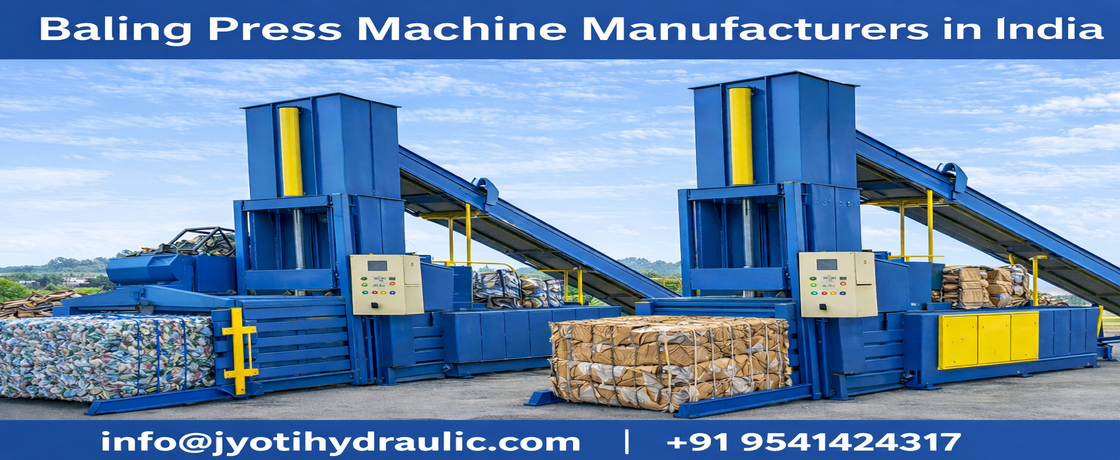
Jyoti Hydraulic understands that modern recycling plants need more than just basic waste handling equipment. They need robust, efficient, and intelligent baling solutions that reduce storage volume, improve material handling, cut transportation costs, and support profitable recycling operations. A waste baling machine is one of the most important systems in any recycling facility because it transforms loose, bulky waste into dense, manageable bales that are easier to store, transport, and sell.
As recycling operations continue to expand across paper, plastic, metal, textile, and packaging waste segments, the demand for dependable baling solutions has increased significantly. From compact units for smaller facilities to heavy-duty presses for high-volume industrial use, the right machine can directly impact plant productivity, labor efficiency, and material value recovery. This complete guide explains how waste baling machines work, their types, applications, technical features, buying considerations, and the future of baling technology.
Introduction
A waste baling machine is designed to compress recyclable material into compact bales using hydraulic force. These bales are tied, ejected, and then sent for storage, transport, or further processing. In recycling plants, balers help solve a common operational challenge: loose waste occupies too much space and is expensive to move.
Whether a plant handles old newspapers, cardboard, PET bottles, aluminum cans, textile scraps, or industrial packaging waste, baling makes the entire chain more organized and economical. For example, a Waste Paper Corrugated Box Baling Press Machine is especially useful in paper recovery units and packaging recycling plants where corrugated boxes and mixed paper waste are generated in high volume.
In India and global recycling markets, baling machines are no longer optional equipment. They are central to building efficient, scalable, and compliant waste management operations.
Industry Overview
The recycling industry has evolved from a largely manual sorting model to an integrated material recovery ecosystem driven by automation, cost optimization, and sustainability goals. Recycling plants today must process larger volumes of segregated waste while maintaining quality standards demanded by downstream recyclers and paper mills, plastic reprocessors, and metal smelters.
This is where baling technology plays a strategic role. A properly selected baler does not just compress material; it improves plant flow, reduces handling time, minimizes contamination risk, and increases the saleability of recovered recyclables.
Different sectors depend on balers for different reasons:
- Paper recyclers need dense bales for paper mills.
- Plastic recycling units use balers to manage lightweight but high-volume waste.
- Scrap yards require high-pressure systems for metal compaction.
- Warehouses and manufacturing plants use balers to handle packaging waste efficiently.
This rising demand has also led to the growth of Scrap Baling Machine Manufacturers in India, who now serve a wide range of industries with customized hydraulic solutions. At the same time, businesses searching for reliable Baling Press Machine Manufacturers are increasingly focused on build quality, service support, bale output, and machine durability rather than price alone.
Technical Insights: How a Waste Baling Machine Works
At its core, a waste baling machine uses hydraulic pressure to compress waste material inside a chamber. Once the required density is achieved, the material is tied using wire, strap, or twine and then ejected as a compact bale.
Basic Working Principle
- Material Feeding
Waste is loaded into the chamber manually, through a conveyor, or via hopper feeding. - Compression Cycle
A hydraulic cylinder pushes the ram or platen downward or horizontally, compressing the waste. - Repeated Pressing
For bulky or springy materials, multiple compression strokes may be required to achieve desired density. - Bale Tying
Once compression is complete, the bale is tied securely. - Ejection
The finished bale is pushed out mechanically or hydraulically for stacking and transport.
Main Components of a Baling Machine
A high-performance baler generally consists of the following parts:
- Hydraulic Power Pack – includes motor, pump, reservoir, valves, and filters
- Hydraulic Cylinder – generates the pressing force
- Compression Chamber – houses the recyclable material during compaction
- Ram / Platen – the moving press element
- Control Panel – manual, semi-automatic, or PLC-based controls
- Bale Ejection System – enables quick discharge of finished bales
- Safety Interlocks – door locking systems, emergency stop, overload protection
- Tying Mechanism – secures the compressed bale
Types of Waste Baling Machines
1. Vertical Baling Machines
These are compact and suitable for facilities with moderate waste generation. They occupy less floor space and are commonly used for paper, cardboard, plastic film, and packaging waste.
2. Horizontal Baling Machines
These are ideal for high-volume recycling plants. Material can be fed continuously, often through conveyors, making them suitable for automated operations.
3. Double Action Baling Press
This machine compresses material from multiple directions for higher density and improved bale shape.
4. Scrap Baling Machines
Designed for metal scrap such as aluminum, steel offcuts, and other industrial scrap. These machines require stronger frames and higher hydraulic tonnage.
5. Specialized Paper and Corrugated Box Balers
A Waste Paper Corrugated Box Baling Press Machine is optimized for compressing loose paper, cartons, corrugated packaging, kraft waste, and paperboard with consistent bale formation.
Applications in Recycling Plants
Waste baling machines are used across nearly every stage of recycling and material recovery operations. Their flexibility makes them useful for both dedicated recycling plants and industrial units with in-house waste handling requirements.
Common Applications
Paper Recycling Plants
These plants use balers for:
- Old corrugated containers
- Mixed paper
- Newspaper bundles
- Office paper waste
- Carton and packaging board
A strong baler improves bale density, which is critical for transportation to paper mills and warehouses.
Plastic Recycling Plants
Balers are used for:
- PET bottles
- HDPE containers
- Shrink wrap
- Plastic film
- Rigid plastic packaging
Since plastics are lightweight and bulky, baling significantly improves storage and logistics efficiency.
Metal Scrap Processing Units
Heavy-duty scrap balers are used to compact:
- Aluminum scrap
- Mild steel scrap
- Tin containers
- Sheet cuttings
- Industrial metal remnants
This is why many industries actively search for experienced Scrap Baling Machine Manufacturers in India with proven expertise in hydraulic pressure design and rugged construction.
Textile and Garment Waste Plants
Balers compress:
- Fabric cuttings
- Yarn waste
- Hosiery waste
- Used garments for recycling or export packaging
Municipal and Commercial Material Recovery Facilities
These plants handle mixed recyclable streams and require durable balers integrated with sorting lines.
Key Benefits and Advantages
A waste baling machine delivers value far beyond compression. It influences operational cost, cleanliness, labor productivity, and resale economics.
1. Space Saving
Loose waste takes up a large amount of floor space. Baled waste occupies far less area, helping plants maintain cleaner, more organized operations.
2. Reduced Transportation Cost
Denser bales mean more material per truckload. This directly lowers transportation cost per ton.
3. Better Material Handling
Bales are easier to stack, move, count, and inventory compared to loose waste.
4. Higher Recycling Value
Well-formed, tightly packed bales are generally preferred by recyclers and processors because they are easier to unload and feed into downstream systems.
5. Improved Safety and Housekeeping
Balers reduce clutter, fire hazards, and unorganized waste accumulation in work areas.
6. Lower Labor Dependence
Semi-automatic and automatic balers reduce the need for repeated manual handling.
7. Operational Efficiency
With faster compaction and bale discharge, recycling plants can process more waste in less time.
Buying Guide: How to Choose the Right Baling Machine
Selecting the right waste baling machine requires a practical understanding of waste type, throughput, plant layout, and long-term operating costs.
1. Identify the Material Type
Different materials respond differently to compression. Paper, corrugated boxes, plastics, and metals require different press force, chamber size, and machine structure.
2. Evaluate Daily Throughput
A plant processing 1 ton per day has very different needs from one handling 20 tons per shift. Machine capacity must match actual production volume.
3. Check Bale Size and Density Requirements
Consider the preferences of your buyers, transporters, and warehouse space. Standardized bale size often improves logistics.
4. Analyze Hydraulic Tonnage
Higher tonnage is essential for tougher, bulkier, or more elastic materials. The right force ensures better compaction and lower cycle time.
5. Review Machine Construction
Look for:
- Heavy-duty steel body
- Quality hydraulic cylinders
- Reliable seals and valves
- Efficient power pack design
- Strong weld integrity
6. Consider Automation Level
Options range from manual to semi-automatic and fully automatic systems. Plants with conveyor-based material flow usually benefit from horizontal automatic balers.
7. Focus on Service Support
After-sales service, spare parts availability, and technical support are crucial. This is why buyers often prefer established Baling Press Machine Manufacturers with strong field support.
8. Study Power Consumption
An efficient hydraulic system can reduce energy costs over time. Ask for motor rating, cycle time, and expected electricity consumption.
9. Inspect Safety Features
A modern baler should include emergency stop systems, overload protection, guarded moving parts, and secure chamber locking.
10. Compare Total Cost of Ownership
Do not judge by initial machine cost alone. Maintenance frequency, downtime, spare parts, and productivity all influence long-term value.
Future Trends in Waste Baling Technology
The future of waste baling is moving toward smarter, safer, and more energy-efficient systems. Recycling plants are under pressure to process larger volumes while reducing operational costs and environmental impact.
Key Emerging Trends
Automation and Smart Controls
PLC-based controls, touch-screen interfaces, and sensor-assisted operation are improving machine consistency and operator convenience.
IoT-Enabled Monitoring
Advanced balers are increasingly being designed for real-time monitoring of cycle count, oil temperature, hydraulic pressure, and maintenance alerts.
Energy-Efficient Hydraulics
Variable displacement pumps and optimized power packs help reduce energy use without compromising compaction performance.
Higher Throughput with Lower Downtime
Improved ram design, better cooling systems, and stronger hydraulic assemblies are increasing machine uptime.
Customized Application Engineering
The future belongs to machines tailored for specific waste streams rather than one-size-fits-all designs.
Integration with Recycling Lines
Baling systems are becoming part of complete sorting, shredding, conveying, and recovery lines for end-to-end material handling efficiency.
For businesses planning long-term investments, partnering with knowledgeable Scrap Baling Machine Manufacturers in India can provide a competitive edge through custom design, reliable installation, and application-specific engineering.
Conclusion
A waste baling machine is one of the most practical and profitable investments for any recycling plant. It improves material density, saves storage space, lowers transportation cost, enhances workplace safety, and creates a more organized recycling workflow. Whether you need a compact vertical baler for packaging waste or a heavy-duty system for scrap and high-volume recyclables, the right machine can transform plant performance.
From paper recovery and corrugated packaging to plastics and industrial scrap, the demand for high-efficiency baling equipment is only growing. Businesses that choose the right technology, backed by experienced Baling Press Machine Manufacturers, are better positioned to improve both operational efficiency and recycling profitability.
Frequently Asked Questions (FAQ)
1. What is a waste baling machine used for?
A waste baling machine is used to compress loose recyclable material into compact bales for easy storage, handling, and transportation.
2. Which materials can be baled in a recycling plant?
Common materials include waste paper, corrugated boxes, cardboard, plastic bottles, plastic film, textile waste, aluminum cans, and metal scrap.
3. What is the difference between a vertical and horizontal baling machine?
A vertical baler is generally compact and suitable for lower to medium volumes, while a horizontal baler is better for large-scale, continuous recycling operations.
4. Why is a Waste Paper Corrugated Box Baling Press Machine important?
It helps compress bulky paper and corrugated packaging waste into dense bales, improving storage efficiency and reducing logistics cost.
5. How do I choose the right baling press machine?
You should consider material type, daily waste volume, bale size, hydraulic force, automation level, energy consumption, and after-sales support.
6. What industries use scrap baling machines?
Scrap baling machines are widely used in metal recycling yards, manufacturing plants, fabrication units, automobile scrap processing, and industrial waste management facilities.
7. Why should I compare Scrap Baling Machine Manufacturers in India carefully?
Because machine quality, hydraulic performance, structural strength, service support, and spare availability can vary significantly between manufacturers.
8. Are baling machines energy efficient?
Modern hydraulic balers can be highly energy efficient when designed with optimized power packs, quality components, and proper control systems.
9. What maintenance does a baling machine require?
Routine maintenance includes checking hydraulic oil, seals, hoses, filters, cylinder condition, electrical controls, and moving parts.
10. Can baling machines be customized?
Yes. Many reputed Baling Press Machine Manufacturers offer customized chamber size, pressure range, feeding method, bale size, and automation options based on plant requirements.
Contact Jyoti Hydraulic Today
Looking for the right waste baling solution for your recycling plant, warehouse, paper unit, or scrap processing facility? Connect with Jyoti Hydraulic for dependable machinery, technical guidance, and industry-focused solutions tailored to your application.
Contact us for inquiries, request a quotation, or get expert consultation today.
📧 info@jyotihydraulic.com
📞 +91 9541424317
Choose a baling solution that improves efficiency, reduces waste handling costs, and supports long-term recycling performance. Reach out to Jyoti Hydraulic now and let our experts help you select the ideal machine for your business.


