
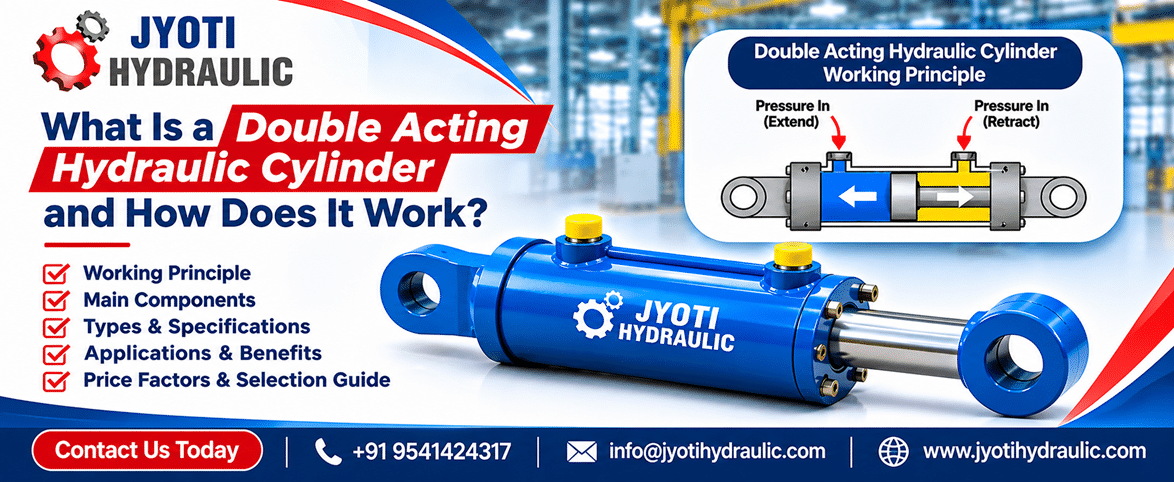
What Is a Double Acting Hydraulic Cylinder?
A double acting hydraulic cylinder is a linear actuator with two working fluid chambers separated by a piston. In a conventional single-rod design, the cap-end chamber acts on the full piston area, while the rod-end chamber acts on the smaller, ring-shaped area around the rod.
“Double acting” describes hydraulic operation in both directions; it does not mean the cylinder has two rods or develops equal pushing and pulling forces. A standard cylinder usually has two working hydraulic ports, although specialised designs can have additional connections.
Explore Jyoti Hydraulic’s double acting hydraulic cylinder range when your machine requires a powered working stroke and powered return.
Technical background: hydraulic cylinder basics and return types.
How Does a Double Acting Hydraulic Cylinder Work?
The double acting hydraulic cylinder working principle is controlled routing of hydraulic fluid to either side of the piston. The pump supplies flow; pressure develops as the load and circuit resist that flow.
What happens during extension?
A directional control valve connects the supply to the cap-end chamber and the rod-end chamber to the return line. Pressure acting on the piston moves the rod outward when the resulting force overcomes the opposing load and friction. Displaced rod-end oil returns through the circuit.
What happens during retraction?
The valve reverses these connections. Oil enters the rod-end chamber, and cap-end oil flows out. The rod moves inward under hydraulic power rather than depending on gravity or a return spring.
What controls force, speed and stopping?
Pressure and effective area determine force; flow and effective area determine speed. In a conventional non-regenerative single-rod circuit, equal inlet flow produces a faster retracting stroke because the rod-end area is smaller. Return-line flow during retraction can exceed pump delivery, so valves and lines must accommodate it.
A suitable hydraulic pump can form part of a hydraulic power pack containing the reservoir, drive motor and controls. Jyoti Hydraulic’s guide to how a large hydraulic power pack works explains the wider supply system.
Powered movement is not automatic load security. Valve neutral arrangements differ, and leakage or component failure can allow movement. Suspended or overrunning loads require an engineered load-control arrangement; maintenance requires suitable mechanical support, not reliance on trapped oil.
Main Components of a Double Acting Hydraulic Cylinder
| Component | Function | Technical importance |
|---|---|---|
| Cylinder barrel | Contains the piston and pressurised fluid. | Bore finish and pressure capacity affect sealing and durability. |
| Piston | Separates the working chambers. | Transfers hydraulic force to the rod. |
| Piston rod | Connects the piston to the machine. | Diameter, finish and alignment influence strength and seal life. |
| Head, gland and end cap | Close the barrel and support the rod assembly. | Retain pressure and locate sealing components. |
| Piston seals | Restrict fluid bypass between chambers. | Support pressure separation and efficient operation. |
| Rod seals and wiper | Limit external leakage and exclude contamination. | Protect fluid cleanliness and the moving rod interface. |
| Wear rings or guide rings | Guide the piston and rod. | Reduce metal contact within their rated loading limits. |
| Ports and mountings | Connect fluid lines and attach the cylinder. | Must suit flow, pressure, alignment and transmitted loads. |
| Optional cushions and sensors | Provide end-stroke deceleration or position feedback. | Must be selected for the actual motion-control requirement. |
Sealing reference: functions of hydraulic seals, wipers and wear rings.
Types of Double Acting Hydraulic Cylinders
Construction and operating action are separate classifications. Several hydraulic cylinder types can use double acting operation.
Tie-rod, welded and mill-type construction
Tie-rod cylinders use external rods to retain the end assemblies. Welded cylinders use welded structural joints and are common in mobile equipment. Mill-type cylinders use robust body and end-connection arrangements for demanding industrial duties. Construction should follow the load cycle, available space and service requirements, not a label alone.
Single-rod, double-rod and telescopic layouts
A single-rod cylinder has unequal working areas. A through-rod cylinder with equal rod diameters has equal effective areas, allowing equal theoretical force and speed under equivalent pressure and flow conditions. Double acting telescopic cylinders use nested stages to obtain long travel from a shorter retracted package; stage areas affect their force and speed.
Sensor-equipped and cushioned cylinders add features rather than changing the basic working principle. Review the available hydraulic cylinder types against your installation and control needs.
Technical Specifications and Design Factors
Hydraulic cylinder bore and stroke describe different requirements. Bore is the internal barrel diameter and determines piston area. Stroke is the available linear travel; it is not the overall cylinder length.
| Specification | Meaning | Selection consideration |
|---|---|---|
| Bore diameter | Internal cylinder diameter. | Required force and available hydraulic pressure. |
| Piston rod diameter | Diameter of the output rod. | Buckling resistance and available pulling area. |
| Stroke length | Rod travel between end positions. | Machine travel, end clearance and installed length. |
| Operating pressure | Pressure required during service. | Rated limits, pressure spikes and circuit intensification. |
| Extension force | Available pushing force. | Cap-end pressure, opposing pressure and friction. |
| Retraction force | Available pulling force. | Rod-end annular area and opposing forces. |
| Mounting arrangement | Flange, clevis, trunnion or another connection. | Force path, articulation and alignment. |
| Seal material | Selected elastomer or polymer sealing system. | Fluid compatibility, temperature, pressure and speed. |
How are extension and retraction forces calculated?
For a conventional single-rod cylinder, let D be bore diameter and d be rod diameter, both in millimetres. The cap-end area is Acap = πD2/4; the rod-end annular area is Aann = π(D2 − d2)/4. Both areas are in mm2.
Ignoring friction and opposing chamber pressure, extension force = p × Acap and retraction force = p × Aann. Pressure p in MPa equals N/mm2, giving force in newtons.
Illustrative example only—not a Jyoti Hydraulic product rating: an 80 mm bore, 45 mm rod and 300 mm stroke operating at 160 bar, or 16 MPa, give areas of approximately 5,026.5 mm2 and 3,436.1 mm2. The ideal extension force is approximately 80.4 kN; ideal retraction force is approximately 55.0 kN.
Actual extension output follows pcapAcap − prodAann − friction. Account for acceleration and machine geometry when determining the required load force. Stroke affects travel and oil volume, not the ideal force at a given pressure and area.
Calculation reference: Parker’s cylinder force, area and flow formulas.
Industrial Applications
An industrial double acting hydraulic cylinder is useful when the machine must perform work in both directions or return without depending on gravity. Typical hydraulic cylinder applications include the following:
- Pressing and fabrication: advancing a guided platen or tool, then retracting it after the operation.
- Recycling: driving compression and return movements in suitable hydraulic baling press machines.
- Machine-tool fixtures: applying clamping force and positively releasing the fixture.
- Construction, agriculture and handling: positioning attachments, moving gates and operating push-pull mechanisms.
Consider a horizontal pushing mechanism: gravity cannot reliably return its slider. A double acting arrangement supplies the return force, while the machine’s guides carry transverse loads. The cylinder should not substitute for properly designed guidance.
Advantages of Double Acting Hydraulic Cylinders
The main advantage is hydraulic control in both directions. A powered return can overcome resistance that would stop a gravity-return mechanism, and suitable valves can regulate each stroke to suit the process.
Other benefits include high linear force from a compact actuator and compatibility with automated sequencing. With appropriate sensing and control, the system can coordinate cylinder movement with clamps, conveyors or tooling.
However, double acting operation alone does not guarantee precise positioning, synchronised cylinders or energy savings. Those outcomes depend on the complete circuit and controls. Compared with a simple single acting arrangement, the additional working connection and control requirements can increase cost and maintenance needs.
Single Acting vs Double Acting Hydraulic Cylinder
| Feature | Single acting | Double acting |
|---|---|---|
| Working principle | Hydraulic power acts in one direction. | Hydraulic power acts in both directions. |
| Working hydraulic ports | Usually one. | Usually two. |
| Extension movement | Hydraulically powered in common push-type designs. | Hydraulically powered. |
| Retraction movement | Usually driven by a spring, gravity or external load. | Hydraulically powered. |
| Force generation | Powered force in one direction. | Powered push and pull; unequal in typical single-rod designs. |
| Return mechanism | Requires a suitable external force or return spring. | Uses pressure in the opposite chamber. |
| Industrial applications | Simple lifting, jacking and suitable clamping duties. | Presses, balers, positioning and push-pull mechanisms. |
Single acting pull-type designs also exist, so hydraulic action should not be identified solely by the direction of visible movement. Choose double acting operation when a powered return is a genuine requirement.
Double Acting Hydraulic Cylinder Price in India
Double acting hydraulic cylinder price depends on the complete specification. A small fixture cylinder and a long-stroke cylinder for continuous industrial service are not equivalent purchases. Request an application-specific quotation rather than treating a generic online figure as a confirmed price.
| Price factor | How it affects cost |
|---|---|
| Bore size | Larger sizes generally require more material and larger machined components. |
| Stroke length | Longer travel increases rod and barrel requirements and may require additional stability measures. |
| Operating pressure | Higher design pressure can require stronger components and different sealing arrangements. |
| Material quality | Material grades, surface treatments and traceability requirements influence manufacturing cost. |
| Seal specifications | Special fluid, temperature or low-friction requirements can change sealing costs. |
| Mounting type | Custom flanges, clevises, pins and trunnions add manufacturing requirements. |
| Customisation | Sensors, cushions, special ports and documentation can increase engineering and production work. |
Compare quotations on the same drawing and duty conditions. Ask whether applicable taxes, freight, fittings, installation, testing documents and spare seals are included. Quantity and delivery requirements should also be stated. For further buying considerations, see Jyoti Hydraulic’s double acting hydraulic cylinder price guide.
How to Choose the Right Double Acting Hydraulic Cylinder?
Start with the machine’s operating duty, not an assumed cylinder size. Use the following sequence to prepare a clear requirement:
- Define both load directions. State pushing and pulling forces, acceleration, orientation and the effect of linkages throughout the stroke.
- Confirm pressure and flow. Check the supply available at the cylinder and the required extension and retraction times.
- Select bore and rod together. Check pushing capacity, pulling capacity and rod buckling under compression.
- Verify the installation envelope. Provide stroke, retracted and extended mounting dimensions, port clearance and mounting details.
- Specify the environment. Include fluid, temperature, contamination, corrosion exposure and cycles per hour.
- Agree controls and acceptance checks. Define cushioning, sensing, load holding, guarding, testing and service documentation.
A larger bore is not automatically better: at unchanged inlet flow, its larger area reduces extension speed and increases oil demand per stroke. Similarly, increasing rod diameter improves structural capacity but reduces the annular area available for pulling.
Selection references: force, stroke, installation and buckling considerations and cylinder selection, mounting and safety guidance.
Why Choose Jyoti Hydraulic as Your Hydraulic Cylinder Manufacturer?
Jyoti Hydraulic offers hydraulic cylinders, power packs, pumps and hydraulic machinery, with standard and application-specific solutions described across its product range. This provides a starting point for discussing the cylinder together with its supply and control requirements.
When evaluating a double acting hydraulic cylinder manufacturer, ask for a proposal tied to your actual machine rather than a general capacity description. Share the load cycle, drawings, hydraulic supply details and installation constraints. Request confirmation of materials, seals, mounting dimensions, testing, delivery and service support before ordering.
Buyers comparing double acting hydraulic cylinder manufacturers in India can review Jyoti Hydraulic’s approach to industrial hydraulic cylinder requirements, then discuss the specific scope required for their application.
Maintenance Tips
Follow the cylinder and machine manufacturers’ maintenance instructions. Inspection intervals should reflect the duty cycle and environment rather than an arbitrary universal schedule.
Protect the fluid and rod: maintain specified fluid cleanliness, service filters as directed, and inspect the exposed rod for scoring, corrosion and contamination. Wiper damage or a damaged rod surface can shorten seal life.
Inspect connections and alignment: check hoses, fittings, mountings and pivot points. Follow specified lubrication and fastening requirements. Investigate new leakage, abnormal noise, temperature changes or uneven movement instead of compensating by increasing pressure.
Diagnose the circuit, not just the cylinder: drift can involve cylinder seals, control valves or other circuit components. A qualified technician should identify the cause before parts are replaced.
Make maintenance safe: isolate and lock out energy sources, mechanically support movable loads, and release and verify stored hydraulic pressure using the machine’s approved procedure. Never loosen a pressurised connection or search for a hydraulic leak with your hand.
Safety reference: hydraulic hose hazards and inspection guidance.
Future Trends in Hydraulic Cylinder Technology
The important developments extend beyond the cylinder body. Position feedback and electrohydraulic control can coordinate movement with machine automation, while pressure, temperature and operating-data monitoring can support maintenance decisions.
Variable-speed hydraulic power units and better-matched controls offer opportunities to reduce avoidable energy use. Actual savings depend on the load cycle and system design; a double acting cylinder is not inherently energy-efficient simply because both strokes are powered.
These are established technology directions, not guaranteed features of every cylinder. For an upgrade, define the required sensing, controller interface and acceptance criteria, and confirm availability with the supplier.
Technology references: closed-loop hydraulic cylinder positioning and networked hydraulic power units and condition monitoring.
Frequently Asked Questions
What is a double acting hydraulic cylinder?
It is a hydraulic actuator that produces linear force in both directions. Pressurised fluid acts alternately on opposite sides of its piston to extend and retract the rod.
How does a double acting hydraulic cylinder work?
A directional valve sends supply oil into one chamber while opening a return path from the other. Reversing these connections reverses the piston movement.
What is the difference between single acting and double acting hydraulic cylinders?
Single acting cylinders receive hydraulic power in one direction and use a spring or external force for return. Double acting cylinders use hydraulic power for both strokes.
How many ports does a double acting hydraulic cylinder have?
A conventional design has two working hydraulic ports, one connected to each chamber. Special designs may include additional connections for bleeding, sensing or integrated valves.
Does a double acting hydraulic cylinder require a hydraulic pump?
It needs a pressurised hydraulic supply, normally provided by a pump or an existing hydraulic power pack. The cylinder does not need its own dedicated pump.
What determines the force of a double acting hydraulic cylinder?
Force depends on chamber pressures and effective piston areas. In a single-rod cylinder, the rod reduces the retracting area. Friction and opposing chamber pressure reduce available output.
What is the double acting hydraulic cylinder price in India?
There is no single price for all sizes and duties. Request a quotation specifying bore, rod diameter, stroke, pressure, mounting, seals and quantity, with taxes and freight identified separately.
Where are double acting hydraulic cylinders used?
They are used in presses, balers, machine-tool fixtures, construction equipment, agricultural attachments and material-handling systems where powered forward and reverse movement is required.
How do I select the correct bore and stroke length?
Calculate the required pushing and pulling forces at available pressure to select the bore and rod combination. Choose stroke from machine travel, then verify mounting dimensions, buckling resistance and clearance.
How can I find a reliable double acting hydraulic cylinder manufacturer in India?
Compare application-engineering support, approved drawings, material and seal specifications, testing documentation, spare-parts availability and written commercial terms. Evaluate suppliers against the same technical requirement rather than price alone.
Conclusion
A double acting hydraulic cylinder provides powered extension and retraction, making it a practical choice for machines that need controlled push-pull movement. Successful selection requires more than a force rating: bore, rod diameter, stroke, pressure, flow, mountings and safety controls must work together.
Discuss your hydraulic cylinder requirements with Jyoti Hydraulic’s technical team. Send your application details or drawing to request expert technical consultation and a customised quotation covering the cylinder and associated hydraulic equipment.
Jyoti Hydraulic
Manufacturer of Hydraulic Cylinders, Hydraulic Power Packs, Hydraulic Machines and Complete Hydraulic Solutions.
Email: info@jyotihydraulic.com
Phone: +91 9541424317


