
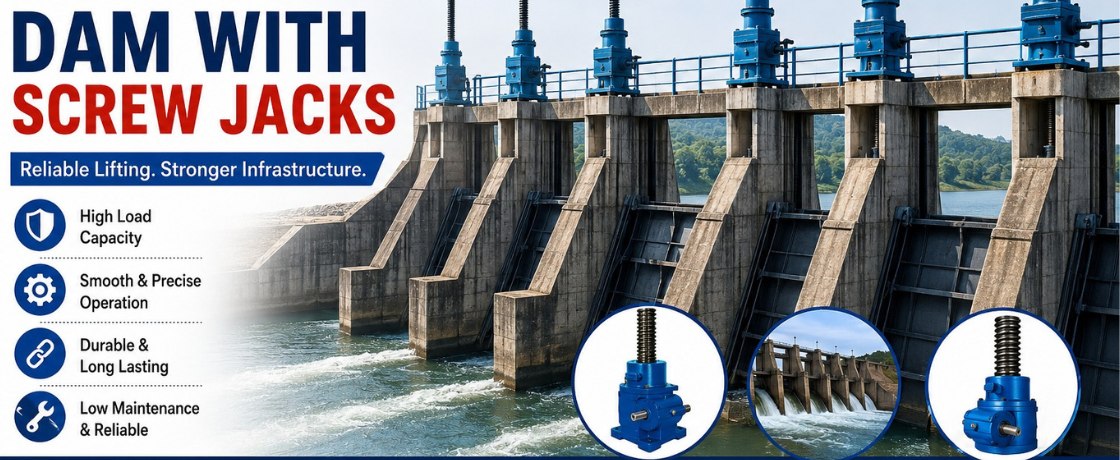
Jyoti Hydraulic provides dependable mechanical lifting solutions for industries that need to raise, lower, position, or support heavy loads with accuracy. A Worm Gear Screw Jack is especially useful where controlled movement, stable load holding, and repeatable positioning are more important than high lifting speed. Its compact construction and mechanical operating system make it suitable for machinery, production lines, lifting platforms, material-handling systems, and industrial automation.
Role of Screw Jacks in Modern Industry
Heavy-load movement is common in manufacturing, steel processing, power generation, construction, packaging, and warehouse operations. However, cranes and hydraulic cylinders are not suitable for every application.
Some industrial systems require a permanently installed lifting mechanism that can move slowly, stop at an exact position, and hold the load without continuous power. Worm gear screw jacks meet these requirements through a simple but reliable mechanical arrangement.
They can be operated individually or connected in multiple units to lift large platforms evenly. Depending on the application, the system may be driven by a handwheel, electric motor, gearbox, or servo motor.
How Does a Worm Gear Screw Jack Work?
A Worm Gear Screw Jack converts rotary input into linear movement. Its main assembly generally includes a worm shaft, worm wheel, lifting screw, bearings, gearbox housing, and mounting components.
When the input shaft rotates, it drives the worm wheel at a reduced speed. This reduction increases torque and moves the lifting screw upward or downward. The controlled screw movement allows heavy loads to be positioned with better accuracy than many conventional lifting systems.
Two common configurations are available:
- Translating screw type: The lifting screw travels vertically while the gear assembly remains fixed.
- Rotating screw type: The screw rotates while a travelling nut moves the load.
The correct configuration depends on available space, lifting height, mounting arrangement, and machine design.
Important Technical Considerations
A screw jack should never be selected only on the basis of load capacity. Engineers must also consider:
- Required lifting stroke
- Travel speed
- Operating frequency
- Static and dynamic load
- Starting torque
- Input motor capacity
- Screw buckling under compression
- Side-load conditions
- Mounting position
- Environmental exposure
- Required safety factor
Long lifting screws may require additional guides to prevent bending or buckling. Side loads should also be avoided because screw jacks are mainly designed to handle axial forces.
For systems using multiple jacks, accurate alignment is essential. Connecting shafts, couplings, and bevel gearboxes must be properly designed so that every lifting point moves at the same rate.
Major Industrial Applications
Worm gear screw jacks are used in many applications, including:
Machine and Equipment Positioning
They help adjust the height of machinery, fixtures, worktables, conveyors, and production equipment.
Lifting Platforms
Multiple screw jacks can lift large platforms while maintaining balanced and synchronized movement.
Steel and Metal Processing
They are used for positioning rollers, furnace components, heavy frames, and processing equipment.
Packaging and Automation
Screw jacks support height adjustment, product changeovers, filling lines, inspection systems, and automated handling equipment.
Power and Infrastructure Projects
They can be used for valve control, maintenance platforms, structural positioning, and equipment alignment.
Benefits of Worm Gear Screw Jacks
A properly selected screw jack offers several practical advantages:
- Controlled and accurate movement
- High load-handling capability
- Stable mechanical operation
- Compact installation
- Low maintenance requirements
- Manual or motorized operation
- Easy integration with automation systems
- Ability to synchronize multiple lifting points
- No risk of hydraulic oil leakage
Many worm gear designs may provide load-holding characteristics at lower speeds. However, self-locking should not automatically be treated as a substitute for a brake. The actual holding ability depends on screw lead, gear ratio, lubrication, vibration, and operating conditions. A separate brake or locking arrangement may be necessary for safety-critical applications.
How to Select the Right Screw Jack Manufacturer
Choosing an experienced Screw Jack Manufacturer in India is important because the lifting system must match the actual application.
Before purchasing, share complete details such as load weight, number of lifting points, required stroke, lifting speed, operating hours, installation position, and environmental conditions.
Reliable Worm Gear Screw Jack Manufacturers should provide:
- Proper load and torque calculations
- Suitable safety factors
- Material and gear specifications
- Motor and gearbox recommendations
- Mounting guidance
- Customized stroke options
- Synchronization solutions
- Technical and after-sales support
The lowest-priced model may not always provide the best value. Incorrect selection can lead to excessive wear, uneven lifting, motor overload, or premature screw failure.
Future of Industrial Screw Jack Systems
Modern screw jack systems are increasingly being integrated with PLCs, servo motors, encoders, load sensors, and digital position controls. These technologies allow operators to monitor lifting height, load distribution, speed, and system condition more accurately.
Predictive maintenance and automated synchronization will further improve reliability in heavy-duty lifting applications.
Conclusion
A Worm Gear Screw Jack is a practical solution for industrial applications that require slow, precise, and dependable lifting. It can be used for machine positioning, platform adjustment, material handling, automation, and synchronized multi-point lifting.
Correct load calculation, screw selection, motor sizing, alignment, and safety planning are essential for dependable performance. Working with experienced Worm Gear Screw Jack Manufacturers helps industries obtain a system designed around their actual operating requirements.
Frequently Asked Questions
What is a Worm Gear Screw Jack used for?
It is used to lift, lower, support, or position heavy loads through controlled mechanical movement.
Can several screw jacks lift one platform?
Yes. Multiple units can be connected through shafts, couplings, and bevel gearboxes for synchronized lifting.
Can a screw jack operate with an electric motor?
Yes. It can be driven manually or through an electric motor, gearbox, or servo-controlled system.
Is every worm gear screw jack self-locking?
Not necessarily. Self-locking depends on the gear ratio, screw lead, lubrication, vibration, and load conditions. A brake may be required in safety-critical systems.
What information is required for screw jack selection?
Important details include load, stroke, lifting speed, duty cycle, number of lifting points, mounting orientation, and working environment.
Get the Right Lifting Solution from Jyoti Hydraulic
Need assistance selecting a suitable screw jack for your machinery or lifting platform? Contact Jyoti Hydraulic for application-based product guidance, technical consultation, and customized lifting solutions.
Contact us to discuss your requirements, request a quotation, or receive expert consultation.
📞 +91 9541424317


