
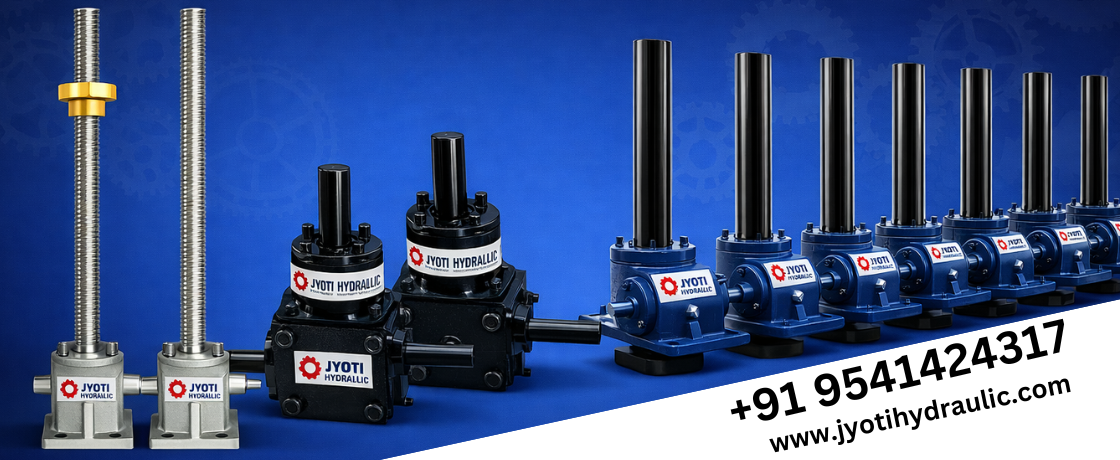
Jyoti Hydraulic understands that in industrial lifting systems, reliability is not achieved only by choosing a strong machine component; it is achieved by using, inspecting, lubricating, and maintaining that component correctly throughout its service life. A Worm Gear Screw Jack is one such critical mechanical device used where heavy loads must be lifted, lowered, pushed, pulled, tilted, or accurately positioned with controlled linear movement. In many factories, these jacks work quietly behind the scenes, but their failure can stop an entire production line, damage expensive equipment, or create unsafe working conditions.
A worm gear screw jack is designed to handle high load, compact installation, smooth operation, and precise movement. However, like every mechanical power transmission system, it depends heavily on correct maintenance. The worm wheel, worm shaft, lifting screw, nut, bearings, seals, and housing must work together under load. When lubrication dries out, alignment shifts, threads wear, or the jack is overloaded, performance begins to decline long before visible failure occurs.
This detailed blog explains industrial maintenance practices for worm gear screw jacks from a practical engineering point of view. It also covers technical insights, applications, benefits, buying considerations, and future trends so that plant engineers, maintenance teams, purchase departments, and machine manufacturers can make better decisions.
Industry Overview: Why Worm Gear Screw Jacks Are Important
Industrial operations are moving toward safer, cleaner, and more controlled lifting systems. Hydraulic and pneumatic systems are widely used, but mechanical screw jacks continue to hold a strong position because they offer controlled linear motion, load holding ability, simple installation, and long working life when maintained properly.
A Worm Gear Screw Jack is commonly selected where the movement must be stable and repeatable. Unlike some lifting systems that may need constant pressure to hold a load, many worm gear screw jack designs can hold position due to the mechanical advantage of the worm gear arrangement. This makes them useful in applications where safety and positioning accuracy are important.
Industries using screw jack systems include:
- Steel processing plants
- Cement manufacturing units
- Power generation plants
- Paper and pulp machinery
- Textile machinery
- Plastic processing equipment
- Food processing machinery
- Packaging machines
- Automotive assembly lines
- Heavy fabrication units
- Material handling systems
- Solar tracking structures
As automation increases, industries are looking for dependable Worm Gear Screw Jack Manufacturers who can supply jacks suitable for high-load, high-cycle, and customized applications. Demand is also growing for reliable Worm Gear Screw Jack Manufacturers in India because Indian engineering companies now offer cost-effective manufacturing, customized design capability, and strong industrial application knowledge.
Technical Insights: How a Worm Gear Screw Jack Works
A worm gear screw jack works on a simple but powerful mechanical principle. Rotary motion is converted into linear motion. The input shaft rotates the worm. The worm drives the worm wheel. The worm wheel transfers motion to the lifting screw or nut, creating upward or downward linear movement.
The main components include:
1. Worm Shaft
The worm shaft receives input from a hand wheel, electric motor, gearbox, or coupling. Its thread-like profile meshes with the worm wheel and transfers torque.
2. Worm Wheel
The worm wheel is generally made from bronze, alloy bronze, or other suitable materials depending on load and operating conditions. It reduces speed and increases torque.
3. Lifting Screw
The lifting screw carries the actual axial load. It may be an acme screw, trapezoidal screw, or ball screw depending on application requirements.
4. Nut Assembly
In rotating screw designs, the nut travels along the screw. In translating screw designs, the screw itself moves linearly.
5. Bearings
Bearings support radial and axial loads, reduce friction, and help maintain smooth operation.
6. Housing
The housing protects the internal mechanism, maintains alignment, and supports the load path.
7. Seals and Lubrication Points
Seals prevent contamination, while grease nipples or oil ports allow lubrication access.
In industrial use, failure usually does not happen suddenly. It often begins with small signs: higher operating torque, abnormal sound, jerky movement, overheating, grease leakage, backlash, vibration, or uneven lifting. Proper maintenance is the process of identifying these early signs and correcting them before serious breakdown occurs.
Why Maintenance Is Critical in Industrial Applications
Many users assume that because a screw jack is mechanically strong, it can run for years without attention. This is one of the most common mistakes in industrial maintenance. A screw jack may be robust, but it is not maintenance-free.
Poor maintenance can cause:
- Premature thread wear
- Worm wheel tooth damage
- Bearing failure
- Excessive backlash
- Reduced lifting accuracy
- Higher power consumption
- Load drift
- Seal damage
- Corrosion
- Complete mechanical seizure
In a production environment, even one failed jack can disturb machine alignment, affect product quality, or stop production. Maintenance is not only about protecting the screw jack; it protects the complete machine system.
Deep Maintenance Tips for Worm Gear Screw Jacks
1. Follow a Fixed Inspection Schedule
Industrial maintenance should not depend only on visible failure. A screw jack should be inspected at planned intervals depending on load, duty cycle, environment, and operating speed.
For light-duty applications, monthly inspection may be enough. For heavy-duty or continuous operation, weekly or even daily checks may be required. In dusty, humid, hot, or chemically aggressive environments, inspection frequency should be increased.
Check the following during inspection:
- Screw surface condition
- Lubrication level
- Abnormal sound
- Temperature rise
- Gearbox leakage
- Mounting bolts
- Coupling condition
- Load alignment
- Limit switch function
- Protective covers
A simple inspection record can help identify gradual performance changes over time.
2. Lubrication Must Be Treated as a Priority
Lubrication is the lifeline of a Worm Gear Screw Jack. The worm and worm wheel operate under sliding contact. The lifting screw and nut also experience friction during movement. Without proper lubrication, metal-to-metal contact increases, heat develops, and wear accelerates rapidly.
Use only the lubricant recommended by the manufacturer. In many cases, high-pressure grease or industrial gear oil is used. The correct lubricant depends on load, speed, temperature, and screw jack design.
Important lubrication practices include:
- Do not mix different grease types without checking compatibility.
- Clean grease nipples before applying new grease.
- Avoid over-greasing because excess grease can increase resistance and attract dust.
- Remove contaminated grease during scheduled servicing.
- Use high-temperature lubricant where operating heat is high.
- Use food-grade lubricant in food processing machinery if required.
- Protect lubrication points from dust and moisture.
A dry screw thread is one of the clearest signs of poor maintenance. If the screw appears shiny, rough, or scratched, lubrication may already be insufficient.
3. Check Load Conditions Carefully
Every screw jack has a rated load capacity. This rating is not just a suggestion; it is the safe operating limit calculated based on screw strength, gear design, bearing capacity, and housing strength.
Overloading creates high stress on the lifting screw and worm gear. Even if the jack does not fail immediately, repeated overload conditions reduce its life.
Maintenance teams should verify:
- Actual load weight
- Load direction
- Side load presence
- Shock loading
- Load distribution in multi-jack systems
- Screw unsupported length
- Buckling risk
A screw jack is mainly designed for axial loading. Side loading should be avoided because it can bend the screw, damage guide arrangements, and create uneven thread wear.
4. Maintain Correct Alignment
Alignment is one of the most underestimated factors in screw jack performance. A jack may be perfectly manufactured, but if installed incorrectly, it will fail early.
Misalignment can occur between:
- Motor and input shaft
- Coupling and gearbox
- Multiple screw jacks in a synchronized system
- Screw and load guide
- Mounting base and machine frame
Signs of misalignment include:
- Uneven lifting
- Vibration during operation
- Excessive noise
- Increased motor load
- Premature coupling wear
- Thread damage on one side
When multiple jacks are connected by shafts, bevel gearboxes, or couplings, synchronization must be checked regularly. A small angular error in one jack can create uneven load sharing across the system.
5. Prevent Contamination
Dust, metal particles, moisture, and chemical fumes can damage screw jack components. In outdoor or heavy industrial environments, contamination is one of the main reasons for reduced service life.
Protection methods include:
- Use bellows over exposed screws.
- Install covers in dusty areas.
- Keep the jack away from direct water spray.
- Use stainless steel or coated components where corrosion risk is high.
- Check seals regularly.
- Clean the screw before re-lubrication.
In cement plants, foundries, and steel plants, abrasive dust can mix with grease and form a grinding paste. This causes rapid wear of the screw and nut. Regular cleaning is essential in such environments.
6. Monitor Temperature During Operation
A moderate temperature rise may be normal during operation, but excessive heat indicates a problem. Heat is usually caused by friction, overloading, poor lubrication, bearing damage, or continuous operation beyond the duty cycle.
If the housing becomes unusually hot, stop the system and inspect:
- Lubricant condition
- Load value
- Operating speed
- Bearing condition
- Gear wear
- Alignment
- Duty cycle
Ignoring heat can lead to lubricant breakdown and gear failure.
7. Inspect Backlash and Positioning Accuracy
Backlash is the free movement between mechanical components due to clearance or wear. Some backlash is normal in worm gear systems, but excessive backlash affects positioning accuracy and can become dangerous in precision applications.
Backlash may increase due to:
- Worm wheel wear
- Screw thread wear
- Nut wear
- Bearing clearance
- Improper adjustment
Applications such as platform leveling, press adjustment, machine bed positioning, and automation systems require controlled backlash. If backlash increases beyond acceptable limits, the jack should be serviced or replaced.
8. Do Not Ignore Noise and Vibration
Healthy screw jacks generally operate smoothly. Any unusual sound is an early warning.
Common sounds and possible causes:
- Grinding noise: poor lubrication or gear damage
- Knocking sound: loose mounting or worn bearing
- Squealing noise: dry screw or high friction
- Intermittent vibration: misalignment or coupling issue
Maintenance teams should never treat noise as normal unless it has been technically verified.
9. Check Mounting Bolts and Foundation
Industrial machines vibrate during operation. Over time, mounting bolts may loosen. A loose jack can shift under load, creating misalignment and structural stress.
During maintenance, check:
- Base plate flatness
- Bolt tightness
- Foundation cracks
- Support structure rigidity
- Lock washers or locking arrangements
- Coupling guards
The screw jack should sit firmly on a stable mounting surface. Uneven mounting can distort the housing and affect gear mesh.
10. Inspect Safety Devices
In many systems, screw jacks work with limit switches, overload protection, brakes, encoders, or safety nuts. These devices should be checked regularly.
Important safety checks include:
- Upper and lower limit switch operation
- Emergency stop response
- Motor brake function
- Overload sensor accuracy
- Mechanical stop condition
- Safety nut wear indicator, if available
A screw jack should not be allowed to travel beyond its designed stroke. Over-travel can damage the screw, nut, housing, and connected machine parts.
Applications of Worm Gear Screw Jacks
Steel Industry
Used for furnace lifting, roller adjustment, conveyor positioning, and heavy equipment alignment.
Cement Plants
Used in kiln systems, gate adjustment, conveyor equipment, and material handling assemblies.
Automotive Manufacturing
Used in assembly fixtures, lifting platforms, welding lines, and inspection systems.
Packaging Machines
Used for height adjustment, guide positioning, and machine format changes.
Solar Tracking Systems
Used for angular positioning of solar panels to improve energy capture.
Food Processing Equipment
Used for controlled lifting and equipment adjustment where clean mechanical motion is required.
Heavy Fabrication
Used for positioning large workpieces, platforms, and welding fixtures.
Benefits of Properly Maintained Worm Gear Screw Jacks
A well-maintained screw jack provides several operational advantages:
- Longer service life
- Better load stability
- Reduced maintenance cost
- Lower downtime
- Improved operator safety
- Smooth motion
- Better positioning accuracy
- Reduced motor load
- Higher production reliability
- Improved machine performance
For industries, maintenance is not an expense. It is a cost-saving strategy.
Buying Guide: How to Select the Right Worm Gear Screw Jack
Before purchasing a screw jack, technical evaluation is necessary. A reliable Screw Jack Manufacturer in India will usually ask for complete application details before recommending a model.
Consider these points:
Load Capacity
Select a jack with proper safety margin. Do not choose capacity equal to exact load weight.
Stroke Length
Longer strokes may require buckling calculations and additional screw support.
Speed Requirement
Higher speed can increase heat and reduce duty cycle. Select speed carefully.
Duty Cycle
Continuous operation requires different design considerations than occasional operation.
Environment
Dust, moisture, heat, chemicals, and outdoor exposure affect material and seal selection.
Mounting Style
Check whether upright, inverted, trunnion, flange, or custom mounting is needed.
Manual or Motorized Operation
Manual operation is suitable for occasional adjustment. Motorized operation is better for automation and frequent movement.
Synchronization
For multiple jack systems, confirm gearbox, coupling, shaft, and alignment requirements.
Manufacturer Support
Choose experienced Worm Gear Screw Jack Manufacturers who can provide drawings, load calculations, technical support, and after-sales guidance.
Working with reputed Worm Gear Screw Jack Manufacturers in India helps industries obtain customized, durable, and cost-effective lifting systems suitable for Indian as well as international working conditions.
Future Trends in Worm Gear Screw Jack Technology
Industrial screw jacks are becoming smarter and more application-specific. The future will focus on reliability, monitoring, and automation.
Key trends include:
Predictive Maintenance
Sensors can monitor vibration, temperature, load, and operating cycles to detect early faults.
IoT Integration
Connected screw jack systems can provide real-time performance data to plant maintenance teams.
Advanced Materials
Improved alloys, coatings, and heat treatments will increase gear and screw life.
Compact High-Load Designs
Industries need smaller systems capable of handling higher loads.
Automation Compatibility
More screw jacks will be integrated with servo motors, PLC systems, encoders, and digital controls.
Energy-Efficient Designs
Improved gear geometry and lubrication systems will reduce power losses.
Conclusion
A Worm Gear Screw Jack is a powerful and dependable industrial lifting device, but its real performance depends on proper maintenance. Lubrication, alignment, load control, contamination prevention, and routine inspection are essential for long-term reliability.
Industries should not wait for breakdowns before servicing screw jack systems. Preventive maintenance protects machinery, improves safety, reduces downtime, and lowers operational costs. Whether used in steel plants, automation lines, packaging machines, solar systems, or heavy material handling equipment, a well-maintained screw jack can deliver years of dependable performance.
Choosing the right partner is equally important. Experienced Worm Gear Screw Jack Manufacturers and trusted Worm Gear Screw Jack Manufacturers in India can help industries select, install, and maintain the correct lifting solution. A professional Screw Jack Manufacturer in India can also provide customized designs for special load, stroke, mounting, and environmental requirements.
FAQ Section
1. What is a Worm Gear Screw Jack?
A worm gear screw jack is a mechanical lifting device that converts rotary motion into linear motion using a worm shaft, worm wheel, and lifting screw.
2. Why is lubrication important in a screw jack?
Lubrication reduces friction between the worm gear, worm wheel, screw, and nut. Without proper lubrication, wear, heat, and mechanical failure can occur.
3. How often should a Worm Gear Screw Jack be inspected?
Inspection frequency depends on usage. Heavy-duty industrial applications may require weekly checks, while light-duty systems may need monthly inspection.
4. Can a screw jack handle side loads?
A screw jack is mainly designed for axial loads. Side loads should be avoided unless the system is specially designed with proper guiding support.
5. What are the signs of screw jack failure?
Common signs include unusual noise, vibration, overheating, jerky movement, grease leakage, increased backlash, and difficulty lifting the load.
6. Where are worm gear screw jacks commonly used?
They are used in steel plants, cement plants, automation systems, packaging machines, automotive assembly lines, solar trackers, and heavy fabrication equipment.
7. How do I choose the right screw jack?
Consider load capacity, stroke length, duty cycle, speed, environment, mounting style, and synchronization needs before selection.
8. Why choose Worm Gear Screw Jack Manufacturers in India?
Indian manufacturers offer strong engineering capability, customization, competitive pricing, and practical experience in heavy industrial applications.
9. Can screw jacks be motorized?
Yes, screw jacks can be operated manually or with electric motors, gearboxes, servo motors, and automated control systems.
10. What causes premature screw jack wear?
Common causes include poor lubrication, overloading, misalignment, contamination, excessive heat, and lack of regular inspection.
Get Expert Support from Jyoti Hydraulic
For durable, precision-engineered, and application-specific worm gear screw jack solutions, connect with Jyoti Hydraulic today.
Whether you need product selection support, a customized lifting system, maintenance guidance, or a competitive quotation, our team can help you choose the right solution for your industrial requirements.
📧 Email: info@jyotihydraulic.com
📞 Call: +91 9541424317
Contact Jyoti Hydraulic now to request a quotation, discuss your application, and get expert consultation for reliable industrial lifting solutions.


