
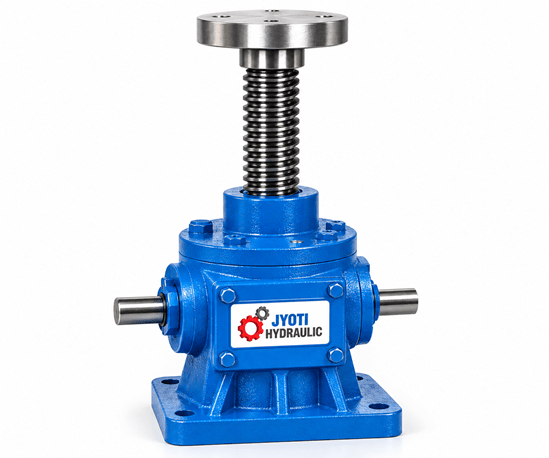
Worm Gear Screw Jack 10 Ton
The Worm Gear Screw Jack 10 Ton from Jyoti Hydraulic is a mechanical lifting solution for industrial applications that require controlled movement of heavy loads. It combines a worm gear mechanism with a lifting screw to convert rotary input into linear travel. This arrangement can be used for raising, lowering and positioning machine assemblies, platforms and other guided loads, subject to the selected configuration.
Choosing a screw jack involves more than matching its capacity to the weight being lifted. Travel distance, operating speed, mounting position and frequency of movement all influence the selection. For a dependable installation, the jack, drive system and supporting structure must work together under the actual operating conditions.
📞 Get in Touch
📞 +91 9541424317
📧 jyotihydraulic@gmail.com
Get Your Quote Instantly
What Is a 10 Ton Worm Gear Screw Jack?
A worm gear screw jack is a mechanical actuator that moves a load through the interaction of gears and screw threads. The input shaft turns a worm, which drives a worm wheel. This rotation is then converted into movement along the screw axis.
The 10 ton designation identifies the nominal capacity class. It does not mean that every installation can move this load at any speed or over any stroke. The permissible working load depends on the screw arrangement, unsupported length, loading direction and operating conditions.
This type of actuator is useful where a heavy component needs gradual, controlled adjustment—for example, setting the height of a production fixture or repositioning a guided machine table.
How Does the Worm Gear Mechanism Work?
The worm gear reduces the input speed and increases the torque available to drive the screw mechanism. The screw lead then determines how far the moving component travels with each revolution.
Two common arrangements are:
- Translating screw: The lifting screw moves through the jack housing. It must be prevented from rotating by a suitable anti-rotation arrangement or the guided load.
- Rotating screw: The screw rotates while a restrained travelling nut moves along it.
These arrangements require different installation clearances. A translating design needs space for the screw as it extends and retracts, while a rotating design needs room for the travelling nut and its connected load. Confirm the arrangement supplied with the selected Jyoti Hydraulic model.
Key Features and Practical Benefits
- Worm gear reduction: Provides mechanical advantage for moving heavy axial loads.
- Controlled linear travel: Supports gradual height adjustment and component positioning.
- Reversible movement: Reversing the input rotation changes the direction of travel.
- Mechanical actuation: The screw mechanism produces movement without requiring a hydraulic cylinder and power pack.
- Drive selection: Manual or motorised operation can be evaluated according to input torque, speed and usage.
- System integration: Suitable configurations can form part of a guided lifting assembly or an engineered arrangement using multiple jacks.
- Application-based selection: Stroke, screw arrangement, mounting and accessories should be matched to the machine layout.
Positioning accuracy, backlash and load-holding behaviour depend on the selected design. These should be specified separately when they are critical to the process.
Technical Specifications and Selection Details
| Parameter | Product information or selection requirement |
|---|---|
| Product name | Worm Gear Screw Jack 10 Ton |
| Brand | Jyoti Hydraulic |
| Nominal capacity class | 10 ton |
| Mechanism | Worm gear and lifting screw |
| Output movement | Linear movement along the screw axis |
| Permissible working load | Confirm for the required stroke and operating conditions |
| Stroke length | Specify required usable travel |
| Screw arrangement | Confirm translating screw or rotating screw configuration |
| Gear ratio and screw lead | Select according to travel speed and input torque |
| Drive arrangement | Confirm manual or motorised supply |
| Mounting orientation | Specify the intended installation position |
| Materials and surface protection | Confirm against the application environment |
| Duty cycle | Confirm permitted running and resting periods |
| Position holding | Verify self-locking characteristics and any braking requirement |
| Accessories | Confirm availability of protection, switches, feedback and drive components |
Request the approved dimensional drawing before finalising the machine frame, mounting holes or drive connections.
How to Select the Right 10 Ton Screw Jack
Calculate the Full Moving Load
Include the weight of the platform, fixtures and moving machine parts, as well as the material being handled. Acceleration, vibration and process forces may add to the load experienced by the jack.
For installations with several lifting points, do not assume the weight will divide equally. An offset centre of gravity or a flexible platform can place a larger share of the load on one jack.
Check Stroke and Screw Stability
Stroke is the usable travel needed to complete the movement. It should be considered alongside the retracted height, extended height and available installation space.
When a screw operates in compression, a longer unsupported length increases its susceptibility to buckling. A capacity suitable for a short stroke may therefore require reassessment for a taller lift. The screw end conditions and guidance arrangement also affect this check.
Match Speed to the Operating Cycle
Lifting speed depends on input shaft speed, gear ratio and screw lead. Motor selection must also account for starting torque, efficiency and the load being moved.
Frequent operation generates heat within the mechanism. Provide both the number of cycles per hour and the duration of each movement so that the proposed drive can be checked against the required duty.
Provide Guidance for the Load
The lifting force should act along the screw axis. Guide rails, slides or other structural components should carry lateral forces and overturning moments.
For example, a wide platform carrying material near one edge needs guidance that prevents tilting. Asking the screw to guide the platform as well as lift it can introduce bending and premature wear.
Typical Industrial Applications
Subject to engineering approval, a 10 ton worm gear screw jack can be considered for:
- Machine table adjustment: Raising or lowering a guided table to the required working height.
- Assembly fixtures: Positioning heavy components during alignment and assembly.
- Conveyor adjustment: Changing the elevation of supported conveyor sections.
- Production equipment: Setting the position of movable tooling or machine assemblies.
- Maintenance fixtures: Providing controlled movement during equipment servicing.
- Multiple-point lifting: Moving a larger platform through a coordinated system of jacks.
The application should determine the configuration. A platform adjusted occasionally has different operating requirements from an actuator that moves repeatedly throughout a production shift.
Can Multiple Screw Jacks Operate Together?
Multiple jacks can be arranged to move a common load using a suitably designed drive system. Mechanical connections may include shafts, couplings and gearboxes, while other arrangements use coordinated motor drives.
The complete system needs checks for load distribution, alignment, shaft torque and structural stiffness. Matching jack capacities alone does not ensure level movement. Differences in resistance, backlash or frame deflection can affect how the load moves.
Share the number of lifting points and their spacing when requesting a quotation for a combined system.
Is the Screw Jack Self-Locking?
Self-locking should be verified for the exact configuration. It depends on the screw geometry, gearing, friction and operating conditions. A worm gear mechanism should not automatically be treated as a guaranteed holding brake.
Where unintended movement could create a hazard or damage equipment, the design may require a brake, mechanical lock or another suitable holding arrangement. Raised equipment also needs appropriate support during maintenance.
Installation and Maintenance
Install the jack on a rigid, correctly aligned mounting surface. Check that the screw axis aligns with the intended load path and that the connected structure moves freely throughout the required travel.
Before operation:
- Verify mounting fasteners, couplings and drive alignment.
- Confirm lubrication requirements and apply the specified lubricant.
- Check usable travel, clearances and end-of-travel controls.
- Test movement without load before progressing through the approved commissioning procedure.
- Confirm that guards and load-holding provisions are in place.
During service, inspect for unusual noise, rising operating temperature, increased backlash and damaged screw surfaces. Dust, abrasive particles and moisture may require additional screw protection. Maintenance intervals should reflect the operating environment and frequency of use.
Worm Gear Screw Jack 10 Ton Price
The price depends on the complete configuration. Stroke length, drive arrangement, mounting details, materials and accessories can all affect the quotation. A manually operated jack and a motorised assembly with controls should therefore be compared on their full scope of supply.
For an application-specific quotation from Jyoti Hydraulic, provide:
- Maximum moving load, including fixtures and platform weight.
- Required stroke and lifting speed.
- Number and spacing of lifting points.
- Mounting orientation and available installation space.
- Operating cycles per hour.
- Preferred drive and available electrical supply.
- Environmental conditions and control requirements.
A sketch or machine drawing can help clarify the installation and reduce changes during fabrication.
Discuss Your Requirement with Jyoti Hydraulic
Selecting a lifting mechanism starts with understanding the machine it will serve. Share your load details, travel requirement and installation layout with Jyoti Hydraulic to discuss the appropriate Worm Gear Screw Jack 10 Ton configuration.
Request a quotation with the dimensional drawing, operating limits and scope of supply so that your team can evaluate the jack against the complete application.
Frequently Asked Questions
Can a 10 ton screw jack lift 10,000 kg?
If the rating uses metric tonnes, 10 tonnes corresponds to a mass of 10,000 kg. However, the allowable working load must still be verified for the stroke, speed, mounting and operating conditions. Confirm the rating basis in the technical documentation.
Does the jack require a hydraulic power pack?
The worm gear and screw mechanism operates through rotary input. It does not require a hydraulic power pack when driven manually or by a suitable electric motor.
Can it be operated by hand?
Manual operation may be suitable where the required input torque and number of turns are manageable. For frequent movements or longer travel, a motorised arrangement may be more practical.
Can the jack operate horizontally?
Horizontal operation may be possible with an approved configuration. The load must be supported and guided appropriately, and the mounting and lubrication requirements must suit that orientation.
What determines the lifting speed?
Lifting speed depends on the input speed, worm gear ratio and screw lead. Increasing motor speed is acceptable only within the jack’s mechanical and thermal limits.
Is it suitable for continuous operation?
Continuous operation should not be assumed. The permitted duty depends on load, speed, friction and heat dissipation. Provide the complete operating cycle for selection.
What information is needed to choose the motor?
Motor selection requires the working load, desired speed, gear ratio, screw lead, efficiency and starting torque. A system driving several jacks must also account for the connected transmission components.
Can it position a load accurately?
It can provide controlled positioning, but achievable accuracy depends on backlash, screw characteristics, structural deflection and drive controls. State the required positioning tolerance and repeatability when making an enquiry.
Blogs
-
 24 Oct
Mini DC Hydraulic Power Pack 12V and 24V: Complete Buying Guide
Read MoreJyoti Hydraulic brings this buying guide to help equipment owners,…
-
 19 Oct
Hydraulic Cylinder with Power Pack Manufacturers in India – Jyoti Hydraulic
Read MoreJyoti Hydraulic brings the conversation about hydraulic cylinders and power…
-
 15 Oct
PET Bottle Hydraulic Baling Press Machine: Working, Benefits & Applications – Jyoti Hydraulic
Read MoreJyoti Hydraulic offers PET bottle baling equipment for businesses that…


