
Worm Gear Screw Jack 5 Ton
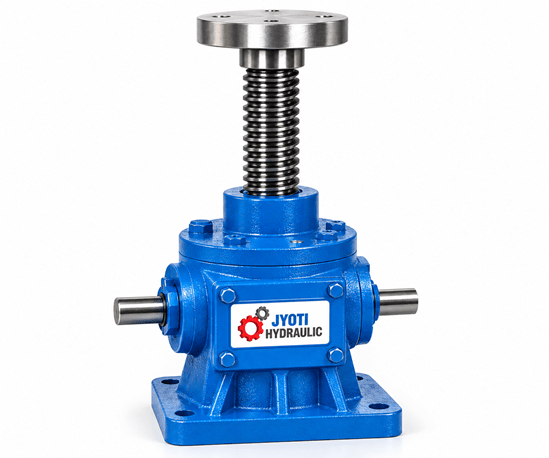
The Worm Gear Screw Jack 5 Ton from Jyoti Hydraulic is a mechanical lifting and positioning solution for industrial applications requiring controlled linear movement. A worm gear mechanism transfers rotary input to a screw assembly, allowing a supported load to move through a defined distance. Typical uses include machine height adjustment, lifting fixtures, adjustable platforms and equipment positioning.
Selecting the right screw jack involves more than checking its nominal capacity. Load direction, lifting stroke, operating speed, mounting arrangement and frequency of operation all affect performance. For a suitable installation, the jack must be matched to the complete mechanism, including its guides, supporting structure and drive system.
Contact Jyoti Hydraulic with your load and movement requirements to discuss a suitable 5 ton screw jack configuration.
📞 Get in Touch
📞 +91 9541424317
📧 jyotihydraulic@gmail.com
Get Your Quote Instantly
What Is a 5 Ton Worm Gear Screw Jack?
A 5 ton worm gear screw jack converts rotational motion into linear movement through a combination of worm gearing and a threaded screw mechanism. It provides mechanical advantage, enabling a comparatively small input torque to move a substantially larger axial load.
The “5 ton” designation identifies the nominal capacity class. It should not be interpreted as a guarantee that the jack can lift the same load at every stroke length, speed or installation angle. The permitted working load depends on the selected design and operating conditions.
Although the brand name is Jyoti Hydraulic, a worm gear screw jack operates mechanically. Its lifting action comes from the gear and screw arrangement rather than hydraulic pressure.
How Does a Worm Gear Screw Jack Work?
Rotating the input shaft turns the worm, which engages with the worm wheel inside the gearbox. The gearing reduces rotational speed and increases the torque available to operate the screw mechanism.
The resulting movement depends on the jack arrangement:
- Translating screw arrangement: The lifting screw travels through the gearbox. It must be restrained against rotation by the load arrangement or a suitable anti-rotation mechanism.
- Rotating screw arrangement: The screw rotates while a guided travelling nut moves along its length.
Reversing the input rotation reverses the direction of travel. Depending on the supplied configuration, the input may be operated by a handwheel or a suitably selected motor and transmission.
The movement produced by each input revolution depends on the screw lead and gear ratio. A greater reduction ratio generally provides slower travel and greater mechanical advantage, with actual input torque also affected by friction and efficiency.
Key Features and Practical Benefits
- Worm gear reduction: Provides mechanical advantage for controlled movement of industrial loads.
- Screw-driven linear travel: Supports lifting, lowering and positional adjustment within the approved operating range.
- Defined travel relationship: Screw lead and gear ratio determine movement per input revolution.
- Mechanical actuation: The jack itself does not require a hydraulic pump, reservoir or hydraulic hoses.
- Machine integration: Can form part of an engineered lifting or adjustment assembly with suitable mounting and load guidance.
- Drive selection: Manual or motor-driven operation can be evaluated according to load, speed and usage requirements.
- System design flexibility: Single-point and multiple-point lifting arrangements can be assessed for the application.
Drive options, screw arrangement, accessories and mounting details should be confirmed for the model being quoted.
Technical Specifications
Parameter | Product Details / Selection Requirement |
Product name | Worm Gear Screw Jack 5 Ton |
Brand | Jyoti Hydraulic |
Nominal capacity class | 5 ton, subject to confirmed rating and operating conditions |
Operating mechanism | Worm gearing with a screw-based linear motion assembly |
Lifting stroke | Specify required travel for model selection |
Screw arrangement | Confirm translating screw or rotating screw configuration |
Input drive | Confirm manual or motor-driven arrangement |
Gear ratio | Select according to travel speed and input torque requirements |
Screw lead and diameter | Confirm from the approved technical drawing |
Operating speed | Confirm for the selected load, ratio and drive |
Mounting orientation | Specify installation direction for engineering review |
Duty cycle | Confirm permitted running and resting periods |
Construction materials | Confirm housing, screw and gear materials in the quotation |
Load-holding provisions | Assess self-locking behaviour and any brake or locking requirement |
Accessories | Confirm availability of travel switches, protective covers and drive components |
Understanding the 5 Ton Capacity
The load carried by a screw jack includes more than the material being lifted. The moving platform, fixtures, tooling and other attached components also contribute to the total load.
Before selection, distinguish between:
- Static load: The load supported while the mechanism is stationary.
- Dynamic load: The load moved during operation.
- Compression load: A load that pushes along the screw axis.
- Tension load: A load that pulls along the screw axis.
Do not assume that static and dynamic ratings are identical. Longer unsupported screw lengths also require particular attention when operating in compression.
For an enquiry, provide the actual working load in kilograms or kilonewtons, together with the direction of loading. This gives a clearer basis for selection than the capacity label alone.
Applications of a 5 Ton Screw Jack
A correctly selected screw jack can support a range of industrial lifting and adjustment tasks.
Machine height adjustment: Raising or lowering machine sections to suit different product sizes, tooling positions or production requirements.
Adjustable work platforms: Moving a guided platform to a required working height within an engineered support structure.
Conveyor positioning: Adjusting conveyor sections to align with adjacent processing or material handling equipment.
Fixture and tooling adjustment: Positioning supported fixtures during assembly, setup or maintenance activities.
Industrial positioning systems: Providing controlled linear movement where stroke, speed and load requirements suit the selected jack.
Each application requires verification of the mounting, load path, travel limits and working environment.
How to Select the Right Configuration
Define the Load and Its Direction
Specify the maximum working load and whether it acts in compression or tension. Include any changing load conditions, vibration or impact associated with the process.
The load should act along the intended screw axis. External guides should manage lateral forces and overturning moments rather than allowing the screw to act as the platform guide.
Specify the Stroke and Installation Space
State the required movement and the available space when the assembly is fully retracted and extended. Allow clearance for the screw, drive components, protective covers and maintenance access.
A longer stroke may require a different screw size or support arrangement, even when the load remains unchanged.
Establish Speed and Operating Frequency
Provide the required lifting time, number of cycles per hour and expected operating duration. Occasional adjustment and repetitive production movement impose different demands on the mechanism.
Motor selection must account for starting torque, operating torque and the losses in connected transmission components.
Define Positioning Requirements
State the acceptable positioning tolerance and whether movement approaches the final position from one direction or both directions.
Backlash can affect position when travel reverses. Fine theoretical movement per input revolution does not, by itself, establish the accuracy or repeatability of the complete machine.
Describe the Working Environment
Mention dust, moisture, outdoor exposure, washdown conditions or elevated temperatures. These details help determine suitable protection, lubrication and material requirements.
Multiple Screw Jack Lifting Systems
Some platforms require support at several lifting points. In these applications, screw jacks may be connected through an engineered arrangement of shafts, couplings and gearboxes, or operated using coordinated drives.
The platform load must be evaluated at each lifting point. Dividing the total load equally by the number of jacks can be misleading when the centre of gravity is offset or the structure deflects.
Matching travel characteristics, correct initial alignment and suitable control provisions are essential to maintaining coordinated movement.
Installation and Maintenance
Reliable operation begins with a rigid mounting structure and correct alignment between the jack and the supported load.
- Secure the jack according to the approved installation drawing.
- Guide the moving structure to prevent unwanted side loading.
- Check drive alignment and coupling installation.
- Set travel limits before operating through the full stroke.
- Use the specified lubricant and maintenance intervals.
- Inspect the screw, fasteners and drive components for wear or looseness.
- Investigate unusual noise, heating or changes in operating effort.
The end of the screw’s travel should not be used as a routine stopping method. Maintenance intervals should reflect the actual workload and surrounding conditions.
Worm Gear Screw Jack 5 Ton Price
The price depends on the required stroke, screw arrangement, drive system, mounting details and accessories. A manually operated adjustment mechanism and a motorised lifting assembly may require substantially different components.
For an application-specific quotation from Jyoti Hydraulic, share:
- Maximum working load, including the moving structure.
- Required lifting stroke and travel speed.
- Number of lifting points.
- Mounting orientation and available space.
- Manual or motor-driven operation.
- Expected cycles per hour.
- Working environment and positioning requirements.
A drawing or installation sketch can help clarify the required arrangement.
Frequently Asked Questions
Can a 5 ton worm gear screw jack lift 5,000 kg?
If the rating is expressed in metric tonnes, 5 tonnes corresponds to a mass of 5,000 kg. However, the allowable working load must still be confirmed for the selected stroke, load direction, speed and duty cycle.
Is a worm gear screw jack self-locking?
Self-locking depends on the specific gear and screw design, efficiency and operating conditions. It should not be assumed from the product name alone. Confirm the load-holding requirements and whether a brake or additional locking provision is needed.
Can this screw jack be operated with an electric motor?
Motor-driven operation may be suitable when the drive arrangement supports it. Motor power, starting torque, speed and control requirements must be selected for the complete lifting mechanism.
Can it be installed horizontally?
Horizontal positioning may be possible with a suitable configuration. The moving load needs appropriate external support and guidance, and the installation should be checked for mounting and lubrication requirements.
Can several screw jacks lift one platform?
Yes, with a properly designed system. Load distribution, matching travel, structural stiffness and drive coordination must be assessed for all lifting points.
Is it suitable for continuous operation?
Continuous operation cannot be assumed. The permitted duty cycle depends on the model, load, speed and thermal limits. Share the required operating schedule before selection.
What is the difference between a screw jack and a hydraulic jack?
A screw jack uses gearing and a screw mechanism to produce movement. A hydraulic jack uses pressurised fluid acting on a piston. The appropriate choice depends on the load, movement, control and installation requirements.
What details are needed to order?
Provide the working load, stroke, lifting speed, mounting orientation, operating frequency and preferred drive type. Include a drawing where the jack must fit into an existing machine.
Discuss your lifting and positioning requirements with Jyoti Hydraulic to identify a suitable Worm Gear Screw Jack 5 Ton configuration and request a quotation.
Blogs
-
 8 Oct
Scrap Baling Press Machine Manufacturer in Faridabad for Industrial Waste Management – Jyoti Hydraulic
Read MoreJyoti Hydraulic delivers practical hydraulic baling solutions for industries looking…
-
 7 Oct
Worm Gear Screw Jack Price in India – Complete Buyer’s Guide- Jyoti Hydraulic
Read MoreJyoti Hydraulic helps industries solve one of the most demanding…
-
 6 Oct
Bevel Gear Box Price in India: Types, Applications & Buying Guide – Jyoti Hydraulic
Read MoreJyoti Hydraulic provides engineered power-transmission solutions for industries where reliable…


