
Industry Overview: Why Hydraulic Rotary Unions Matter
A hydraulic rotary union maintains a fluid connection across a rotating interface. It allows hydraulic oil to reach equipment mounted on a rotating shaft, table or assembly without forcing the stationary supply hoses to follow that rotation.
Consider a rotary machining table fitted with hydraulic clamps. The table must change position while its clamping circuit remains connected to the hydraulic supply. A suitable rotary union provides that connection through one or more internal passages.
For a closer explanation of the internal components and operating principle, read What Is a Hydraulic Rotary Union and How Does It Work?
The important distinction is that a rotary union transfers fluid; it does not generate hydraulic pressure or drive the machine’s rotation. Its performance must therefore be assessed alongside the pump, valves, actuators and mechanical installation.
What Are the Most Common Hydraulic Rotary Union Problems?
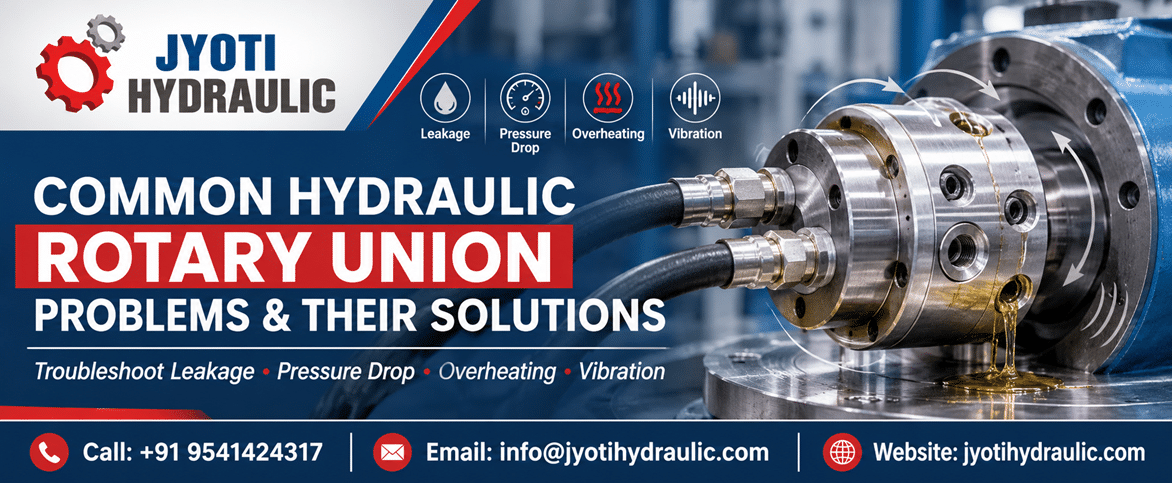
The most common problems include external oil leakage, excessive pressure drop, internal leakage between passages, overheating, vibration and premature seal deterioration.
Effective troubleshooting identifies the fault location and operating conditions before deciding whether to repair, replace or change the installation. Replacing the union without addressing the underlying problem can leave the machine vulnerable to the same failure again.
Safety Before Inspection
Before loosening connections or removing the union, stop the machine and follow its approved isolation procedure. Release stored hydraulic pressure, account for accumulators and trapped fluid, secure supported loads and verify that the relevant circuit is safe to open.
Never use your hands to locate a pressurised oil leak. Operating-pressure tests should be performed only by trained personnel using suitable instruments and designated test connections.
Common Hydraulic Rotary Union Problems and Practical Solutions
1. External Oil Leakage
What you notice: Oil collects around a connection, mounting interface or the rotating assembly.
Possible causes: Damaged seals, incorrect connection sealing, contaminated oil, excessive operating pressure or mechanical stress from the installation.
The location and timing of the leak provide useful clues. Leakage immediately after installation should prompt a review of assembly and connection details. Leakage that develops after extended operation may require closer investigation of wear, fluid condition and operating history.
Practical solution: After safe isolation, establish the exact leakage point. Check whether the oil originates from a pipe fitting, a static interface or the union’s internal sealing arrangement.
Inspect hose routing and mounting conditions against the approved drawing. Do not assume that tightening every connection will solve the problem. Where internal components are damaged, arrange an approved repair or replacement and correct the contributing conditions before restarting.
2. Excessive Pressure Drop or Slow Actuator Movement
What you notice: A hydraulic function becomes slower, struggles under load or performs inconsistently during rotation.
Possible causes: Restricted passages, inadequate flow capacity, unsuitable fluid viscosity, internal leakage or a fault elsewhere in the circuit.
A low reading at the actuator does not automatically prove that the rotary union is defective. The hydraulic power pack, control valves, hoses and actuator must also be considered.
Practical solution: Have a qualified technician compare pressure and flow at the approved test points under repeatable load and temperature conditions. The objective is to determine whether the performance loss begins upstream of the union, occurs across it or develops farther downstream.
Pressure drop should be assessed while fluid is flowing. A static pressure reading cannot establish whether a passage is adequately sized for the required operating flow.
For the relationship between machine demand, pump delivery and operating pressure, see How to Select the Right Hydraulic Pump for an Industrial Power Pack.
Do not increase the relief-valve setting simply to compensate for an unexplained pressure loss.
3. Internal Leakage Between Fluid Passages
What you notice: Separate hydraulic functions appear to influence one another, or a circuit behaves unexpectedly even though the union remains dry externally.
Possible causes: Damage to the internal seals separating passages, wear on the sealing surfaces or incorrect port connections.
A multi-passage rotary union must maintain the required separation between its fluid channels. An externally dry housing does not establish that every internal passage is properly isolated.
Practical solution: First verify the hose connections and port identification against the hydraulic schematic. Then request the manufacturer’s approved passage-isolation procedure and allowable leakage criteria.
Unexpected actuator movement or pressure decay can also originate in valves or cylinders. These alternatives should be investigated before attributing the fault to the union.
4. Overheating During Operation
What you notice: The union housing runs hotter than its established baseline, particularly after a change in speed, pressure or production cycle.
Possible causes: Excessive sealing friction, unsuitable pressure-speed conditions, restricted flow, misalignment or hydraulic fluid arriving at an excessive temperature.
Practical solution: Compare the inlet-fluid temperature, housing temperature and actual operating conditions with the selected model’s limits. Determine whether the heat is concentrated at the union or is part of a wider system problem.
Review recent changes. A machine converted from intermittent indexing to continuous rotation may impose a different thermal duty even when its pressure setting remains unchanged.
A higher-temperature seal material is not automatically the answer. Fluid compatibility, friction, lubrication and mechanical loading must still suit the application.
5. Vibration, Wobble or Unusual Rotational Resistance
What you notice: The housing oscillates, the assembly appears to run unevenly or rotational resistance changes after installation.
Possible causes: Mounting misalignment, excessive runout, unsuitable support, hose strain or deterioration of supporting components.
Practical solution: Check the mounting face, concentricity, hose arrangement and anti-rotation provision against the manufacturer’s drawing. Compare measured runout with the specified tolerance rather than applying a generic acceptance value.
Pay attention to installation changes made during maintenance. A hose that is too short or a rigid connection that pulls the housing out of position can introduce an unintended load.
Do not use the supply hose as an improvised restraint unless the manufacturer explicitly specifies that arrangement.
6. Premature Wear Caused by Contaminated Oil
What you notice: A replacement union develops problems unusually early, or inspection reveals scoring and abrasive damage.
Possible causes: Particles circulating in the hydraulic oil, dirt introduced during maintenance, deteriorating system components or ineffective contamination control.
Practical solution: Review the oil condition, filtration arrangement and recent maintenance history. Inspect contamination entry points and investigate whether another component is generating wear debris.
Replacing the rotary union alone may not resolve the problem if contaminated fluid remains in the system. Any cleaning or flushing should follow the equipment supplier’s approved procedure.
Keep replacement components and open connections protected during installation. Specify the required fluid cleanliness and verify it through suitable analysis rather than relying only on a filter’s nominal micron description.
7. Swollen, Hardened or Damaged Seals
What you notice: Removed seals appear distorted, cracked, brittle or damaged around their edges.
Possible causes: Fluid incompatibility, excessive temperature, pressure-related damage, unsuitable clearances or installation damage.
The appearance of a failed seal is evidence, but it is not a complete diagnosis. Different failure mechanisms can produce similar visible damage.
Practical solution: Record the exact hydraulic fluid, operating temperature, pressure conditions and any recent changes to the system. Ask the supplier to check the seal material and geometry against the complete application.
Avoid choosing a replacement solely because it has the same dimensions. A seal must also suit the fluid, speed, pressure and mating surfaces.
Preserve failed components for assessment where possible; cleaning or discarding them immediately can remove useful evidence.
8. Unexpected Oil Flow Through a Drain Connection
What you notice: Oil appears in a designated drain or leakage-collection line.
Possible causes: Depending on the design, this may be normal controlled leakage, an increase in internal leakage or a problem with drain routing.
Practical solution: Confirm the sealing technology before treating drain flow as a defect. Certain designs intentionally collect leakage through a dedicated connection.
Compare the observed condition with the manufacturer’s specified limits and installation instructions. Check that the drain is routed correctly and does not experience unacceptable backpressure.
Never plug a drain to conceal oil flow. The correct response is to establish whether the flow is expected and investigate any abnormal change.
Technical Insights: What Determines Reliable Operation?
Pressure and Speed Must Be Checked Together
A catalogue may list a maximum pressure and a maximum rotational speed, but those figures are not necessarily permitted simultaneously.
Ask the manufacturer to approve the actual combination of pressure, speed, temperature and duty cycle. Include pressure transients and changes between operating stages where relevant.
Passage Size Matters More Than Connection Size Alone
Two unions with similar external connections may have different internal flow characteristics. Selection should consider the required flow through each passage and the acceptable pressure drop.
For systems requiring one fluid path across the rotating interface, single-flow rotary unions provide a configuration to discuss with the supplier. Confirm that the exact model is approved for the intended hydraulic fluid and operating conditions.
Installation Is Part of the Selection
A correctly rated union can still perform poorly when subjected to unintended pipe loads or unsuitable mounting conditions.
Treat the mounting drawing, hose routing, anti-rotation arrangement and maintenance access as part of the component specification—not details to resolve after delivery.
Applications: How the Machine Changes the Diagnostic Priority
Rotary Tables and Hydraulic Clamping Fixtures
In a rotating fixture, investigate whether the clamping circuit receives the pressure and flow required throughout the machine cycle. Do not assume that a satisfactory pressure reading at the power pack proves satisfactory conditions at the clamp.
The relationship between pressure and actuator force is explained in How to Calculate Hydraulic Cylinder Force, Pressure and Bore Size.
Automated Production Equipment
Machines with several rotating hydraulic functions require clear passage identification and appropriate circuit separation. When a fault appears after hose replacement or maintenance, check the circuit connections before dismantling the union.
Heavy Machinery and Material Handling Systems
For demanding installations, review mounting loads, vibration, environmental exposure and pressure history. A replacement that matches the original dimensions still requires confirmation against the actual operating duty.
These diagnostic priorities complement the machine’s maintenance instructions; they do not replace them.
Buying Guide: Selecting Hydraulic Rotary Union Manufacturers
When comparing Hydraulic Rotary Union Manufacturers, look beyond the purchase price and connection dimensions. A useful quotation should identify a component suited to the complete application.
Prepare the following information before requesting a recommendation:
| Selection factor | Information to provide or confirm |
|---|---|
| Hydraulic fluid | Exact fluid type, product designation and compatibility requirements. |
| Operating pressure | Normal pressure, expected peaks and conditions in each passage. |
| Rotation | Maximum speed, direction changes and continuous or intermittent duty. |
| Flow requirement | Required flow through each channel and acceptable pressure loss. |
| Temperature | Fluid and ambient temperature ranges, including startup conditions. |
| Passage arrangement | Number of independent circuits and required port identification. |
| Installation | Mounting dimensions, connection details, available space and hose routing. |
| Maintenance support | Inspection requirements, approved repair options and spare-part availability. |
For buyers evaluating Hydraulic Rotary Union Manufacturers in India, technical clarity should be a central part of the comparison. Ask what installation instructions, application review and service support accompany the proposed component.
When replacing a failed union, include the failure history with the enquiry. A photograph and port size may help identify the assembly, but they do not describe its operating conditions.
Preventive Maintenance and Its Benefits
A practical maintenance plan begins with the instructions for the installed model. Lubrication arrangements and service requirements vary, so a generic greasing schedule or universal replacement interval is not appropriate.
Record the part number, installation date, operating hours, fluid specification and inspection findings. Compare temperature, leakage and operating behaviour with a healthy baseline.
When a problem occurs, record when it appeared: during cold startup, after warm-up, under maximum load, during a direction change or immediately after maintenance. These distinctions make the next investigation more useful.
The intended benefits are straightforward: fewer repeat repairs, less unplanned downtime, better oil-loss control and more informed replacement decisions. Assess those benefits through plant records rather than assuming that a new component alone has solved the problem.
Future Considerations: Condition Monitoring and Better Failure Records
For future machine upgrades, consider whether relevant pressure, temperature or leakage information can be monitored and retained.
The value lies in detecting a meaningful change. A temperature reading without operating context may be difficult to interpret; a sustained increase under the same load and speed provides a clearer reason to investigate.
Digital maintenance records can also connect component changes with oil-analysis results, production adjustments and recurring symptoms. Start with measurements that answer a maintenance question rather than adding monitoring equipment without a defined purpose.
Conclusion
Hydraulic rotary union problems are best approached as engineering investigations, not automatic replacement jobs. Establish the fault location, review the operating conditions and examine the installation before selecting the corrective action.
The objective is not merely to stop the visible leak. It is to remove the conditions that caused the failure.
A suitable product, clean fluid, correct installation and documented maintenance together provide a stronger basis for dependable operation than repeated like-for-like replacement without investigation.
Frequently Asked Questions
Why does a new hydraulic rotary union leak immediately?
Possible causes include incorrect connection sealing, installation damage, unsuitable mounting conditions or hose strain. Check the installation against the approved drawing before assuming that normal wear is responsible.
Can a hydraulic rotary union be repaired?
Some designs can be repaired using approved components and procedures. Repair suitability depends on the model and the condition of critical surfaces. Confirm the permitted repair method with the manufacturer before disassembly.
How often should a hydraulic rotary union be serviced?
Follow the selected model’s maintenance instructions and consider its operating conditions. There is no single service interval suitable for every combination of pressure, speed, fluid and duty cycle.
Does low actuator pressure always indicate a faulty rotary union?
No. Pumps, valves, hoses and actuators can produce similar symptoms. Diagnosis should establish where the pressure or flow problem occurs using the machine’s approved test procedure.
Can a hydraulic rotary union operate continuously?
Only when the selected model is rated for continuous operation at the intended pressure, speed and temperature. Approval for intermittent rotation does not automatically cover uninterrupted service.
Is oil in the drain line always a sign of failure?
No. Some designs use a drain to collect controlled internal leakage. Compare the flow with the manufacturer’s requirements and investigate abnormal changes. Do not block the drain.
What information is needed for a replacement quotation?
Provide the existing part number, installation dimensions, hydraulic fluid, operating pressure, rotational speed, temperature, flow requirement and number of passages. Include a description of the failure and any recent machine changes.
Contact Jyoti Hydraulic for a Quotation and Expert Consultation
Recurring leakage, unexplained pressure loss or premature wear deserves more than another replacement selected by appearance.
Contact Jyoti Hydraulic to discuss your application, request a quotation and get expert consultation on hydraulic rotary union selection. Share your machine specifications, installation drawing and failure history so the discussion focuses on your actual operating requirements.
📧 info@jyotihydraulic.com
📞 +91 9541424317
Get in touch today and take the next step towards a rotary union solution matched to your machine.


